 Hip-hop has always thrived on competition.
Long before platinum albums, Grammy Awards, and billion-dollar businesses, rap was built on the simple idea of proving who was the best. In the parks, community centers, and block parties of New York City during the 1970s, DJs battled for crowds, dancers challenged one another in circles of cheering spectators, and MCs tested their skills against rivals eager to take their place.
Competition wasn’t viewed as something negative. It was the fuel that drove the culture forward. Every rivalry pushed artists to improve their craft, develop new techniques, and create bigger and better performances. Without these early battles, hip-hop might never have evolved into the global phenomenon it became.
By the time the 1980s arrived, rivalries had expanded beyond local neighborhoods. Crews competed on records, radio shows, and concert stages. Some feuds remained friendly while others became intensely personal. Regardless of the circumstances, these rivalries helped shape the direction of hip-hop during its formative years.
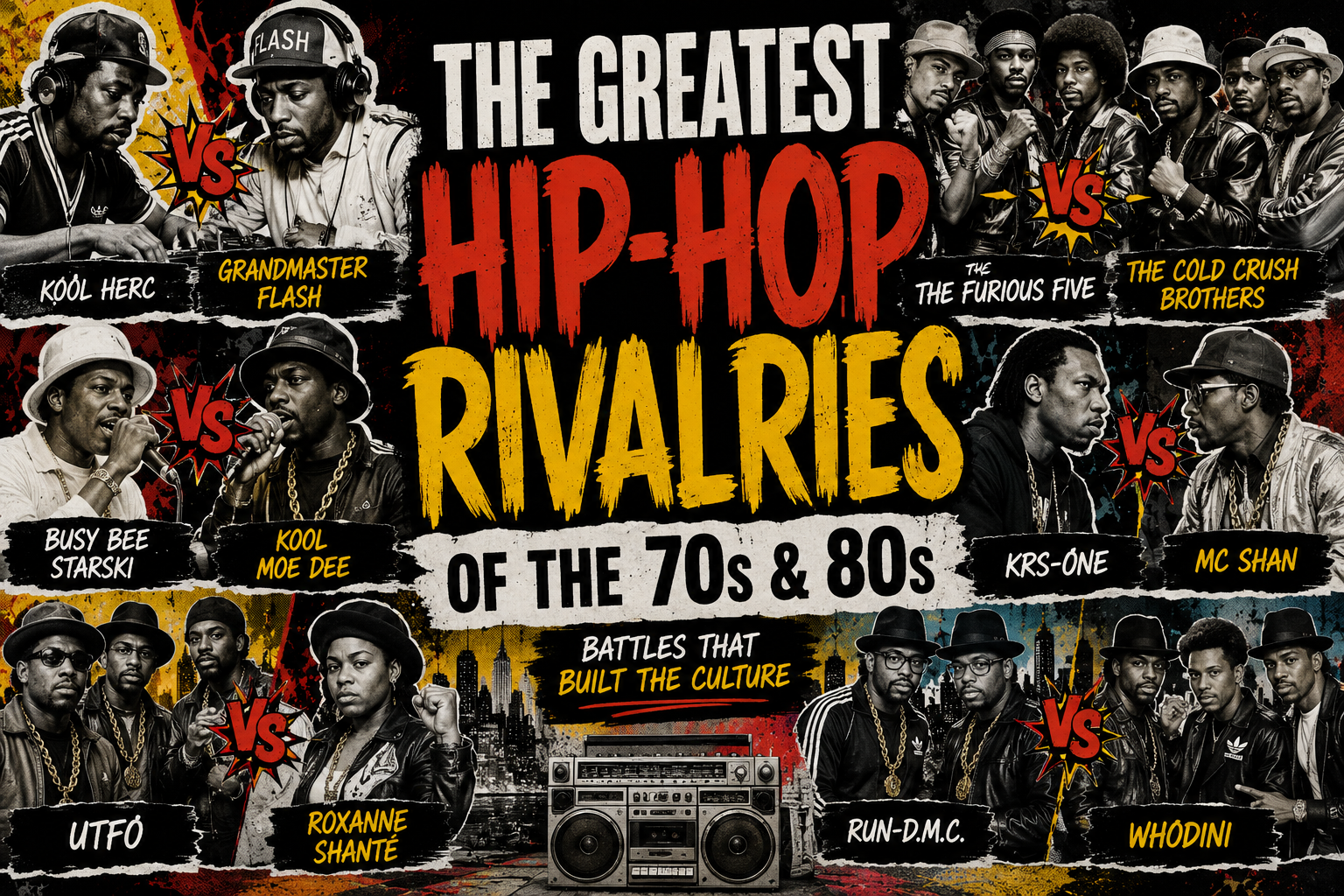
Here are some of the greatest and most influential hip-hop rivalries of the 1970s and 1980s.
Kool Herc vs. Grandmaster Flash
If hip-hop had a Mount Rushmore, both DJ Kool Herc and Grandmaster Flash would undoubtedly be included.
During the early days of hip-hop in the Bronx, these two legendary DJs represented different approaches to the art form.
Kool Herc is often credited as the founding father of hip-hop. His block parties introduced the technique of extending percussion breaks, allowing dancers to showcase their skills. His massive sound systems and larger-than-life presence helped establish many of the cultural traditions that defined early hip-hop.
Grandmaster Flash took those ideas and elevated them technically. He became obsessed with precision. Through experimentation, Flash developed methods for cueing records, extending breaks, and manipulating turntables with incredible accuracy.
Their rivalry wasn’t necessarily hostile. Instead, it was a competition between innovation and refinement.
Fans often debated which DJ was superior. Some preferred Herc’s raw energy and pioneering vision, while others admired Flash’s technical mastery.
Together, they pushed the art of DJing to unprecedented levels and helped establish the blueprint for generations of DJs to follow.
Kool Herc vs. Afrika Bambaataa
Another major rivalry during hip-hop’s earliest years involved Kool Herc and Afrika Bambaataa.
While Herc focused primarily on creating unforgettable parties, Bambaataa envisioned something larger. A former gang member who founded the Universal Zulu Nation, Bambaataa saw hip-hop as a tool for community building and positive social change.
The two DJs frequently competed for audiences throughout the Bronx.
Each brought unique strengths to their events. Herc’s reputation as a pioneer attracted huge crowds, while Bambaataa became known for his eclectic musical selections that included funk, soul, rock, and electronic music.
Their competition helped expand the musical boundaries of hip-hop.
As each DJ searched for new ways to captivate audiences, the culture itself grew stronger and more diverse.
The Furious Five vs. The Cold Crush Brothers
Perhaps no rivalry better captures the spirit of early hip-hop than the battle between Grandmaster Flash and the Furious Five and The Cold Crush Brothers.
During the late 1970s and early 1980s, these two groups were widely considered among the best live acts in New York City.
The Furious Five featured explosive performers and innovative routines. Led by the charismatic Melle Mel, the group developed a reputation for energy, precision, and lyrical skill.
The Cold Crush Brothers were equally impressive. Known for elaborate stage shows, coordinated performances, and sharp rhymes, they became legends throughout the city’s hip-hop scene.
Their battles attracted enormous attention.
Fans debated endlessly about which group deserved the title of New York’s best crew. These contests helped establish many of the traditions that would later define rap battles.
In many ways, they transformed hip-hop competition into an art form.
Busy Bee Starski vs. Kool Moe Dee
Few moments in hip-hop history are more important than the famous battle between Busy Bee Starski and Kool Moe Dee.
Before this clash, most rap performances emphasized crowd participation, humor, and entertainment. Busy Bee excelled at this style. Audiences loved his charisma and playful approach.
Kool Moe Dee represented something different.
During a highly publicized battle in 1981, Moe Dee shocked audiences by delivering a direct, aggressive lyrical attack against Busy Bee. Instead of focusing solely on entertaining the crowd, he systematically criticized his opponent’s skills.
The battle changed hip-hop forever.
Many historians view it as the moment rap began shifting toward more competitive and lyrically complex styles.
Suddenly, being a great entertainer wasn’t enough. MCs were expected to prove their technical abilities as well.
The ripple effects of that battle can still be felt today.
The Treacherous Three vs. The Fearless Four
The early 1980s featured numerous crew rivalries, but few were as respected as The Treacherous Three versus The Fearless Four.
Both groups were known for advanced rhyme patterns and innovative performances.
The Treacherous Three, featuring Kool Moe Dee, specialized in complex lyrical routines that showcased technical skill. The Fearless Four countered with powerful performances and memorable stage presence.
Their competition helped raise the overall quality of rap music during a crucial period.
As each group attempted to outdo the other, audiences benefited from increasingly sophisticated performances.
The rivalry demonstrated that hip-hop could be both entertaining and artistically ambitious.
UTFO vs. Roxanne Shanté
One of the most famous rivalries of the 1980s began almost accidentally.
In 1984, the group UTFO released “Roxanne, Roxanne,” a song about a woman rejecting their advances. The record became a hit, but few could have predicted what happened next.
A teenage rapper named Roxanne Shanté responded with “Roxanne’s Revenge.”
The answer record exploded in popularity.
Shanté’s sharp wit, confidence, and fearless delivery captivated audiences. The song became so successful that it launched what became known as the “Roxanne Wars.”
Dozens of artists released their own responses, creating one of the earliest large-scale rap controversies.
The battle established diss records as a major part of hip-hop culture and transformed Roxanne Shanté into a star.
KRS-One vs. MC Shan
Few rivalries had a greater impact on hip-hop’s development than the feud between KRS-One and MC Shan.
At its core, the conflict centered on a deceptively simple question: Where did hip-hop originate?
MC Shan’s song “The Bridge” celebrated Queensbridge, leading some listeners to interpret it as a claim that hip-hop began in Queens.
KRS-One and Boogie Down Productions responded forcefully with “South Bronx.”
The exchange escalated rapidly.
Each side released increasingly aggressive records defending its position. Fans chose sides, radio stations debated the issue, and the battle became one of the defining moments of 1980s hip-hop.
Beyond geography, the rivalry showcased the growing sophistication of rap lyricism.
Both artists delivered powerful performances that remain influential decades later.
Boogie Down Productions vs. Juice Crew
What began as a dispute between KRS-One and MC Shan soon evolved into a larger conflict between Boogie Down Productions and the Juice Crew.
The Juice Crew featured an impressive roster that included Marley Marl, Big Daddy Kane, Biz Markie, Kool G Rap, and MC Shan.
Boogie Down Productions countered with KRS-One’s unmatched intensity and lyrical aggression.
The rivalry produced a series of memorable records that pushed both sides to new creative heights.
Fans eagerly awaited each new response.
The feud demonstrated how competition could inspire artistic excellence. Many of the records created during this period are still regarded as classics.
More importantly, the battle helped establish diss tracks as a legitimate and respected form of artistic expression.
LL Cool J vs. Kool Moe Dee
As hip-hop entered the late 1980s, generational conflicts began emerging within the culture.
One of the most famous involved LL Cool J and Kool Moe Dee.
LL represented the new generation. Young, confident, and commercially successful, he quickly became one of rap’s biggest stars.
Kool Moe Dee viewed himself as a veteran who had helped build the culture from the ground up.
Their rivalry reflected a broader tension between old-school pioneers and younger artists achieving mainstream success.
The feud generated several memorable songs and public exchanges.
Although neither artist completely defeated the other, the battle highlighted hip-hop’s rapid evolution and growing commercial appeal.
MC Shan vs. Marley Marl’s Former Allies
The aftermath of the Bridge Wars created tensions throughout the Juice Crew.
While Marley Marl remained one of hip-hop’s most respected producers, shifting alliances and disagreements occasionally led to friction among artists associated with the collective.
These conflicts reflected a larger trend during the late 1980s.
As hip-hop became more profitable, competition intensified. Friendships were tested, loyalties shifted, and rivalries became increasingly public.
The Juice Crew’s internal struggles foreshadowed many of the larger disputes that would dominate hip-hop during the 1990s.
Run-D.M.C. vs. Whodini
Unlike some rivalries fueled by hostility, the competition between Run-D.M.C. and Whodini was largely professional.
Both groups emerged as major forces during the mid-1980s.
Whodini combined rap with R&B influences and polished production, creating crossover appeal. Run-D.M.C. adopted a harder, street-oriented sound that revolutionized hip-hop.
Fans frequently debated which group represented the future of rap.
The competition encouraged innovation from both sides.
While Run-D.M.C. ultimately became more influential historically, Whodini played a crucial role in expanding hip-hop’s audience and commercial potential.
Together, they helped move rap from local communities to the national stage.
The Zulu Nation DJs vs. Everyone Else
During the late 1970s and early 1980s, members of Afrika Bambaataa’s Zulu Nation often found themselves competing against nearly every major DJ crew in New York.
The rivalry wasn’t centered on a single opponent.
Instead, it reflected the organization’s growing influence within hip-hop culture.
Zulu Nation DJs became known for creativity, technical skill, and adventurous musical selections. Their willingness to incorporate diverse genres challenged conventional thinking and expanded hip-hop’s possibilities.
Other DJs were forced to adapt.
As a result, audiences enjoyed more innovative performances and broader musical experiences.
The competitive atmosphere accelerated hip-hop’s development during a critical period.
Why These Rivalries Mattered
Looking back, it is easy to view these rivalries simply as entertainment. In reality, they served a much greater purpose.
Every major advancement in early hip-hop emerged from competition.
DJs invented new techniques because they wanted to outperform rivals. MCs developed sharper lyrics because they needed an edge in battles. Crews created more elaborate stage shows because audiences expected something bigger and better than the previous event.
Competition drove innovation.
Without rivalries, scratching might not have evolved as quickly. Battle rap might never have become a central element of the culture. Diss records might not exist in their modern form.
These conflicts pushed artists beyond their comfort zones and forced them to improve.
The result was a stronger, more creative culture.
Conclusion
The rivalries of the 1970s and 1980s helped transform hip-hop from a local phenomenon into a global movement.
Whether it was Kool Herc competing with Afrika Bambaataa, The Cold Crush Brothers battling The Furious Five, or KRS-One trading lyrical shots with MC Shan, each rivalry contributed something valuable to the culture’s evolution.
Unlike many modern feuds driven by social media headlines, these early battles were often rooted in artistic competition. Artists fought for respect, recognition, and the chance to prove they were the best at their craft.
The stakes felt enormous because hip-hop itself was still being defined.
Every battle helped establish new standards. Every rivalry inspired innovation. Every challenge pushed the culture forward.
Today, hip-hop remains deeply connected to competition. Battle rap, diss tracks, DJ contests, and lyrical showdowns all trace their roots back to these pioneering rivalries.
The names may not always receive the attention they deserve, but their influence remains impossible to ignore. The greatest hip-hop rivalries of the 1970s and 1980s didn’t just entertain audiences—they helped build the culture itself.
This post has already been read 1179 times!