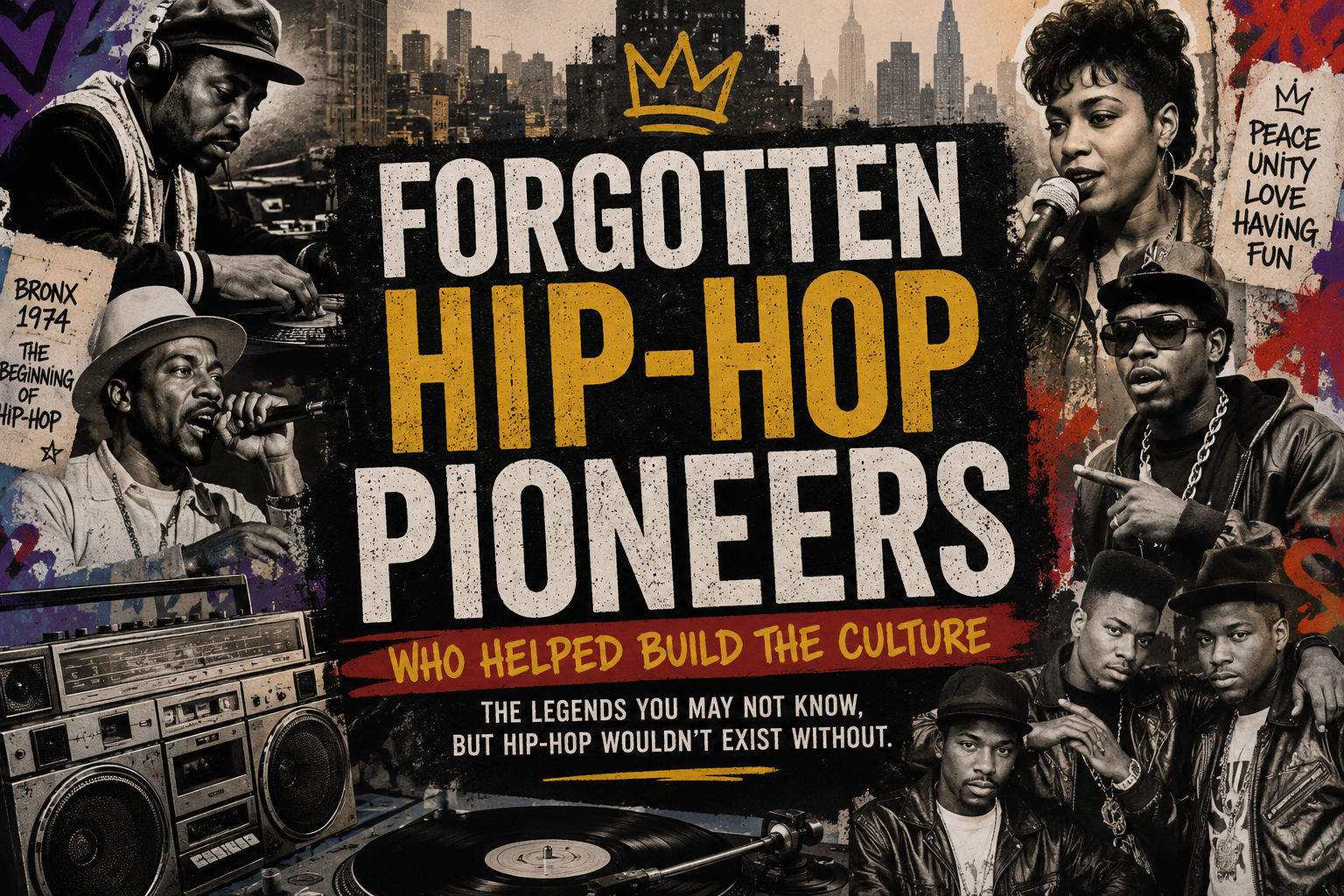
 When most people discuss the history of hip-hop, the conversation tends to focus on the biggest stars. Names like Run-D.M.C., Public Enemy, N.W.A., Tupac, The Notorious B.I.G., and Jay-Z dominate documentaries, magazine covers, and “greatest of all time” lists. Their contributions are undeniable, but hip-hop did not become a global cultural force because of a handful of superstars alone. The foundation was built by countless DJs, MCs, promoters, dancers, graffiti artists, and innovators whose names have gradually faded from mainstream memory.
Hip-hop’s story began in the 1970s in New York City, particularly in the Bronx. What started as neighborhood block parties evolved into a worldwide movement that transformed music, fashion, language, and culture. Along the way, numerous pioneers helped shape the art form, often without receiving the recognition they deserved.
These forgotten architects laid the groundwork for future generations. Their ideas became standard practice. Their innovations were copied, refined, and expanded upon by artists who became household names. Without them, hip-hop might look very different today.
Here are some of the most important forgotten hip-hop pioneers who helped build the culture.
DJ Hollywood: The Original Crowd Controller
Long before rap records dominated radio stations, DJ Hollywood was one of New York’s most influential entertainers. While many people credit later stars with developing the smooth, rhythmic style of rapping, Hollywood was already captivating audiences in the late 1970s.
His performances featured a melodic, conversational approach that differed from the more aggressive styles that would emerge later. He borrowed elements from radio personalities and disco culture, creating routines that kept crowds engaged for hours.
Many future MCs studied his performances. His influence can be heard in countless rappers who adopted a more polished delivery style. Despite his importance, DJ Hollywood rarely receives the same recognition as other early pioneers.
Yet his impact on microphone technique and crowd interaction remains enormous.
Grand Wizard Theodore: The Inventor of Scratching
One of the most important innovations in hip-hop history happened almost by accident.
Grand Wizard Theodore is widely credited with inventing scratching, one of the signature sounds of hip-hop DJing. According to the famous story, Theodore was practicing records in his bedroom when his mother interrupted him. While holding the record in place beneath the needle, he noticed the unique sound being created.
Instead of dismissing it as noise, he experimented with the technique and transformed it into an entirely new musical tool.
Today scratching is one of the defining elements of DJ culture. It became an art form of its own, influencing everyone from battle DJs to producers and turntablists around the world.
Millions of listeners have heard scratching on records, but relatively few know the name of the man who pioneered it.
The Funky 4 + 1: Breaking New Ground
The history of hip-hop often centers around solo stars or famous groups from the mid-1980s onward, but The Funky 4 + 1 helped open doors years earlier.
The group made history in 1981 when they became one of the first hip-hop acts to appear on national television. Their appearance introduced rap music to viewers who had never encountered the culture before.
Perhaps even more groundbreaking was the inclusion of Sha-Rock, one of hip-hop’s first prominent female MCs. At a time when rap was overwhelmingly male-dominated, she proved women could command the microphone with the same skill and authority as any man.
The group’s influence extended far beyond record sales. They demonstrated that hip-hop could reach mainstream audiences while maintaining its roots.
Sha-Rock: The First Female MC Superstar
While modern hip-hop features numerous successful women, the path was not always easy.
Before artists like Queen Latifah, Missy Elliott, Lauryn Hill, or Nicki Minaj, there was Sha-Rock.
As a member of The Funky 4 + 1, she established herself as one of the culture’s earliest female stars. Her confidence, stage presence, and lyrical abilities earned respect throughout New York’s emerging hip-hop scene.
Many younger fans have never heard her name, yet she helped shatter barriers that existed during rap’s formative years.
Every successful female MC who followed benefited from doors that pioneers like Sha-Rock helped open.
Disco King Mario: The Neighborhood Legend
Hip-hop history often highlights DJs like Kool Herc, Afrika Bambaataa, and Grandmaster Flash. While they deserve their legendary status, Disco King Mario was equally important within his community.
Operating primarily in the Bronx during the 1970s, Mario built massive local followings through neighborhood parties and innovative sound systems.
His events helped establish many of the practices that became central to hip-hop culture. Future stars attended his parties, observed his techniques, and adapted his ideas.
Though his fame never reached the national level, his local influence was profound.
Many early pioneers considered him one of the most respected DJs in New York.
Eddie Cheeba: The Bridge Between Eras
Eddie Cheeba occupies an important place in hip-hop history because he helped connect multiple musical traditions.
His style blended influences from Jamaican toasting, radio personalities, disco DJs, and emerging rap culture.
At a time when hip-hop’s identity was still developing, Cheeba demonstrated how different influences could be merged into something entirely new.
His charismatic delivery inspired numerous MCs who later achieved mainstream success.
Although his contributions are often overlooked, he played a crucial role in shaping rap’s vocal traditions.
The Cold Crush Brothers: Legends Without Hit Records
Some artists become famous through chart success. Others become legends through live performance.
The Cold Crush Brothers belong firmly in the second category.
Widely regarded as one of the greatest live rap groups of the early era, they dominated New York stages during hip-hop’s formative years. Their routines, harmonies, crowd participation techniques, and lyrical battles became models for future rap crews.
Many younger fans know them only through brief documentary appearances, but their influence extends throughout hip-hop history.
Countless MCs borrowed elements from their stage shows and performance strategies.
In many ways, they helped define what a rap group should look and sound like.
Busy Bee Starski: The Master Entertainer
Before rap became known primarily for lyrical complexity, it was about entertaining crowds.
Few performers embodied that philosophy better than Busy Bee Starski.
Known for his humor, charisma, and audience interaction, Busy Bee was one of the most beloved figures in early hip-hop. His performances showcased the party atmosphere that characterized the culture’s earliest years.
While later generations focused heavily on lyrical competition, Busy Bee represented a time when making people dance and have fun remained the primary objective.
His influence can still be seen in artists who prioritize showmanship and crowd engagement.
The Treacherous Three: Raising the Lyrical Bar
The Treacherous Three rarely receive the same attention as Run-D.M.C. or Public Enemy, but their impact on rap technique was enormous.
The group’s members introduced increasingly complex rhyme structures and performance styles during the early 1980s.
One member, Kool Moe Dee, would later become a legendary battle rapper, but the entire group helped push hip-hop toward greater lyrical sophistication.
They demonstrated that rap could be both entertaining and technically impressive.
Many of the advanced rhyme techniques common today can trace their roots back to innovators like The Treacherous Three.
Jazzy Jay: The DJ’s DJ
Within hip-hop circles, Jazzy Jay is revered as one of the culture’s most influential DJs.
A member of the Zulu Nation, he played a critical role in preserving and expanding DJ culture during hip-hop’s early years.
Jay helped train younger DJs, supported emerging artists, and promoted technical excellence behind the turntables.
His contributions extended beyond performance. He served as a mentor, educator, and cultural ambassador.
While casual fans may not recognize his name, many respected DJs consider him one of the most important figures in hip-hop history.
Kool Lady Blue: A Pioneer Behind the Scenes
Not every hip-hop pioneer held a microphone or worked behind turntables.
Kool Lady Blue became one of the culture’s earliest and most important promoters.
She organized events, connected artists, and helped create opportunities for performers during a period when hip-hop lacked formal industry support.
Her efforts helped transform neighborhood entertainment into a growing cultural movement.
Without organizers and promoters like Kool Lady Blue, many artists would never have found audiences.
Her contributions remind us that building a culture requires far more than performers alone.
DJ Red Alert: Bringing Hip-Hop to Radio
Before streaming services and social media, radio exposure could make or break an artist.
DJ Red Alert played a critical role in introducing hip-hop to wider audiences through influential radio programs.
His shows showcased emerging artists and underground records that might otherwise have remained local phenomena.
Numerous future stars received early exposure through his broadcasts.
By bringing hip-hop into people’s homes, Red Alert helped accelerate the culture’s growth during a crucial period.
His influence stretched far beyond New York City.
Awesome Two: The Voices of Underground Hip-Hop
The radio duo known as Awesome Two helped define hip-hop broadcasting during the 1980s.
Their programs provided exposure for countless artists and created a platform for underground music.
At a time when mainstream media often ignored rap, they treated the culture seriously and gave it room to develop.
Their influence helped establish many of the standards later adopted by hip-hop radio stations nationwide.
Although their names are less familiar today, their contributions helped shape how rap reached audiences.
The Fantastic Romantic Five: Community Heroes
Hip-hop has always been more than music.
Groups like The Fantastic Romantic Five used the culture as a vehicle for community engagement and social impact.
They participated in anti-violence initiatives, educational programs, and public events designed to improve neighborhoods.
Their work demonstrated hip-hop’s potential as a positive force for change.
While commercial success often dominates historical narratives, community leaders played an equally important role in the culture’s development.
The Fantastic Romantic Five exemplified that spirit.
The Legacy of the Forgotten Builders
Hip-hop’s history is often told through platinum albums, sold-out arenas, and superstar personalities. Yet the culture’s true foundation was constructed by countless individuals whose contributions occurred before the spotlight arrived.
Many of these pioneers never became wealthy. Some never achieved mainstream fame. Others were overshadowed by artists who borrowed and expanded upon their innovations.
Nevertheless, their fingerprints remain everywhere.
Every DJ who scratches a record owes a debt to Grand Wizard Theodore. Every female rapper who commands a stage follows a path helped clear by Sha-Rock. Every live rap performance reflects lessons learned from groups like The Cold Crush Brothers and The Treacherous Three. Every hip-hop radio station owes something to figures like Red Alert and the Awesome Two.
The culture that now spans continents began with local heroes performing at block parties, community centers, parks, and neighborhood clubs. They created something entirely new without knowing it would eventually become one of the world’s most influential cultural movements.
As hip-hop continues to evolve, it is important to remember these forgotten pioneers. Their stories remind us that history is not built solely by the most famous names. It is built by innovators, risk-takers, teachers, organizers, and dreamers whose contributions echo long after their names fade from headlines.
Hip-hop’s greatest stars may receive most of the attention, but the culture itself was built by many hands. The forgotten pioneers discussed here helped create the foundation upon which generations of artists continue to build. Without them, hip-hop would not be what it is today.
This post has already been read 1005 times!