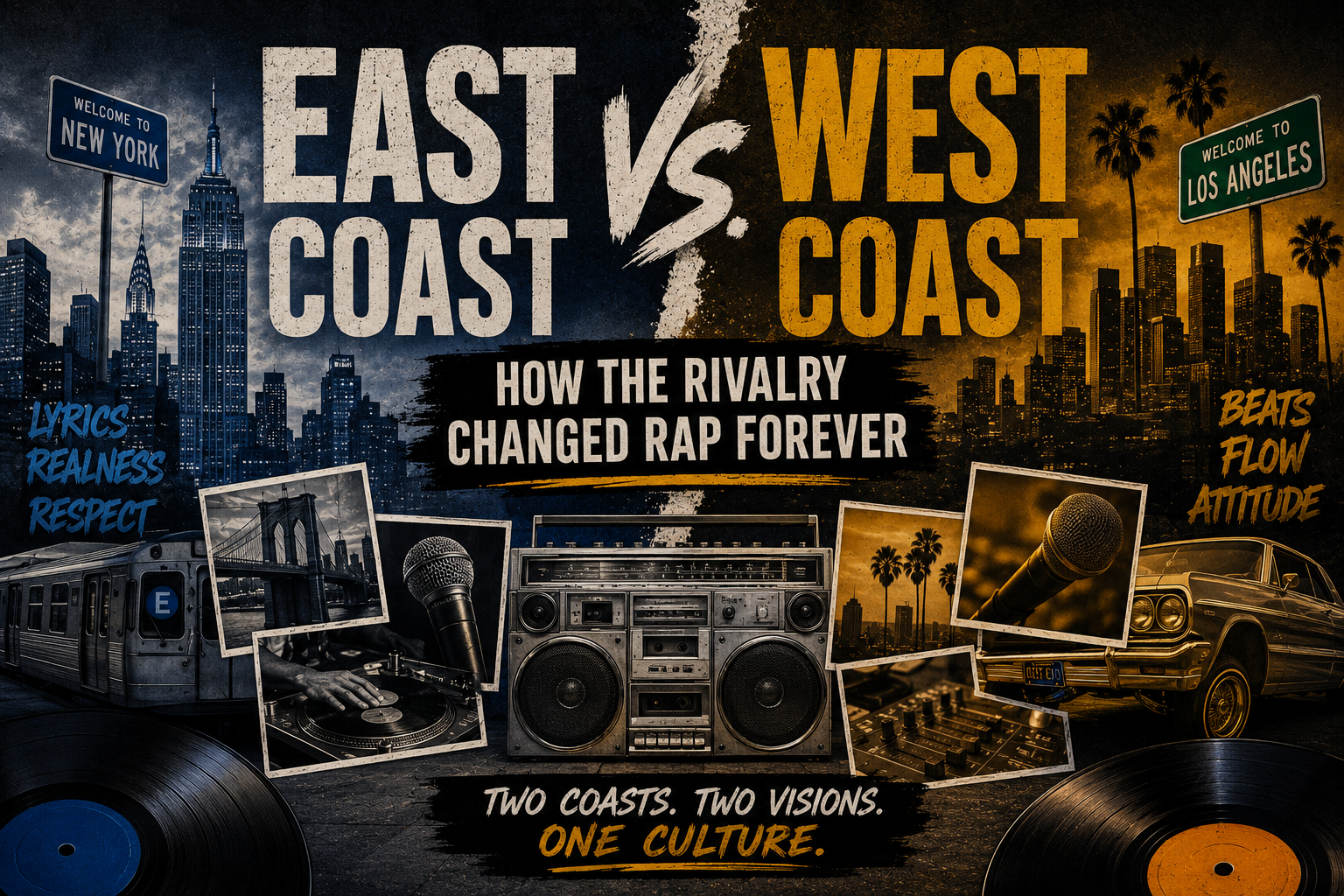
 Few stories in music history are as fascinating, influential, and tragic as the East Coast versus West Coast rivalry.
What began as a healthy competition between regional hip-hop scenes eventually evolved into one of the most infamous feuds in entertainment history. The conflict produced classic albums, legendary songs, unforgettable personalities, and some of the most important moments in rap’s evolution. At the same time, it also fueled hostility, violence, and heartbreak that culminated in the deaths of two of hip-hop’s biggest stars.
Today, the East Coast-West Coast rivalry remains one of the defining chapters in rap history. It transformed the music industry, reshaped how artists promoted themselves, and forever changed the public’s perception of hip-hop. The feud’s impact can still be felt decades later.
To understand how rap became a global force during the 1990s, it is impossible to ignore the rivalry that dominated the decade.
The Birthplace of Hip-Hop
Before there was an East Coast-West Coast rivalry, there was only one coast that mattered in hip-hop.
The East Coast, particularly New York City, was the birthplace of the culture.
Hip-hop emerged in the Bronx during the 1970s through the efforts of pioneers like DJ Kool Herc, Afrika Bambaataa, and Grandmaster Flash. By the early 1980s, New York was unquestionably the center of rap music.
Virtually every major artist came from the city or its surrounding areas.
Run-D.M.C.
Public Enemy.
The Beastie Boys.
LL Cool J.
Eric B. & Rakim.
Boogie Down Productions.
The Juice Crew.
New York wasn’t simply a rap city.
It was rap.
The idea that another region might someday challenge its dominance seemed almost impossible.
Yet change was already coming.
The Rise of West Coast Hip-Hop
While New York built hip-hop’s foundation, artists thousands of miles away were creating their own version of the culture.
Los Angeles became the center of West Coast rap during the early and mid-1980s.
Initially, many East Coast fans viewed West Coast rap as an imitation.
Artists such as Ice-T helped change that perception.
Ice-T’s music reflected life in Los Angeles rather than New York. His lyrics focused on local experiences, local slang, and local realities.
West Coast artists weren’t trying to copy New York anymore.
They were creating their own identity.
By the late 1980s, that identity exploded onto the national stage through a group called N.W.A.
N.W.A. Changes Everything
No group did more to establish West Coast rap as a dominant force than N.W.A.
Featuring Eazy-E, Dr. Dre, Ice Cube, MC Ren, and DJ Yella, the group introduced millions of listeners to gangsta rap.
Their 1988 album Straight Outta Compton shocked America.
The music was aggressive.
The lyrics were controversial.
The production was innovative.
Most importantly, it felt authentic.
N.W.A. presented stories about life in Compton that mainstream audiences rarely heard.
The group’s success forced the music industry to take West Coast hip-hop seriously.
For the first time, New York’s dominance faced a legitimate challenge.
The rivalry had begun.
Competition Creates Innovation
At first, competition between the coasts was healthy.
East Coast artists wanted to maintain their position as hip-hop’s leaders.
West Coast artists wanted respect and recognition.
The result was an explosion of creativity.
Both regions pushed themselves harder.
Producers experimented with new sounds.
MCs elevated their lyrical abilities.
Record labels invested heavily in talent.
Fans benefited from a remarkable period of artistic growth.
The rivalry inspired excellence.
No one wanted to be second best.
Different Sounds, Different Philosophies
Part of what made the rivalry so compelling was how different the music sounded.
East Coast hip-hop typically emphasized lyrical complexity, intricate rhyme schemes, and sample-heavy production.
Artists like Nas, Wu-Tang Clan, Mobb Deep, and The Notorious B.I.G. represented this tradition.
Their music often featured gritty beats, dense storytelling, and sharp wordplay.
West Coast hip-hop developed a different identity.
Dr. Dre pioneered G-Funk, a style built around melodic synthesizers, deep basslines, and funk influences.
Artists such as Snoop Dogg, Warren G, and Tupac Shakur became synonymous with this sound.
Neither approach was inherently better.
They simply reflected different environments and musical influences.
The contrast made comparisons inevitable.
Fans debated endlessly.
Which coast had better rappers?
Which coast had better producers?
Which coast represented the future of hip-hop?
These discussions fueled the rivalry even further.
The Source Awards and Growing Tensions
By the mid-1990s, the competition had become increasingly personal.
One of the most important turning points occurred at the 1995 Source Awards.
The event was supposed to celebrate hip-hop.
Instead, it exposed growing divisions within the culture.
When Death Row Records founder Suge Knight took the stage, he delivered remarks widely interpreted as attacks against East Coast executives, particularly Sean “Puffy” Combs.
The audience reacted immediately.
Boos echoed throughout the venue.
Artists from different regions openly displayed hostility.
Television viewers witnessed tensions that had previously remained behind the scenes.
Many historians view the Source Awards as the moment the rivalry became public.
What had once been competition was now becoming conflict.
The Rise of Death Row Records
No label symbolized West Coast dominance more than Death Row Records.
Founded by Suge Knight and Dr. Dre, Death Row quickly became one of the most successful labels in music.
The roster was extraordinary.
Dr. Dre.
Snoop Dogg.
Tupac Shakur.
Each artist became a superstar.
Albums such as The Chronic and Doggystyle transformed hip-hop.
Death Row projected power, confidence, and success.
The label’s influence extended beyond music.
It became a cultural phenomenon.
As Death Row grew, so did perceptions that the West Coast had surpassed New York.
East Coast artists took notice.
Bad Boy Records Strikes Back
While Death Row dominated the West Coast, New York found its champion in Bad Boy Records.
Founded by Sean “Puffy” Combs, the label became home to one of rap’s greatest talents: The Notorious B.I.G.
Biggie represented everything East Coast fans loved.
His storytelling ability was unmatched.
His flow was effortless.
His charisma was undeniable.
Albums like Ready to Die reminded the world that New York still produced elite artists.
Bad Boy’s commercial success challenged Death Row’s dominance.
The battle lines became increasingly clear.
Death Row versus Bad Boy.
West Coast versus East Coast.
Tupac versus Biggie.
The rivalry had found its central characters.
Tupac and Biggie: Friends Become Rivals
One of the most tragic aspects of the East Coast-West Coast feud is that Tupac Shakur and The Notorious B.I.G. were once friends.
Early in their careers, the two artists admired each other’s work.
They spent time together.
They collaborated.
They shared mutual respect.
That relationship began deteriorating after a 1994 robbery and shooting involving Tupac in New York.
Tupac survived but became convinced that people within the East Coast rap scene knew more about the attack than they admitted.
Biggie denied any involvement.
The friendship collapsed.
Suspicion replaced trust.
The situation worsened as media coverage intensified.
Journalists recognized the feud’s commercial potential and frequently framed events as battles between rival camps.
The conflict grew larger than either artist.
Hit ‘Em Up
No song better represents the intensity of the rivalry than Tupac’s “Hit ‘Em Up.”
Released in 1996, the record remains one of the most aggressive diss tracks ever recorded.
Tupac directly targeted Biggie, Bad Boy Records, and numerous East Coast artists.
The song shocked listeners.
Its hostility was unprecedented.
While diss tracks had existed for decades, few reached this level of personal confrontation.
“Hit ‘Em Up” became a defining moment.
The rivalry was no longer symbolic.
It was openly hostile.
Millions of fans chose sides.
Media Fuels the Fire
The media played a significant role in escalating tensions.
Magazines, radio stations, and television programs recognized that controversy generated attention.
Stories emphasizing conflict received extensive coverage.
Every interview became potential headline material.
Every comment was analyzed.
Every disagreement was magnified.
The narrative became self-sustaining.
Artists felt pressure to defend themselves publicly.
Fans became emotionally invested.
The rivalry transformed into one of the biggest stories in popular culture.
Unfortunately, the increased attention also made reconciliation more difficult.
Too many people benefited from the feud continuing.
The Murder of Tupac Shakur
On September 7, 1996, the rivalry entered its darkest chapter.
After attending a boxing match in Las Vegas, Tupac Shakur was shot multiple times while riding in a car with Suge Knight.
He died six days later.
The news stunned the music world.
Tupac was only twenty-five years old.
Questions immediately emerged.
Who was responsible?
Was the murder connected to the East Coast-West Coast feud?
The answers remain subjects of debate decades later.
What is certain is that hip-hop lost one of its most influential voices.
The tragedy changed everything.
Yet even after Tupac’s death, the violence was not over.
The Murder of The Notorious B.I.G.
Six months later, another devastating tragedy occurred.
On March 9, 1997, The Notorious B.I.G. was shot and killed in Los Angeles.
Like Tupac, he was only twenty-four years old.
The similarities were impossible to ignore.
Two superstars.
Two murders.
Two unsolved mysteries.
Hip-hop found itself in mourning.
The deaths shocked fans around the world.
Many began questioning how a musical rivalry had spiraled so far out of control.
The culture faced a moment of reckoning.
Something had to change.
The End of the War
Following the deaths of Tupac and Biggie, many artists and executives worked to reduce tensions.
Public calls for unity became more common.
Regional divisions gradually softened.
Artists from different coasts began collaborating again.
The rivalry never completely disappeared, but its intensity diminished significantly.
Most people recognized that the cost had become too high.
Two extraordinary talents were gone.
No one wanted to see history repeat itself.
The era of open warfare was ending.
How the Rivalry Changed Hip-Hop Music
Despite its tragic consequences, the East Coast-West Coast rivalry transformed rap in important ways.
Competition encouraged artistic growth.
Artists worked harder.
Producers became more innovative.
Record labels invested heavily in talent development.
The 1990s produced some of hip-hop’s greatest albums.
The pressure to outperform rivals pushed musicians toward excellence.
Many classic records emerged directly from this environment.
The rivalry helped elevate rap’s creative standards.
How the Rivalry Changed the Business
The feud also changed the business side of hip-hop.
Record labels realized rap could generate enormous profits.
Media companies recognized the genre’s cultural power.
Corporate America began paying attention.
Hip-hop evolved from a niche market into a dominant commercial force.
The rivalry attracted unprecedented public interest.
People who had never listened to rap suddenly followed the story.
Sales increased.
Concert attendance grew.
Magazine circulation expanded.
The industry became larger than ever before.
Regional Identity Becomes Important
Another lasting impact involved regional pride.
The rivalry encouraged artists throughout America to embrace local identities.
Southern rap soon emerged as a major force.
Midwestern artists gained national recognition.
Cities like Atlanta, Houston, Memphis, New Orleans, Detroit, and Chicago developed distinctive sounds.
The success of East and West Coast scenes demonstrated that regional perspectives could thrive commercially.
Hip-hop became more diverse as a result.
Lessons Learned
Perhaps the most important legacy of the rivalry involves the lessons it taught.
The conflict demonstrated both the power and danger of competition.
Healthy rivalry can inspire greatness.
Unchecked hostility can lead to tragedy.
Modern artists frequently reference the East Coast-West Coast era as a cautionary tale.
Most understand the importance of maintaining perspective.
Disagreements may generate publicity, but they should never escalate into violence.
The losses of Tupac and Biggie remain painful reminders of what can happen when conflicts spiral beyond control.
The Legacy of Tupac and Biggie
Although the rivalry ended decades ago, the legacies of Tupac Shakur and The Notorious B.I.G. continue to grow.
Both artists are now viewed as cultural icons.
Their music remains influential.
New generations discover their work every year.
Ironically, many younger fans celebrate both artists simultaneously.
The idea of choosing sides feels less important today.
Instead, listeners recognize that hip-hop was fortunate to experience both talents.
Their contributions transcended regional divisions.
They became global figures.
Conclusion
The East Coast versus West Coast rivalry remains one of the most important chapters in hip-hop history.
It transformed rap from a growing genre into a cultural powerhouse. It inspired some of the greatest music ever recorded while also exposing the dangers of unchecked conflict. The feud elevated artists, labels, and regional scenes to unprecedented heights, helping establish hip-hop as the dominant force it would become in the decades that followed.
At its best, the rivalry encouraged creativity, innovation, and excellence. At its worst, it contributed to an atmosphere of hostility that culminated in unimaginable tragedy.
The deaths of Tupac Shakur and The Notorious B.I.G. forever changed the culture. Yet their music, along with the countless artists influenced by the rivalry, continues to shape hip-hop today.
In the end, East Coast versus West Coast was about far more than geography. It was about identity, pride, competition, ambition, and the growing pains of a young culture finding its place in the world.
The rivalry may have ended, but its impact remains woven into the fabric of rap music forever.
This post has already been read 1812 times!