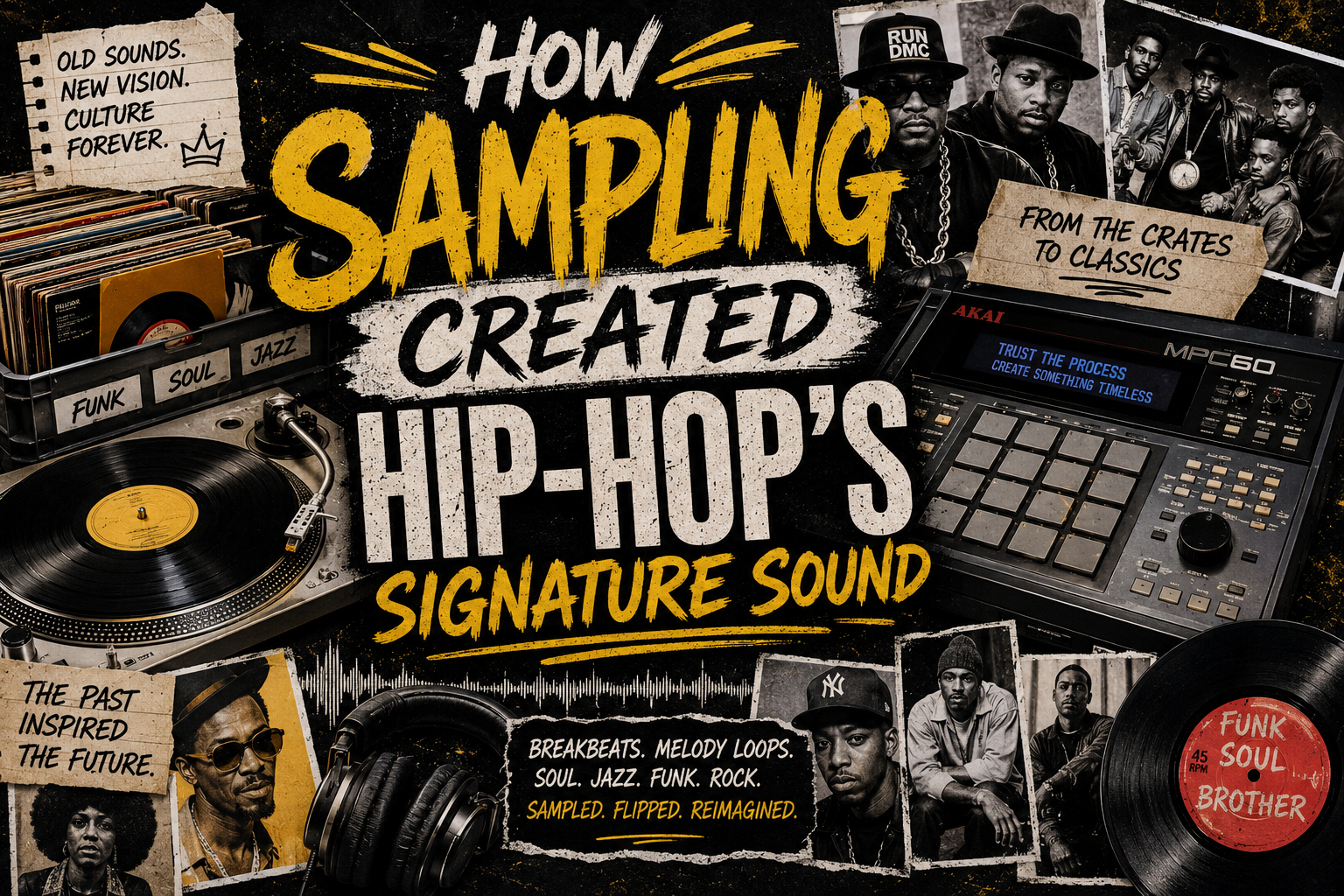
 Few musical techniques have influenced an entire genre as profoundly as sampling influenced hip-hop.
From the earliest block parties in the Bronx during the 1970s to the platinum-selling albums of the 1990s and beyond, sampling became the foundation upon which hip-hop was built. It transformed old records into new art. It allowed producers to become composers. It connected generations of music fans while creating an entirely new musical language.
Today, sampling is so deeply associated with hip-hop that it is difficult to imagine the genre without it. Some of rap’s greatest songs were constructed from fragments of funk, soul, jazz, rock, disco, and R&B recordings. What began as a practical solution for DJs trying to keep dancers moving eventually became one of the most creative forms of musical expression ever developed.
The story of sampling is also the story of hip-hop itself. It is a story of innovation, resourcefulness, technology, and culture. Most importantly, it is the story of how a generation of artists transformed existing sounds into something completely new.
The Bronx: Where It All Began
To understand sampling, you first have to understand the environment that created hip-hop.
During the 1970s, many neighborhoods in the Bronx faced economic hardship. Schools lacked funding, buildings deteriorated, and opportunities were limited. Yet despite these challenges, creativity flourished.
Young people created their own entertainment.
Block parties became gathering places where DJs played records through powerful sound systems. These events featured dancing, MCs, and an atmosphere of community that would eventually form the basis of hip-hop culture.
One DJ in particular would unknowingly create the foundation for sampling.
His name was DJ Kool Herc.
Herc noticed that dancers reacted most enthusiastically during the percussion-heavy “breaks” in funk records. These brief sections often featured only drums and rhythm instruments.
The problem was that the breaks were usually short.
Herc developed a technique using two copies of the same record. By switching back and forth between turntables, he could extend the break indefinitely.
The technique became known as the “Merry-Go-Round.”
Without realizing it, Herc had introduced the core idea that would eventually become sampling: taking an existing piece of music and repurposing it to create something new.
The Breakbeat Revolution
The breakbeat quickly became the heartbeat of early hip-hop.
Dancers, later known as b-boys and b-girls, developed entire styles around these extended drum sections. MCs learned to rhyme over them. DJs searched obsessively for records containing powerful breaks.
Soon, DJs became musical archaeologists.
They hunted through crates of old vinyl searching for obscure records with usable drum patterns. A forgotten funk album from years earlier might suddenly become valuable because it contained a ten-second break perfect for a party.
Records by artists such as James Brown became especially important.
Brown’s music featured strong rhythms, tight grooves, and energetic drum performances. Songs like “Funky Drummer,” “Give It Up or Turnit a Loose,” and “The Payback” would eventually become some of the most sampled recordings in history.
The breakbeat wasn’t just music.
It was the DNA of hip-hop.
Grandmaster Flash and Technical Innovation
While Kool Herc pioneered breakbeat culture, Grandmaster Flash pushed the technology further.
Flash became obsessed with precision.
He developed techniques that allowed him to locate specific sections of records quickly and accurately. He marked vinyl with crayons, practiced endlessly, and transformed DJing into a highly technical craft.
His innovations made it easier to isolate and manipulate portions of songs.
In many ways, Flash acted as a bridge between traditional DJing and modern sampling.
He demonstrated that recorded music could be deconstructed and reorganized creatively.
Future producers would build upon those ideas using new technologies.
Sampling Before Samplers Existed
One of the most fascinating aspects of early hip-hop is that sampling existed before digital samplers.
DJs essentially performed live sampling with turntables.
Every time they repeated a break, combined two records, or manipulated a sound, they were engaging in the same creative process that later producers would perform electronically.
This approach required tremendous skill.
There were no computers.
No software programs.
No digital editing tools.
Everything happened manually.
The DJ became both performer and producer simultaneously.
These early experiments laid the groundwork for everything that followed.
The Arrival of Drum Machines
As hip-hop entered the early 1980s, technology began changing the genre.
Drum machines like the Roland TR-808 appeared in recording studios.
These devices allowed producers to create rhythms without relying entirely on live drummers.
The 808 became especially important because of its deep bass sounds and distinctive kick drum.
Many classic hip-hop records incorporated drum machine patterns alongside sampled material.
Rather than replacing sampling, drum machines expanded producers’ options.
The combination proved revolutionary.
Together, they created many of the sounds that defined 1980s hip-hop.
The Sampler Changes Everything
The true sampling revolution arrived with digital samplers.
Machines such as the E-MU SP-1200 and the Akai MPC series transformed music production forever.
For the first time, producers could record snippets of existing music into electronic devices and trigger those sounds at will.
This was a game-changer.
Instead of relying solely on turntables, producers could manipulate sounds with extraordinary flexibility.
They could:
- Loop drum breaks
- Rearrange melodies
- Alter pitch
- Change tempo
- Combine sounds from multiple records
The possibilities seemed endless.
Hip-hop producers suddenly possessed an entirely new instrument.
Marley Marl: The First Great Sampling Producer
Many historians credit Marley Marl as one of the first producers to fully exploit sampling technology.
While experimenting in the studio during the mid-1980s, Marl discovered that he could isolate individual drum sounds from existing records.
Instead of sampling an entire breakbeat, he could extract a single snare drum or kick drum.
This breakthrough changed hip-hop production forever.
Producers could now build entirely new rhythms using pieces of older recordings.
The technique became standard practice throughout the industry.
Marley’s innovations influenced countless future producers and helped define the sound of the Golden Age.
Public Enemy and the Art of Sonic Collage
If Marley Marl expanded sampling’s possibilities, Public Enemy’s production team, The Bomb Squad, pushed them to the extreme.
Their work sounded unlike anything audiences had ever heard.
Instead of using one or two samples, The Bomb Squad layered dozens of sounds together.
Funk records collided with sirens, speeches, drum breaks, and fragments of other recordings.
The result was dense, chaotic, and powerful.
Albums such as It Takes a Nation of Millions to Hold Us Back felt less like traditional recordings and more like audio documentaries.
Sampling became an art form.
Every sound served a purpose.
The music reflected the energy, tension, and urgency of urban life.
The Genius of De La Soul
While Public Enemy used sampling to create intensity, De La Soul used it to create whimsy and creativity.
Their groundbreaking 1989 album 3 Feet High and Rising became a landmark in hip-hop history.
The record featured an astonishing variety of samples.
Game shows.
French language recordings.
Soul music.
Comedy records.
Pop songs.
The album demonstrated that sampling could be playful and imaginative.
Anything could become part of a hip-hop song.
There were no rules.
That freedom encouraged producers to think differently about music itself.
A Musical Education
One reason sampling became so important is that it introduced listeners to older music.
Many young hip-hop fans discovered previous generations of artists through samples.
A teenager might hear a rap song and become curious about its source.
That curiosity often led listeners toward funk, jazz, soul, and blues recordings they otherwise might never have encountered.
Hip-hop became a gateway to music history.
Artists such as James Brown, George Clinton, Isaac Hayes, Curtis Mayfield, Roy Ayers, and countless others found new audiences because producers sampled their work.
Sampling created conversations between generations.
Old music gained new life.
New music gained historical depth.
Everyone benefited.
Digging in the Crates
By the late 1980s and early 1990s, record collecting became a crucial part of hip-hop culture.
Producers spent countless hours searching through record stores, flea markets, garage sales, and thrift shops.
This activity became known as “digging in the crates.”
Finding a rare sample carried enormous prestige.
The best producers weren’t necessarily those with expensive equipment.
They were often the ones who discovered sounds nobody else had found.
The hunt became part of the art.
Knowledge of music history became a competitive advantage.
Producers transformed into scholars, collectors, and historians.
DJ Premier and Minimalist Perfection
Among the greatest sampling artists was DJ Premier.
Premier’s production style demonstrated that sampling didn’t require complexity to be effective.
He often built tracks from relatively simple components.
A jazz sample.
A drum break.
A bassline.
A vocal snippet.
Yet his arrangements felt perfect.
Songs by Gang Starr, Nas, Jeru the Damaja, and countless others showcased his ability to transform small musical fragments into unforgettable compositions.
Premier’s work became a masterclass in restraint and precision.
Pete Rock and Soulful Sampling
If DJ Premier represented precision, Pete Rock represented warmth.
Pete Rock excelled at transforming soul and jazz recordings into emotionally rich hip-hop productions.
His beats felt smooth, musical, and deeply human.
He possessed an extraordinary ability to identify tiny musical moments hidden within older recordings.
A horn flourish.
A piano chord.
A vocal phrase.
These fragments became the building blocks of classic songs.
Pete Rock helped establish the soulful production style that remains influential today.
RZA and the Wu-Tang Sound
The early 1990s brought another sampling innovator: RZA.
The architect behind the Wu-Tang Clan developed a distinctive production style that felt gritty, cinematic, and unpredictable.
RZA sampled soul records, kung fu movie soundtracks, television clips, and obscure recordings from countless sources.
His productions sounded raw and imperfect.
That roughness became part of their appeal.
The Wu-Tang sound demonstrated that sampling wasn’t merely about finding good music.
It was about creating atmosphere.
Every sample contributed to the group’s unique world.
The Legal Battles Begin
As sampling became more widespread, legal challenges emerged.
During hip-hop’s early years, many producers sampled freely without obtaining permission.
The industry largely ignored the practice.
That changed dramatically during the late 1980s and early 1990s.
Record labels and copyright holders began filing lawsuits.
Several high-profile court decisions established new legal standards.
Producers now needed permission to use copyrighted recordings.
The process became expensive and complicated.
Many artists argued that these restrictions limited creativity.
Others believed copyright owners deserved compensation.
The debate continues today.
How Legal Changes Altered Hip-Hop
The new legal environment transformed production techniques.
Large-scale sample collages became increasingly difficult to create because clearing dozens of samples could cost enormous amounts of money.
As a result, producers adapted.
Some used fewer samples.
Others hired musicians to recreate portions of recordings.
Many explored new approaches entirely.
While the legal changes altered hip-hop’s sound, they did not eliminate sampling.
Instead, producers found innovative ways to continue working within the new rules.
Sampling as an Art Form
Critics have occasionally dismissed sampling as copying.
Artists and producers strongly disagree.
Sampling requires creativity, vision, and technical skill.
The producer must identify a useful sound, isolate it, manipulate it, and place it within an entirely new context.
The goal is not duplication.
The goal is transformation.
A great sample often becomes unrecognizable.
Listeners hear something completely different from the original source.
In this sense, sampling resembles collage art.
The artist assembles existing materials to create something new.
The originality lies in the arrangement.
Why Sampling Became Hip-Hop’s Signature Sound
Sampling succeeded because it perfectly reflected hip-hop culture.
Hip-hop emerged from communities with limited resources but unlimited creativity.
Artists learned to make something extraordinary from whatever was available.
Sampling embodied that philosophy.
A forgotten record from a thrift store could become a hit song.
A tiny musical fragment could inspire an entirely new composition.
Nothing was wasted.
Everything possessed potential.
That mindset became central to hip-hop’s identity.
Sampling wasn’t merely a production technique.
It was a cultural statement.
The Lasting Legacy of Sampling
Today, sampling remains one of the most influential developments in modern music history.
Its impact extends far beyond hip-hop.
Pop, electronic music, R&B, dance music, and countless other genres regularly employ sampling techniques.
Yet no genre embraced the practice more fully than hip-hop.
Sampling helped define the culture’s sound, aesthetics, and creative philosophy.
It connected generations.
It preserved musical history.
It encouraged innovation.
Most importantly, it gave hip-hop a distinctive voice unlike anything that had existed before.
Conclusion
The story of sampling is inseparable from the story of hip-hop.
What began with DJs extending breakbeats at Bronx block parties evolved into one of the most important artistic techniques of the modern era. From Kool Herc and Grandmaster Flash to Marley Marl, Public Enemy, Pete Rock, DJ Premier, and RZA, each generation expanded the possibilities of what sampling could achieve.
The technology changed. The legal landscape evolved. Production styles shifted. Yet the core idea remained the same: taking existing sounds and transforming them into something new.
That process became hip-hop’s signature sound.
More than any specific instrument, rhythm, or vocal style, sampling gave the genre its unique identity. It allowed producers to become historians, innovators, and composers simultaneously. It connected the past to the present while creating the future.
Decades after its birth in the Bronx, sampling remains one of hip-hop’s greatest contributions to music—a creative revolution built from the simple idea that old sounds can always find new life.
This post has already been read 1157 times!