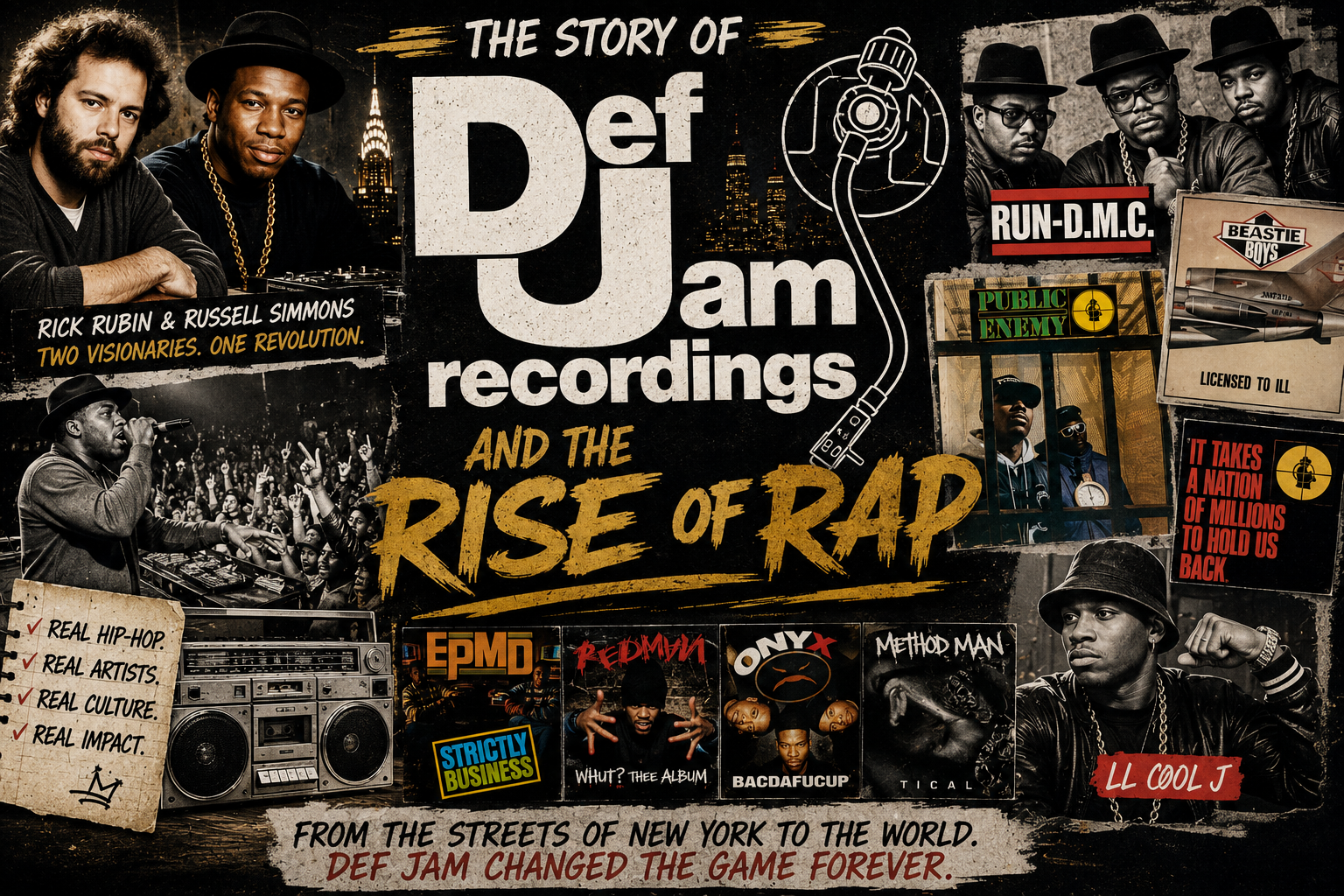
 When people discuss the history of hip-hop, certain artists immediately come to mind. Run-D.M.C., Public Enemy, Beastie Boys, LL Cool J, and countless others helped transform rap from a local New York phenomenon into a global cultural force. Yet behind many of those legendary artists stood a record label that changed the music industry forever: Def Jam Recordings.
More than just a record company, Def Jam became the blueprint for modern hip-hop success. It was a label that understood the streets while simultaneously understanding the business world. It bridged the gap between underground culture and mainstream acceptance. At a time when many music executives viewed rap as a passing fad, Def Jam recognized its potential and built an empire around it.
The story of Def Jam is also the story of rap’s rise from neighborhood block parties to worldwide domination. Without Def Jam, hip-hop’s journey to the top of the music industry might have taken a very different path.
Hip-Hop Before Def Jam
To understand Def Jam’s importance, it’s necessary to understand the state of hip-hop in the early 1980s.
Rap music had already existed for nearly a decade. DJs and MCs had built a thriving culture throughout New York City during the 1970s. Early records like “Rapper’s Delight” by the Sugarhill Gang proved that rap could sell records, but much of the music industry remained skeptical.
Major labels largely ignored hip-hop.
Many executives believed rap was a novelty. They assumed it would disappear within a few years like countless musical trends before it. As a result, many rap artists struggled to secure meaningful recording contracts.
The music that did reach radio often lacked the raw energy that existed at live performances. The excitement of New York’s streets was difficult to capture in the recording studio.
Hip-hop needed someone who understood both the culture and the business.
That person would be Rick Rubin.
Rick Rubin’s Dorm Room Revolution
The origins of Def Jam are surprisingly humble.
In the early 1980s, Rick Rubin was a student at New York University. Unlike most music executives, Rubin wasn’t approaching hip-hop from a corporate perspective. He was a genuine fan who spent time immersed in New York’s emerging rap scene.
Rubin began experimenting with music production from his college dorm room.
His goal was simple: create records that sounded as powerful as the live performances he witnessed in clubs and parks.
At the time, many rap records featured polished disco influences. Rubin wanted something harder and more aggressive. He stripped away unnecessary elements and emphasized heavy drum beats.
The result was a sound unlike anything else on the market.
In 1984, Rubin officially founded Def Jam Recordings from his dorm room. Few could have imagined that the tiny startup would eventually become one of the most influential labels in music history.
The Arrival of Russell Simmons
Every great business partnership requires complementary strengths.
While Rick Rubin excelled at production and artistic vision, Russell Simmons brought business expertise and industry connections.
Simmons was already involved in hip-hop through artist management and promotion. He possessed a deep understanding of the culture as well as an ability to identify talent.
The partnership between Rubin and Simmons proved transformative.
Rubin supplied the creative direction.
Simmons supplied the business strategy.
Together, they formed a team capable of changing the music industry.
Their shared belief was revolutionary for the time: rap deserved to be treated as a legitimate commercial genre rather than a temporary novelty.
That philosophy would become Def Jam’s foundation.
LL Cool J Becomes Def Jam’s First Superstar
One of Def Jam’s earliest and most important signings was a teenager from Queens named James Todd Smith.
The world would soon know him as LL Cool J.
When LL arrived at Def Jam, he was only sixteen years old. Despite his youth, he possessed extraordinary confidence and charisma.
His first single, “I Need a Beat,” became an underground success and demonstrated Def Jam’s potential.
Unlike many earlier rap records, the song sounded powerful and modern. The drums hit hard. The vocals felt aggressive and confident.
Audiences responded immediately.
LL Cool J quickly became one of hip-hop’s first true superstars.
His success helped prove that rap artists could achieve mainstream popularity while remaining authentic to the culture.
For Def Jam, it was the first major victory.
Many more would follow.
Run-D.M.C. Changes Everything
Although Run-D.M.C. were technically signed to Profile Records, Russell Simmons managed the group, and Def Jam became closely associated with their rise.
The trio represented a dramatic shift in hip-hop.
Gone were the flashy costumes and disco-inspired aesthetics of earlier rap acts. Run-D.M.C. wore Adidas sneakers, leather jackets, and fedoras. They looked like people from the neighborhoods they represented.
Their music was equally revolutionary.
Tracks like “Rock Box” blended rap with hard rock influences. The group embraced stripped-down production and aggressive delivery.
Their breakthrough reached another level in 1986 with “Walk This Way,” a collaboration with Aerosmith.
The song became a cultural phenomenon.
For perhaps the first time, millions of rock fans embraced hip-hop.
The success of “Walk This Way” demonstrated that rap could appeal to audiences far beyond New York City.
The walls separating musical genres began to crumble.
The Beastie Boys Surprise Everyone
One of Def Jam’s most unlikely success stories involved three young men originally known for punk rock.
The Beastie Boys seemed like an unconventional fit for a rap label.
Yet Rick Rubin recognized their potential.
Their debut album, “Licensed to Ill,” arrived in 1986 and became a sensation.
The record mixed humor, rebellious energy, and hard-hitting production. Songs like “Fight for Your Right” and “No Sleep Till Brooklyn” received heavy radio and MTV exposure.
The album became the first rap record to reach number one on the Billboard charts.
Its success shocked the music industry.
Many executives who had dismissed rap suddenly realized the genre possessed enormous commercial potential.
The Beastie Boys helped expand hip-hop’s audience and demonstrated Def Jam’s ability to identify talent beyond traditional expectations.
Def Jam Creates a New Sound
Part of Def Jam’s success stemmed from its unique sonic identity.
Rick Rubin’s production style differed dramatically from many contemporary records.
His approach emphasized simplicity.
Instead of filling tracks with excessive instrumentation, Rubin focused on powerful drums, memorable samples, and strong vocal performances.
The result felt larger than life.
Songs sounded aggressive, energetic, and direct.
This production philosophy influenced countless artists and producers throughout the industry.
Even today, traces of Rubin’s early Def Jam work can be heard throughout modern hip-hop.
The label didn’t simply release rap records.
It helped define how rap records should sound.
Public Enemy and Political Hip-Hop
As Def Jam expanded, the label demonstrated that rap could address serious social issues.
One of the most important examples was Public Enemy.
Led by Chuck D and Flavor Flav, the group brought a level of political consciousness rarely heard in mainstream music.
Albums like “Yo! Bum Rush the Show,” “It Takes a Nation of Millions to Hold Us Back,” and “Fear of a Black Planet” challenged listeners to think about race, power, media representation, and inequality.
The Bomb Squad’s production created dense, chaotic soundscapes unlike anything else in popular music.
Public Enemy proved that rap could be intellectually ambitious while remaining commercially successful.
The group’s influence extended far beyond music.
They became cultural commentators and political voices for an entire generation.
The Golden Age of Def Jam
By the late 1980s, Def Jam stood at the center of hip-hop’s golden age.
Its roster featured some of the most important artists in music.
LL Cool J continued producing hits.
Public Enemy redefined lyrical depth.
The Beastie Boys expanded rap’s audience.
New artists continued arriving with fresh ideas and perspectives.
Def Jam became synonymous with quality.
Fans trusted the label.
If a record carried the Def Jam logo, listeners expected something innovative.
Few labels in any genre have ever enjoyed that level of credibility.
The company had evolved from a dorm-room operation into a cultural institution.
Hip-Hop Enters the Mainstream
Def Jam’s success coincided with hip-hop’s broader rise into mainstream culture.
Radio stations that once ignored rap began dedicating programming to the genre.
MTV gradually increased hip-hop coverage.
Major corporations started recognizing rap’s commercial potential.
Fashion trends inspired by hip-hop spread throughout America.
What had once been considered underground was becoming impossible to ignore.
Def Jam played a central role in this transformation.
The label consistently produced artists capable of reaching both dedicated hip-hop fans and mainstream audiences.
In many ways, Def Jam became the face of rap’s commercial breakthrough.
Challenges and Growing Pains
Success rarely arrives without complications.
As Def Jam grew larger, tensions inevitably emerged.
Creative disagreements, financial pressures, and changing industry dynamics created challenges.
Rick Rubin eventually left Def Jam in 1988.
His departure marked the end of the label’s original era.
However, the foundation he helped build remained strong.
Russell Simmons continued expanding the company while adapting to an increasingly competitive marketplace.
The label faced new obstacles but remained one of hip-hop’s most powerful institutions.
Its influence was now too significant to disappear.
The Rise of Def Jam in the 1990s
The 1990s brought another wave of growth.
Artists such as Redman, EPMD, Onyx, and Method Man helped keep Def Jam relevant during a rapidly changing era.
Perhaps most importantly, Def Jam signed a young rapper from New York’s Marcy Projects.
His name was Jay-Z.
Although Jay-Z’s rise occurred slightly later than Def Jam’s original golden age, his eventual success helped solidify the label’s long-term dominance.
Def Jam continued evolving alongside hip-hop itself.
The company demonstrated an ability to adapt without abandoning its roots.
That flexibility became one of its greatest strengths.
Beyond Music
Def Jam’s influence extended beyond record sales.
The label helped shape fashion, language, marketing, and youth culture.
Artists associated with Def Jam influenced everything from sneaker trends to advertising campaigns.
The company also helped create new opportunities for Black entrepreneurs within the entertainment industry.
Russell Simmons became one of the most recognizable business figures in America.
His success inspired countless aspiring entrepreneurs.
Def Jam showed that hip-hop could generate not only cultural influence but substantial economic power.
The implications were enormous.
Entire industries would eventually emerge around the culture.
The Legacy of Rick Rubin
Although Def Jam became much larger than any one individual, Rick Rubin’s contributions remain impossible to overlook.
His production philosophy changed popular music.
His willingness to combine genres helped break down barriers between audiences.
His commitment to authenticity established standards that many artists still follow today.
Rubin eventually worked with artists ranging from Johnny Cash and Tom Petty to Metallica and the Red Hot Chili Peppers.
Yet his early work at Def Jam remains among the most important chapters of his career.
Without his vision, the label might never have existed.
The Legacy of Russell Simmons
Russell Simmons deserves equal recognition.
While Rubin created the sound, Simmons helped build the business.
His understanding of branding, promotion, and artist development transformed Def Jam into a powerhouse.
He recognized opportunities where others saw limitations.
Most importantly, he believed in hip-hop long before corporate America embraced it.
That belief helped create an empire.
Though his legacy has become more complicated in recent years due to personal controversies, his role in Def Jam’s growth remains historically significant.
Def Jam’s Lasting Impact on Hip-Hop
Today, it is difficult to imagine a world without Def Jam.
The label helped launch careers, establish industry standards, and legitimize an entire genre.
Many modern hip-hop business practices can be traced directly to innovations pioneered by Def Jam.
The company’s influence extends across multiple generations.
Artists who never recorded for the label still benefited from doors that Def Jam helped open.
Its success forced the music industry to take rap seriously.
That achievement alone would have secured its place in history.
Conclusion
The story of Def Jam Records is ultimately the story of belief.
Rick Rubin believed rap deserved better production.
Russell Simmons believed hip-hop deserved serious business investment.
Artists believed the culture deserved national attention.
Together, they transformed a regional movement into a global phenomenon.
From a college dorm room to one of the most influential labels in music history, Def Jam’s journey mirrors hip-hop’s rise itself. Both started as outsiders. Both faced skepticism. Both overcame enormous obstacles.
Today, hip-hop dominates charts, streaming platforms, radio stations, and popular culture. While countless artists, producers, DJs, and executives contributed to that success, Def Jam occupies a unique place in the story.
The label didn’t just ride the wave of rap’s popularity.
It helped create the wave.
Few companies have ever shaped a musical genre as profoundly as Def Jam shaped hip-hop. Its artists, innovations, and vision changed the industry forever, ensuring that the rise of rap would become one of the most important cultural stories of the modern era.
This post has already been read 1170 times!