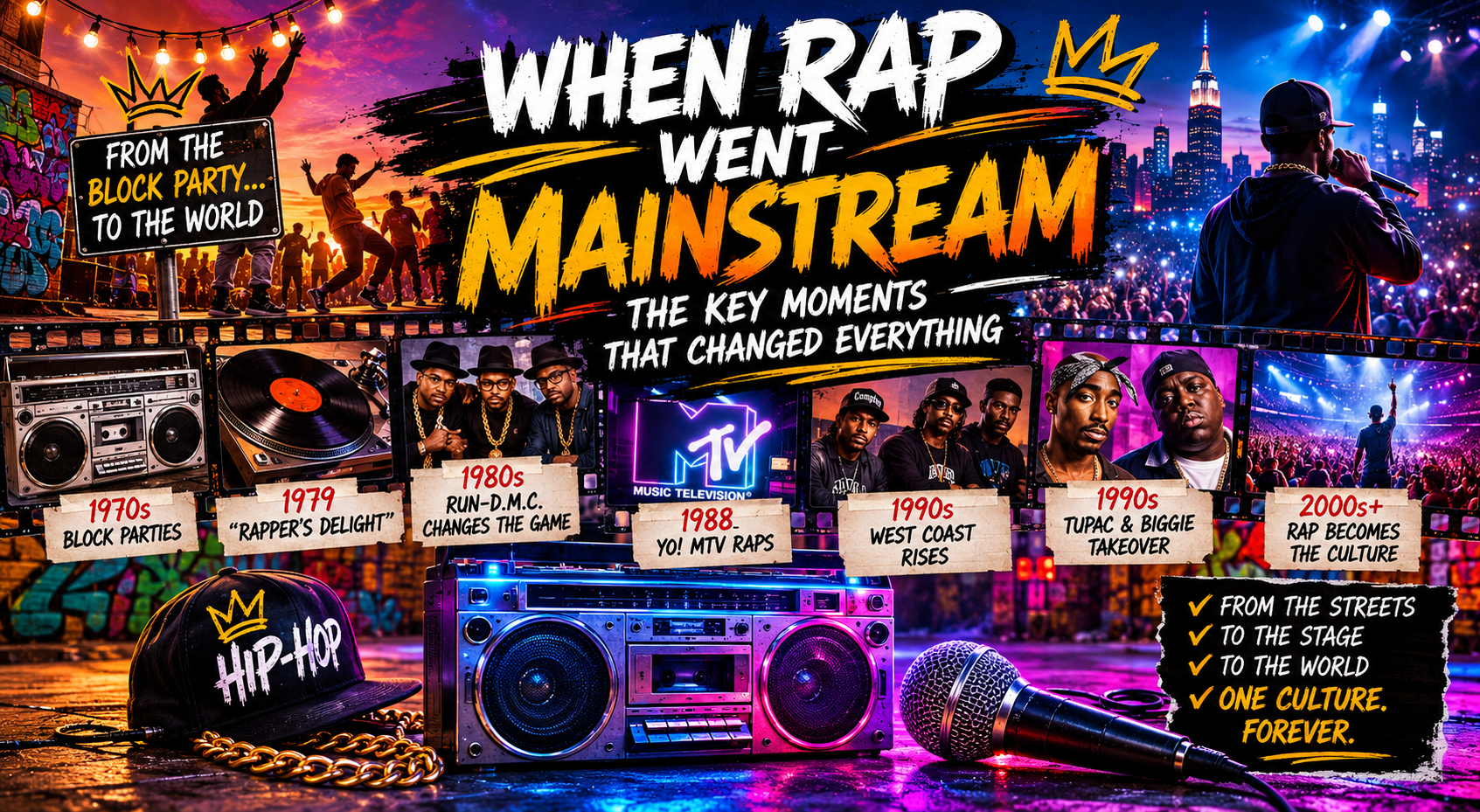
 Today, hip-hop is the dominant force in popular music. Rappers headline major festivals, sell out stadiums, influence fashion trends, appear in blockbuster films, and generate billions of streams every year. What began at Bronx block parties during the 1970s has become one of the most influential cultural movements in history.
But hip-hop’s rise to mainstream acceptance wasn’t inevitable.
For much of its early existence, rap was viewed as a novelty by the music industry. Many executives believed it was a passing trend that would disappear within a few years. Radio stations often ignored it. Television networks rarely featured it. Critics dismissed it as simplistic or lacking artistic value.
Yet against all odds, hip-hop survived and eventually conquered the mainstream.
The transformation didn’t happen overnight. Instead, it occurred through a series of key moments that gradually pushed rap from the streets into living rooms, record stores, arenas, and eventually every corner of popular culture.
These are the moments that changed everything.
The Block Parties That Started It All (1973–1979)
Before rap could become mainstream, it first had to exist.
Hip-hop’s story begins in the Bronx during the early 1970s. DJs such as Kool Herc, Afrika Bambaataa, and Grandmaster Flash organized block parties where music, dancing, and MCing merged into something entirely new.
These events weren’t commercial.
There were no major labels involved.
No national television appearances.
No platinum albums.
Hip-hop existed almost entirely as a live culture.
People attended parties, heard DJs extend breakbeats, watched dancers perform incredible moves, and listened to MCs hype the crowd.
The culture was thriving locally, but very few people outside New York knew it existed.
That would soon change.
“Rapper’s Delight” Introduces Rap to America (1979)
If one record deserves credit for introducing rap to mainstream audiences, it is “Rapper’s Delight” by the Sugarhill Gang.
Released in 1979, the song became a massive hit.
For many listeners, it was the first rap record they had ever heard.
Purists often criticized the song because the group wasn’t directly connected to New York’s original hip-hop scene. Nevertheless, its impact cannot be overstated.
“Rapper’s Delight” sold millions of copies worldwide.
Suddenly, radio stations were playing rap music.
Record labels noticed.
Consumers noticed.
The music industry realized that rap records could generate serious revenue.
For the first time, hip-hop had entered the mainstream conversation.
Kurtis Blow Becomes Rap’s First Major Star (1980)
Following the success of “Rapper’s Delight,” another breakthrough occurred.
Kurtis Blow became one of the first rappers to secure a major-label recording contract.
His hit “The Breaks” became the first certified gold rap single.
This achievement was significant because it demonstrated that rap wasn’t limited to novelty records.
Kurtis Blow established himself as a genuine artist capable of sustained success.
He appeared on television, toured nationally, and became one of hip-hop’s earliest ambassadors.
His accomplishments helped legitimize rap as a professional career.
MTV Changes Music—But Not Yet Rap (1981)
When MTV launched in 1981, it transformed the music industry.
Music videos suddenly became essential promotional tools.
Artists who received MTV exposure gained enormous advantages.
There was one problem.
MTV largely ignored hip-hop.
For years, rap artists struggled to secure airtime.
Many executives believed MTV’s audience wouldn’t embrace rap music.
This exclusion created significant obstacles for hip-hop’s growth.
Yet it also made future breakthroughs even more meaningful.
When rap finally gained access to MTV, everything changed.
Run-D.M.C. Reinvents Hip-Hop (1983–1985)
Few groups had a greater impact on rap’s mainstream rise than Run-D.M.C.
Before their arrival, many rap artists wore flashy costumes influenced by disco culture.
Run-D.M.C. looked different.
Leather jackets.
Adidas sneakers.
Black hats.
Gold chains.
They looked like the neighborhoods they came from.
Their music sounded different as well.
The production was harder.
The beats were stripped down.
The attitude felt authentic.
Songs like “It’s Like That,” “Sucker M.C.’s,” and “King of Rock” introduced audiences to a more aggressive version of hip-hop.
Run-D.M.C. became rap’s first true crossover superstars.
Their success helped reshape public perceptions of the genre.
Def Jam Creates a New Blueprint (Mid-1980s)
The formation of Def Jam Recordings represented another major turning point.
Founded by Rick Rubin and Russell Simmons, Def Jam understood both hip-hop culture and mainstream marketing.
The label’s roster included LL Cool J, Beastie Boys, and Public Enemy.
Each artist reached different audiences while maintaining credibility within hip-hop.
Def Jam proved that rap could succeed commercially without abandoning its identity.
The label became a model for future hip-hop businesses.
Its success encouraged the industry to invest more heavily in rap artists.
“Walk This Way” Breaks Down Barriers (1986)
Few songs changed music history more dramatically than Run-D.M.C.’s collaboration with Aerosmith on “Walk This Way.”
The concept seemed unusual at the time.
A legendary rock band.
A groundbreaking rap group.
Together on one song.
The result was a phenomenon.
The music video received heavy MTV rotation.
Rock fans discovered hip-hop.
Hip-hop fans discovered rock.
The collaboration introduced rap to millions of listeners who might otherwise never have explored the genre.
More importantly, it demonstrated that hip-hop could compete in mainstream spaces traditionally dominated by rock music.
The walls separating genres began to crumble.
The Beastie Boys Reach Number One (1986)
Later that same year, another breakthrough arrived.
The Beastie Boys released Licensed to Ill.
The album became the first rap record to reach number one on the Billboard charts.
This achievement shocked many industry observers.
Hip-hop was no longer simply surviving.
It was dominating.
The album’s success expanded rap’s audience dramatically and proved that the genre possessed enormous commercial potential.
Major labels could no longer ignore what was happening.
Rap had become a major business.
Yo! MTV Raps Brings Hip-Hop Into Homes (1988)
One of the most important moments in hip-hop history occurred when MTV launched Yo! MTV Raps.
For years, rap artists struggled for exposure on the network.
Now they had an entire show dedicated to hip-hop.
The impact was enormous.
Viewers across America—and eventually around the world—could watch rap videos regularly.
Artists who previously lacked national exposure suddenly reached millions of people.
The program helped transform local stars into global celebrities.
For countless fans outside New York, Los Angeles, and other major cities, Yo! MTV Raps served as their introduction to hip-hop culture.
Public Enemy Proves Rap Can Be Serious
As hip-hop’s popularity increased, some critics dismissed it as shallow entertainment.
Public Enemy shattered that perception.
Albums like It Takes a Nation of Millions to Hold Us Back demonstrated that rap could address politics, race, media representation, and social issues.
Chuck D’s powerful lyrics challenged listeners intellectually.
The group’s success expanded public understanding of what hip-hop could achieve.
Rap wasn’t merely party music.
It could also function as journalism, protest, and social commentary.
This broadened the genre’s appeal and cultural significance.
N.W.A. Forces America to Listen (1988)
While Public Enemy addressed social issues from New York, N.W.A. delivered an entirely different perspective from Los Angeles.
Their album Straight Outta Compton shocked the nation.
The group’s lyrics described life in Compton with unprecedented honesty.
Critics attacked the music.
Politicians condemned it.
Law enforcement agencies expressed outrage.
Yet controversy only increased public interest.
Millions of people who had never listened to rap suddenly wanted to hear what all the commotion was about.
N.W.A. demonstrated hip-hop’s power to dominate national conversations.
The genre had become impossible to ignore.
MC Hammer and Commercial Explosion (1990)
Not every milestone involved controversy.
MC Hammer’s success introduced rap to mainstream family audiences.
His album Please Hammer Don’t Hurt ‘Em became one of the best-selling rap records ever released.
Songs like “U Can’t Touch This” dominated radio and television.
Hammer appeared everywhere.
Commercials.
Award shows.
Talk shows.
Mainstream America embraced him.
Some hip-hop purists criticized his pop-oriented approach, but his commercial impact was undeniable.
He brought rap into households that had previously ignored the genre.
Vanilla Ice and Mainstream Saturation (1990)
Around the same time, Vanilla Ice achieved unprecedented commercial success.
“Ice Ice Baby” became the first rap single to reach number one on the Billboard Hot 100.
The song’s popularity further demonstrated hip-hop’s growing commercial appeal.
Although opinions about Vanilla Ice remain divided, his success reflected a larger reality.
Rap had become part of mainstream popular culture.
The genre was now reaching audiences far beyond its original fan base.
Dr. Dre Reinvents Hip-Hop Again (1992)
Just as rap entered the mainstream, Dr. Dre transformed its sound.
His album The Chronic introduced G-Funk to the world.
The production featured melodic synthesizers, funk influences, and polished arrangements.
The music sounded completely different from East Coast rap.
The album became a massive success.
It also launched the career of Snoop Dogg.
Together, they helped establish West Coast hip-hop as a dominant force.
The success of The Chronic proved that rap could continually reinvent itself while expanding its audience.
The Source Awards and Cultural Dominance
By the mid-1990s, hip-hop had grown so influential that it required its own major awards shows and media outlets.
The Source Awards became a focal point for the culture.
Artists, executives, journalists, and fans treated the event as one of the industry’s most important gatherings.
This level of infrastructure reflected hip-hop’s maturity.
The genre was no longer an outsider.
It had become an institution.
Tupac and Biggie Become Superstars
No discussion of rap’s mainstream rise would be complete without Tupac Shakur and The Notorious B.I.G.
Both artists transcended music.
They became cultural icons.
Their albums achieved massive commercial success while maintaining artistic credibility.
Their personalities fascinated the public.
Their stories captivated the media.
By the mid-1990s, rap stars were receiving attention comparable to major movie actors and rock legends.
Hip-hop had reached a new level of cultural influence.
The Deaths That Shocked the World
The murders of Tupac in 1996 and Biggie in 1997 represented tragic turning points.
For many outside the culture, the events served as proof of hip-hop’s importance.
The deaths generated international news coverage.
Major newspapers covered the stories extensively.
Television networks interrupted programming.
The world paid attention.
While the circumstances were heartbreaking, the reaction demonstrated how significant rap had become.
Hip-hop was no longer a niche genre.
It was front-page news.
Jay-Z and the Business Revolution
As the 1990s progressed, artists increasingly viewed hip-hop as more than music.
Jay-Z helped lead this transformation.
He approached rap as both an art form and a business opportunity.
His success inspired countless entrepreneurs.
Hip-hop became associated with ownership, investment, branding, and wealth creation.
The culture’s influence expanded beyond entertainment.
It began reshaping business itself.
Eminem Takes Rap to New Audiences
At the end of the decade, another major breakthrough occurred.
Eminem emerged as one of the most successful rappers in history.
His extraordinary lyrical ability and controversial persona attracted enormous attention.
More importantly, he introduced hip-hop to millions of listeners worldwide.
His success demonstrated the genre’s universal appeal.
Rap was no longer tied to specific regions or demographics.
It had become global.
Hip-Hop Becomes the New Pop Music
By the early 2000s, the battle for mainstream acceptance was over.
Hip-hop had won.
The genre dominated radio.
It dominated MTV.
It dominated record sales.
Fashion trends increasingly originated within hip-hop culture.
Advertising agencies sought rap artists for endorsements.
Hollywood embraced hip-hop stars.
The culture influenced virtually every aspect of entertainment.
What once existed only at Bronx block parties had become the center of popular culture.
Why These Moments Mattered
Each milestone represented more than a commercial achievement.
Together, they changed how society viewed hip-hop.
They challenged stereotypes.
They created opportunities.
They expanded audiences.
Most importantly, they proved that rap possessed staying power.
For decades, critics predicted hip-hop’s decline.
Instead, the genre continued growing.
Every breakthrough made the next one possible.
The success of “Rapper’s Delight” led to Kurtis Blow.
Kurtis Blow helped pave the way for Run-D.M.C.
Run-D.M.C. opened doors for Def Jam.
Def Jam created opportunities for future stars.
The chain continued generation after generation.
Conclusion
The rise of rap from neighborhood block parties to mainstream dominance remains one of the most remarkable stories in music history.
It didn’t happen because of a single artist, song, or moment. Instead, it occurred through a series of breakthroughs that gradually expanded hip-hop’s reach. From “Rapper’s Delight” and Run-D.M.C. to N.W.A., Public Enemy, Dr. Dre, Tupac, Biggie, Jay-Z, and countless others, each generation pushed the culture further into the mainstream.
Along the way, hip-hop overcame skepticism, industry resistance, and cultural barriers. It evolved from an underground movement into the defining musical force of the modern era.
Today, rap’s influence extends far beyond music. It shapes fashion, language, business, sports, film, and politics. Its artists are among the most recognizable figures in the world.
The key moments that changed everything were not just milestones for hip-hop—they were milestones for popular culture itself. Together, they transformed rap from a local phenomenon into a global language spoken by millions.
When rap went mainstream, it didn’t simply join popular culture.
It became popular culture.
This post has already been read 847 times!