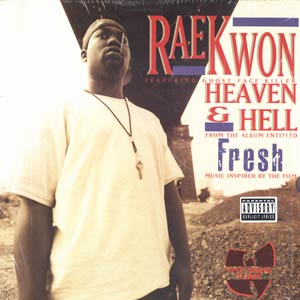
 By 1995, the Wu-Tang Clan had already reshaped hip-hop’s landscape, but what came next was even more ambitious: a series of solo albums that expanded their mythology while sharpening each member’s individual voice. Among those releases, Only Built 4 Cuban Linx… by Raekwon stands as one of the most cinematic and influential rap albums ever made. And within that sprawling, street-level epic, “Heaven & Hell” emerges as one of its most haunting and morally complex moments.
Featuring a standout appearance from Ghostface Killah, “Heaven & Hell” is more than just another crime narrative. It’s a meditation on consequence—on the thin, often invisible line between survival and destruction, ambition and regret. It doesn’t glorify the street life so much as it exposes its contradictions, offering a glimpse into a world where every decision carries weight.
A Soundtrack for Moral Conflict
The production on “Heaven & Hell,” handled by RZA, is instantly arresting. Built around eerie, looping strings and a skeletal drum pattern, the beat feels like it’s suspended in tension. There’s no warmth here, no sense of comfort—just a cold, cinematic atmosphere that mirrors the song’s themes.
RZA’s genius lies in his restraint. Instead of overwhelming the track with layers, he creates space—space for the lyrics to breathe, for the tension to build, for the listener to sit with the unease. The result is a beat that feels less like a backdrop and more like an environment.
It’s the sonic equivalent of walking through a dimly lit alley, unsure of what’s waiting around the corner.
Raekwon’s Narrative Precision
Raekwon has always been a master storyteller, but on “Heaven & Hell,” his precision is especially striking. His delivery is calm, almost detached, as he recounts scenes of street life with vivid detail.
What makes his approach so effective is its lack of dramatization. He doesn’t exaggerate or embellish—he presents events as they are, letting their weight speak for itself. This matter-of-fact tone makes the content hit harder, turning each line into a piece of a larger, unfolding narrative.
Raekwon’s verses are filled with imagery—luxury and danger intertwined, moments of success shadowed by the constant threat of loss. It’s a world where nothing is guaranteed, where every gain comes with a cost.
Ghostface Killah’s Emotional Counterpoint
If Raekwon provides the structure, Ghostface Killah brings the emotion. His verse on “Heaven & Hell” is raw, urgent, and deeply human. Where Raekwon is controlled, Ghostface is expressive, his voice rising and falling with intensity.
This contrast is what makes the track so compelling. The two MCs aren’t just trading verses—they’re offering different perspectives on the same reality. Raekwon observes; Ghostface feels. Together, they create a fuller picture, one that captures both the external and internal dimensions of their world.
Ghostface’s ability to inject emotion into his delivery adds a layer of vulnerability to the track. It reminds the listener that behind the bravado and the hustle, there are real people grappling with real consequences.
The Meaning of “Heaven & Hell”
The title itself speaks to the duality at the heart of the song. “Heaven” and “Hell” aren’t presented as distant, abstract concepts—they exist side by side, often within the same moment.
In the context of the track, “heaven” might be the rewards of the street life—the money, the status, the sense of control. “Hell” is everything that comes with it—the violence, the paranoia, the inevitability of loss.
What makes the song so powerful is how it blurs the line between the two. Moments of triumph are tinged with danger, while moments of despair are framed as consequences of choices made in pursuit of something better.
This duality is central to the album as a whole. Only Built 4 Cuban Linx… isn’t just a collection of songs—it’s a narrative, a world where actions have repercussions and nothing is as simple as it seems.
A Cornerstone of the “Purple Tape”
Often referred to as the “Purple Tape” due to its original cassette color, Only Built 4 Cuban Linx… is widely regarded as one of the greatest hip-hop albums ever made. It introduced a new level of cinematic storytelling to the genre, influencing countless artists in the years that followed.
“Heaven & Hell” plays a crucial role within that framework. It’s not the most flashy track on the album, nor is it the most immediately accessible. But it’s one of the most thematically rich, encapsulating the moral complexity that defines the project.
It’s a moment of reflection within an album full of action—a pause that forces the listener to consider the bigger picture.
Standing Apart in the ’90s Landscape
In 1995, hip-hop was dominated by a mix of styles. On the West Coast, artists like 2Pac were blending introspection with aggression, while on the East Coast, figures like The Notorious B.I.G. were redefining storytelling with charisma and detail.
Raekwon and the Wu-Tang Clan took a different approach. Their music was less polished, more fragmented, and deeply rooted in a shared aesthetic that drew from martial arts films, street slang, and raw experience.
“Heaven & Hell” embodies that approach. It doesn’t try to appeal to everyone—it stays true to its vision, creating something that feels authentic and uncompromising.
Influence and Legacy
Over the years, “Heaven & Hell” has become a touchstone for artists interested in narrative depth and atmospheric production. Its influence can be heard in the work of rappers who prioritize storytelling and mood, from underground lyricists to mainstream stars.
Artists like Kendrick Lamar have carried forward that tradition, crafting songs that explore moral complexity and personal consequence. While the styles may differ, the foundation remains the same: a commitment to telling stories that matter.
The track also reinforces Raekwon’s reputation as one of hip-hop’s greatest storytellers. His ability to create vivid, immersive narratives has earned him a lasting place in the genre’s history.
Why It Still Resonates
Decades after its release, “Heaven & Hell” continues to resonate because its themes are timeless. The tension between ambition and consequence, success and sacrifice, is something that extends far beyond the streets.
The song doesn’t offer easy answers or clear resolutions. Instead, it presents a reality that’s messy, complicated, and deeply human. That honesty is what gives it staying power.
In an era where music can sometimes feel disposable, tracks like this remind us of the power of depth—of taking the time to explore ideas and emotions in a meaningful way.
Final Thoughts
“Heaven & Hell” by Raekwon is more than just a standout track from a classic album—it’s a meditation on the choices we make and the consequences that follow.
With its haunting production, precise storytelling, and emotional depth, it captures a side of hip-hop that goes beyond surface-level narratives. It challenges the listener to think, to reflect, to engage.
It’s not an easy song. It’s not meant to be.
But in that difficulty lies its power. Because sometimes, the most important stories are the ones that don’t offer comfort—only truth.
This post has already been read 817 times!