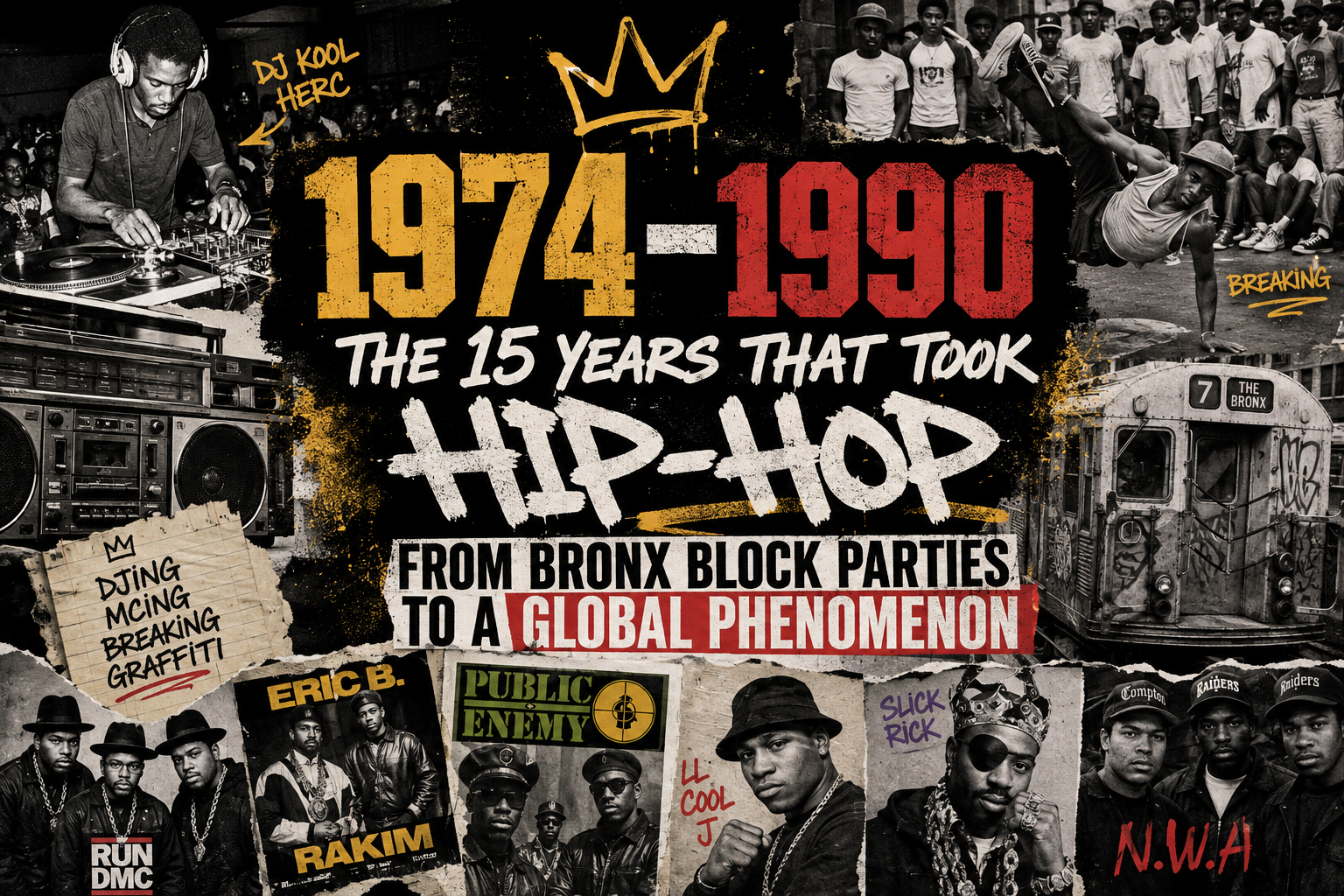
In the summer of 1974, hip-hop was not an industry. It was not a genre neatly packaged into record-store bins, and there were no platinum albums, superstar rappers, giant arena tours, or corporate hip-hop departments. There was no established blueprint for what it was supposed to become.
There were just DJs, MCs, dancers, artists, teenagers, neighborhoods, sound systems, and parties.
The Bronx was dealing with poverty, abandoned buildings, political neglect, and neighborhoods that had been devastated by years of economic decline. Yet within that environment, young people were creating something remarkably ambitious. They were taking pieces of existing music and turning them into something new. Funk records became raw material. Soul breaks became the foundation for extended dance sections. DJs became performers. MCs evolved from party announcers into writers, personalities and eventually poets. Graffiti transformed walls and subway cars into moving galleries. Breakdancers turned the floor into a stage.
What eventually became known as hip-hop was never invented in a single moment by a single person. It developed through a series of innovations, rivalries, parties, records, neighborhoods and personalities. The culture grew because people kept pushing the boundaries of what a DJ, an MC, a record, or a party could be.
The story from 1974 through 1990 is therefore much bigger than the story of rap music.
It is the story of a cultural movement figuring itself out.
During those sixteen calendar years, hip-hop went from neighborhood entertainment to an international phenomenon. It moved from parks and apartment buildings to radio stations, independent record labels, major-label offices, MTV, Hollywood, Europe and eventually virtually every corner of popular culture.
And perhaps most importantly, the music changed dramatically along the way.
The early DJs were the stars. Then the MCs became more important. Party records gave way to increasingly sophisticated rap performances. Sampling became an art form. Drum machines changed the sound. Producers became musical architects. Rap groups began making albums instead of merely singles. Social commentary became central. Hardcore street narratives emerged. Female MCs demanded their place. West Coast artists developed their own identity. Def Jam turned rap into a major-label business model.
By 1990, hip-hop was no longer asking whether it belonged in popular music.
It had already changed popular music.
The journey began in the Bronx.
The Bronx Creates Something New
1974–1977: The Party Becomes the Laboratory
The earliest years of hip-hop are difficult to reduce to a single origin story because the culture grew from a community rather than appearing fully formed.
One of the most important figures was DJ Kool Herc, the Jamaican-born DJ who became famous for his parties in the Bronx. Herc understood something about records that would become fundamental to hip-hop: the best part of a funk or soul record might only last a few seconds.
The drummer might suddenly take over.
The bass might become more prominent.
The vocals might disappear.
The crowd would react.
Herc began isolating those sections and extending them, using two copies of the same record to move back and forth between breaks. Instead of allowing a great musical moment to end, he could keep it going.
That simple idea had enormous consequences.
The break became the center of the party.
The dancers could keep moving.
The crowd could keep responding.
The DJ could manipulate the music in real time.
The DJ was no longer simply playing records.
The DJ was constructing the soundtrack.
This was particularly important because hip-hop developed as a participatory culture. People weren’t necessarily waiting for a finished song to tell them how to feel. The DJ was creating an environment where the audience became part of the performance.
The party itself became the laboratory.
And the Bronx was the perfect environment for that experimentation.
The music was also inseparable from the technology. Turntables, mixers, microphones, speakers and records were the tools. The limitations of the equipment encouraged creativity. A DJ didn’t have to own a recording studio to create something new. A pair of turntables could be enough.
That was revolutionary.
Traditional music required musicians, instruments, rehearsal spaces and recording equipment.
Hip-hop could begin with records someone already owned.
The DJ could transform existing music into a new experience.
That idea would eventually become one of hip-hop’s defining philosophies: existing sounds could be rearranged, recombined and repurposed.
Afrika Bambaataa and the Expansion of the Culture
While Kool Herc became one of the foundational DJs, Afrika Bambaataa helped expand the cultural possibilities of what was developing.
Bambaataa came out of the Bronx street-gang environment and eventually became associated with the Universal Zulu Nation. His vision of hip-hop was broader than simply DJing or rapping. He connected music with dance, graffiti, style, identity and community.
His parties helped establish the idea that hip-hop could be a complete cultural movement.
Bambaataa also had an enormous influence on the musical direction of the culture because he was willing to look outside traditional funk and soul.
This mattered enormously.
Early hip-hop DJs were digging through funk records, but eventually hip-hop would absorb rock, disco, electronic music, jazz, television themes and virtually anything else that could provide an interesting sound.
That openness became one of the culture’s greatest strengths.
Hip-hop didn’t need to belong to one musical tradition.
It could borrow from everything.
The MC Moves Toward the Center
The earliest MCs were not necessarily rappers in the modern sense.
Their role was often closer to that of a master of ceremonies. They introduced the DJ, addressed the crowd, encouraged dancers and helped keep the party moving.
But as the culture developed, MCs became increasingly creative.
They rhymed.
They competed.
They developed personalities.
They created routines.
They began treating the microphone as an instrument.
This was another crucial transformation.
The DJ provided the musical foundation, but the MC provided a human voice that could interact with the audience.
The relationship between DJ and MC became one of hip-hop’s foundational partnerships.
The DJ controlled the music.
The MC controlled the microphone.
Together, they created something that didn’t really exist anywhere else.
The Breakdancers and Graffiti Artists
Hip-hop’s history is sometimes reduced to rap music, but during the 1970s the culture was much broader.
Breakdancing developed alongside the music.
Dancers responded to the extended breaks that DJs created. Moves became increasingly athletic, creative and competitive. Battles became performances in which dancers tried to outdo one another.
The relationship was obvious: DJs extended the breaks because dancers wanted them, and dancers pushed DJs to make those breaks more exciting.
Graffiti provided another form of competition and expression.
Names became identities.
Walls and subway cars became canvases.
Artists developed elaborate lettering styles, characters and visual signatures.
The four commonly recognized elements of hip-hop—DJing, MCing, breaking and graffiti—did not develop in isolation. They reinforced one another.
A party could contain all of them.
That made hip-hop feel less like a musical genre and more like a world.
Hip-Hop Discovers the Record Business
1978–1979: The Underground Becomes a Record
For years, hip-hop existed largely outside the traditional recording industry.
Then record companies began noticing what was happening.
The breakthrough came with “Rapper’s Delight” by the Sugarhill Gang in 1979.
The record was enormously important, but its history is also complicated because the Sugarhill Gang were not simply the people who invented rap. They represented something that had already been developing in the Bronx for years.
What “Rapper’s Delight” did was bring the sound to people who had never experienced a Bronx block party.
That distinction matters.
Hip-hop did not begin when “Rapper’s Delight” was released.
But “Rapper’s Delight” demonstrated that the music could become a commercial record.
Suddenly, the recording industry had a reason to pay attention.
The song became a major success, and the floodgates began opening.
Other independent labels started releasing rap records.
The music moved into record stores.
Radio programmers began experimenting with it.
And artists who had previously performed almost exclusively at parties suddenly had an opportunity to reach audiences across the country.
The underground had discovered a path into the mainstream.
Sugar Hill Records Builds a Foundation
Sylvia Robinson’s Sugar Hill Records became one of the most important early labels in hip-hop.
The label didn’t just release “Rapper’s Delight.” It helped establish a roster and infrastructure for early rap.
The Sugarhill Gang, Grandmaster Flash and the Furious Five, and other artists associated with the label became central figures in the early recording era.
The label also understood something important: hip-hop was not just a fad.
There was an audience for it.
Grandmaster Flash brought a highly developed DJ style to records. The Furious Five provided MC performances that demonstrated how much more sophisticated rap could become.
The recording studio created another challenge, though.
A DJ could manipulate two turntables for a live audience, but a record had to capture that energy permanently.
That meant hip-hop artists had to figure out how to translate a live party into recorded music.
The process would become increasingly sophisticated over the next decade.
Grandmaster Flash Changes the DJ
Grandmaster Flash was one of the key figures in the evolution of DJ technique.
His innovations with turntables, cutting, backspins and mixing helped turn DJing into an increasingly precise performance art.
The DJ was no longer merely selecting records.
The DJ could manipulate them.
Flash’s techniques made the turntable itself feel like an instrument.
That concept would eventually influence generations of hip-hop producers and DJs.
It also reinforced an important principle: technical skill mattered.
Hip-hop developed a competitive culture because everyone was constantly trying to become better.
Who could scratch better?
Who could rhyme better?
Who could throw the best party?
Who had the best sounds?
Who could create the best routine?
Competition wasn’t merely conflict.
It was a method of innovation.
“The Message” Changes Everything
In 1982, Grandmaster Flash and the Furious Five released “The Message.”
It represented a major turning point.
The record was stark, serious and socially observant.
Instead of focusing primarily on partying, dancing and boasting, it confronted the realities of urban life.
This wasn’t entirely new. Hip-hop had always reflected its environment, and earlier MCs had addressed their neighborhoods and experiences.
But “The Message” demonstrated that rap could carry serious social commentary into the mainstream.
That expanded the possibilities of the music.
Rap could entertain.
Rap could make people dance.
Rap could make people laugh.
Rap could boast.
And rap could talk about poverty, crime, hopelessness, politics and social conditions.
That would become one of the genre’s defining characteristics.
The rapper could serve as an observer.
The microphone could become a newspaper.
The beat could carry an argument.
And the audience could hear stories about communities that were often ignored by mainstream media.
Run-DMC and the New School
1980–1983: The Sound Gets Harder
The early 1980s brought another major transformation.
The sound of hip-hop became more stripped down.
Drum machines became increasingly important.
Producers began relying less heavily on live funk bands and more heavily on programmed rhythms, turntable techniques and electronic sounds.
The music became harder.
Cleaner.
More direct.
At the same time, MCs became more technically ambitious.
The old party routines were still around, but rappers were beginning to develop distinctive voices and writing styles.
This was the beginning of the transition from old-school party rap toward the more sophisticated lyrical styles that would dominate the middle and late 1980s.
Kurtis Blow Opens the Door
Kurtis Blow was one of the first rappers to establish himself as a genuine recording star.
His success helped prove that an MC could become the central figure of a record.
That was significant because the earliest hip-hop recordings often felt like documents of a larger party culture.
Kurtis Blow helped move the rapper toward the role of lead artist.
The MC was becoming the star.
That shift would eventually make possible the rise of artists such as LL Cool J, Run-DMC, Rakim and countless others.
Run-DMC Arrives
Then came Run-DMC.
Joseph “Run” Simmons, Darryl “DMC” McDaniels and DJ Jam Master Jay changed the visual and musical identity of hip-hop.
Their music was harder and more minimal than much of the earlier party rap.
The production left room for the voices.
Their delivery was forceful.
Their presentation was stripped down.
And their style looked different.
The tracksuits, sneakers, hats and streetwear were not just fashion choices. They helped establish a visual language for hip-hop.
Run-DMC didn’t look like traditional pop stars.
That was precisely the point.
They looked like people from the neighborhoods where hip-hop had developed.
Their image connected the music to everyday street culture.
“It’s Like That” and “Sucker MCs”
Run-DMC’s early records demonstrated how much the genre had changed.
The arrangements were minimal.
The drums were prominent.
The rhymes were direct.
There was less emphasis on the elaborate party-band sound associated with some earlier rap records.
This stripped-down approach created enormous space for the MC.
That would become increasingly important.
The rapper’s voice became the central instrument.
And DJ Jam Master Jay was equally important because the music never became simply vocal-driven. The DJ remained part of the identity.
Run-DMC represented a bridge between the first generation of hip-hop and the new generation.
They respected the culture that came before them while pushing it into a harder and more modern direction.
“Walk This Way” Breaks Down the Wall
The collaboration between Run-DMC and Aerosmith on “Walk This Way” in 1986 became one of the most important crossover moments in popular music.
It wasn’t simply a rap group covering a rock song.
It was two musical cultures colliding.
The record introduced Run-DMC to an enormous audience that might never have purchased a rap record.
It also demonstrated something that would become central to hip-hop: genre boundaries were optional.
Rock could become hip-hop.
Funk could become hip-hop.
Disco could become hip-hop.
Jazz could become hip-hop.
Anything containing a useful sound could become part of the musical vocabulary.
The success of “Walk This Way” also helped change how record companies viewed rap.
Hip-hop was no longer merely a specialized market.
It could sell huge numbers of records.
Def Jam and the New Rap Economy
Rick Rubin and Russell Simmons
The creation of Def Jam Recordings was another critical turning point.
Russell Simmons understood the business side of hip-hop.
Rick Rubin understood the musical possibilities.
Together, they created a label that treated rap as a major musical force rather than a novelty.
Def Jam’s early roster included artists who would fundamentally change the genre.
LL Cool J.
Beastie Boys.
Public Enemy.
The label’s records had a distinctive aesthetic: hard beats, aggressive performances and a willingness to challenge conventional ideas about what rap could sound like.
Def Jam also understood youth culture.
Its artists looked like their audience.
Its records sounded immediate.
Its presentation was confident.
Hip-hop was developing its own music business rather than simply waiting for the traditional industry to decide what it should be.
LL Cool J Becomes a Star
LL Cool J represented another stage in hip-hop’s evolution.
He could deliver hard-edged battle rap, but he also had charisma and crossover appeal.
His image was different from Run-DMC’s.
He was younger.
More individualistic.
More focused on himself as a personality.
LL demonstrated that an MC could become a solo pop star without losing the credibility associated with hip-hop.
That was a major development.
The early years had been dominated by crews and DJ-MC combinations.
The 1980s increasingly produced individual stars.
The rapper became a brand.
That would become enormously important in the decades that followed.
The Golden Age Begins
1984–1986: Sampling Becomes an Art Form
The mid-1980s produced an explosion of creativity.
Sampling technology was becoming more accessible, and producers were discovering that they could take pieces of existing recordings and transform them into entirely new musical compositions.
This was not merely copying.
The best producers treated samples as building blocks.
A drum break could become the foundation of a new rhythm.
A bassline could be looped.
A horn section could be chopped.
A vocal phrase could become a hook.
A movie dialogue sample could establish atmosphere.
The possibilities seemed endless.
Hip-hop producers were effectively creating a new form of musical collage.
One record could contain pieces of several decades of popular music.
That made hip-hop historically unusual.
A new rap record could simultaneously reference James Brown, jazz, rock, funk, soul and contemporary electronic music.
The past was constantly being pulled into the present.
Marley Marl
Marley Marl was one of the most influential producers of this period.
His production work helped establish the idea that sampling itself could be a creative performance.
The producer wasn’t simply putting a beat behind an MC.
The producer was composing.
That distinction became increasingly important.
Marley Marl and the Juice Crew helped develop a more sophisticated approach to beat construction, while the group’s MCs pushed lyrical technique forward.
This was the beginning of the era when producers and MCs became increasingly inseparable.
A great rapper needed a great beat.
A great producer needed an MC who could exploit it.
The Bridge Wars
The rivalry between Boogie Down Productions and the Juice Crew became one of hip-hop’s defining conflicts.
It centered partly on the history of Queensbridge and whether the neighborhood deserved recognition as an important birthplace of hip-hop.
But like many hip-hop rivalries, it became much larger than its original argument.
KRS-One and Boogie Down Productions represented a different vision of rap.
They were aggressive.
They were intellectually confrontational.
They wanted to establish authority.
The conflict demonstrated how competition could push rappers to improve.
Diss records became a legitimate art form.
Hip-hop’s competitive tradition had evolved from party battles into recorded warfare.
Rakim Changes the MC
1986–1987: A New Standard for Rapping
Then came Eric B. & Rakim.
Rakim’s impact on hip-hop is difficult to overstate.
Before Rakim, rap certainly contained sophisticated rhyming.
But Rakim changed how the MC could approach rhythm, phrasing and lyrical density.
His delivery was controlled rather than frantic.
He could sit inside a beat instead of constantly attacking it.
His rhymes could extend across multiple bars.
His internal rhyming patterns made verses sound increasingly complex.
The MC was becoming less like a party announcer and more like a writer.
This was a fundamental transformation.
Rakim helped establish the modern concept of the elite MC.
A great rapper was no longer judged simply on energy or crowd control.
Technical ability mattered.
Wordplay mattered.
Flow mattered.
Structure mattered.
Originality mattered.
The bar had been raised.
The Golden Age Mentality
The late 1980s are often remembered as hip-hop’s golden age because of the sheer variety of styles emerging simultaneously.
There were conscious rappers.
Party rappers.
Hardcore rappers.
Storytellers.
Political groups.
Comedians.
Battle rappers.
Female MCs.
West Coast artists.
New York crews.
Alternative groups.
The genre was becoming too large to fit into one definition.
That diversity was part of the magic.
One record might be playful and ridiculous.
The next could be politically furious.
Another could tell a detailed neighborhood story.
Another could simply be designed to destroy a dance floor.
Hip-hop was becoming a universe rather than a sound.
Public Enemy and the Political Explosion
1987–1989
If Run-DMC made hip-hop commercially powerful and Rakim made it lyrically sophisticated, Public Enemy made it politically explosive.
Chuck D, Flavor Flav, Terminator X and the Bomb Squad created something that sounded unlike virtually anything else in popular music.
The Bomb Squad’s production was dense, chaotic and aggressive.
Multiple samples collided.
Sirens, voices, drums, horns and other sounds were layered into walls of noise.
Chuck D’s voice cut through the middle with authority.
Flavor Flav provided an eccentric counterbalance.
The group was theatrical, confrontational and political.
Public Enemy demonstrated that rap could be a vehicle for serious political discussion without becoming conventional political music.
They weren’t trying to sound respectable.
They were trying to sound dangerous.
That distinction mattered.
It Takes a Nation of Millions
The release of It Takes a Nation of Millions to Hold Us Back in 1988 represented a landmark.
The album sounded urgent.
It sounded crowded.
It sounded angry.
It sounded like information arriving faster than the listener could process it.
The Bomb Squad’s production was revolutionary because it treated sampling almost like a sonic explosion.
There wasn’t much empty space.
Everything seemed to be moving.
The production reflected the group’s worldview.
Hip-hop had now developed the ability to make albums that were not simply collections of singles.
An album could have a concept.
A mood.
A political argument.
A sonic identity.
A beginning, middle and end.
The rap album was becoming a legitimate album format.
The West Coast Finds Its Voice
The Early West Coast Scene
While New York remained the center of hip-hop’s recording industry, the West Coast was developing its own identity.
Los Angeles had its own traditions.
Electro became particularly important.
Artists such as World Class Wreckin’ Cru and Egyptian Lover helped establish a futuristic sound that was distinct from New York’s breakbeat-heavy approach.
Then came artists such as Ice-T, who began pushing rap toward harder street narratives.
The West Coast wasn’t simply copying New York.
It was developing its own perspective.
Ice-T and Street Narratives
Ice-T’s importance comes partly from his willingness to tell stories that were rooted in the realities of Los Angeles.
His music helped establish the foundation for what would become gangsta rap.
The subject matter was controversial, but the larger significance was that regional experience was becoming central to hip-hop.
A rapper didn’t need to sound like New York.
Los Angeles could have its own voice.
Oakland could have its own voice.
Philadelphia could have its own voice.
Miami could have its own voice.
Hip-hop was becoming regional.
And once hip-hop became regional, it could become national.
N.W.A. and the Shockwave of 1988–1990
Compton Changes the Conversation
N.W.A. arrived with an entirely different approach.
Dr. Dre’s production was heavy, sparse and ominous.
Ice Cube brought an aggressive writing style.
Eazy-E had a distinctive voice and business presence.
MC Ren and DJ Yella rounded out a group that would become one of the most controversial acts in American music.
Their music was explicit, confrontational and deeply rooted in the environment they described.
What made N.W.A. so powerful was not simply the profanity or controversy.
It was perspective.
They were presenting a world that mainstream America rarely heard directly from the people living inside it.
The group’s music challenged the assumption that hip-hop had to sound like New York.
Suddenly, Compton was on the musical map.
Straight Outta Compton
Released in 1988, Straight Outta Compton became a landmark.
It was raw.
Aggressive.
Minimal.
Regional.
And completely confident.
The album also demonstrated the growing importance of production.
Dr. Dre’s work helped establish a template for West Coast rap that would eventually dominate popular music.
The drums were heavy.
The bass was powerful.
The arrangements left space for the voices.
The sound was unmistakably Southern California.
The album’s impact went far beyond sales.
It changed the perception of what a successful rap group could be.
A group from Compton didn’t need New York’s approval.
They could create their own sound and force the country to listen.
Women in Early Hip-Hop
MC Lyte, Queen Latifah and Salt-N-Pepa
The history of early hip-hop is incomplete without the women who helped shape it.
Female MCs were present from the beginning, but the recording industry often struggled to give them the same attention as male performers.
That changed as artists such as MC Lyte, Queen Latifah and Salt-N-Pepa established themselves.
MC Lyte brought technical skill and authority.
Queen Latifah brought intelligence, confidence and a powerful sense of identity.
Salt-N-Pepa demonstrated that female rap groups could become major commercial stars.
These artists didn’t simply participate in hip-hop.
They expanded its possibilities.
Queen Latifah in particular helped challenge the assumption that female rappers needed to imitate the aggressive masculinity that dominated much of the genre.
She could be assertive without losing sophistication.
She could discuss identity, relationships and social issues while maintaining credibility.
That broadened the range of subjects and personalities available to hip-hop.
The Art of the Rap Album
From Singles to Complete Statements
The early hip-hop record was often about the single.
That made sense.
The culture had developed around parties.
A DJ needed a record that could move a crowd.
A 12-inch single could provide that.
But by the late 1980s, albums had become increasingly important.
Run-DMC released influential albums.
LL Cool J developed as an album artist.
Public Enemy created ambitious political records.
Boogie Down Productions built larger arguments.
Eric B. & Rakim demonstrated that lyrical sophistication could sustain an entire album.
N.W.A. created a regional statement.
This shift changed the economics of hip-hop.
An artist no longer had to live and die by one hit.
A successful album could establish an identity.
That encouraged experimentation.
Artists could include serious songs, party songs, storytelling tracks and technical showcases on the same record.
The album became a portrait of the artist.
The Producer Becomes a Star
Another major change was the rise of the producer.
Early hip-hop had centered around DJs.
As recording technology became more sophisticated, producers increasingly became musical architects.
Rick Rubin.
Marley Marl.
The Bomb Squad.
Dr. Dre.
Prince Paul.
These figures demonstrated that production could define an entire sound.
The producer chose samples.
Built rhythms.
Created arrangements.
Decided how dense or minimal a track should be.
Sometimes the producer’s choices were as important as the rapper’s performance.
This would become even more obvious in the 1990s.
Hip-Hop and MTV
The Visual Revolution
Television transformed hip-hop.
MTV gave artists another way to reach audiences.
Run-DMC understood the importance of video immediately.
Their image translated perfectly to television.
The group looked distinctive.
Their performances were energetic.
Their videos helped make their personalities recognizable to people who had never attended a hip-hop party.
“Walk This Way” was particularly important because the video visually represented the collision between rock and rap.
The wall separating the two worlds became part of the story.
That was an almost perfect metaphor for what hip-hop was doing to popular culture.
It was breaking down walls.
Movies and Hollywood
Hip-hop also began appearing in films.
Beat Street and Breakin’ brought elements of hip-hop culture to mainstream audiences.
Run-DMC appeared in movies.
Hip-hop artists became recognizable celebrities.
The culture was moving beyond records.
Fashion companies noticed.
Advertisers noticed.
Hollywood noticed.
Television noticed.
The mainstream was no longer merely observing hip-hop.
It was beginning to incorporate it.
The Fashion Revolution
Hip-hop changed clothing almost as dramatically as it changed music.
Run-DMC’s Adidas sneakers became iconic.
Tracksuits became associated with rap culture.
Gold chains became visual symbols of success.
Hats, jackets, sneakers and streetwear became part of an increasingly recognizable hip-hop aesthetic.
This was significant because hip-hop had always been about identity.
The clothes told people who you were.
They communicated neighborhood, crew, taste and status.
Eventually, the fashion industry began borrowing directly from hip-hop.
That relationship would become enormous in later decades.
But its foundations were established during this period.
Hip-hop artists weren’t merely selling records.
They were selling an image of themselves.
And audiences wanted to participate.
The Language of Competition
Battles, Beef and Bragging Rights
Competition had always been part of hip-hop.
At block parties, MCs battled.
DJs competed.
Dancers battled.
Graffiti artists competed for recognition.
As rap became a recording medium, those competitions moved onto records.
Diss tracks became a major part of the culture.
The Bridge Wars demonstrated the possibilities.
Later battles would become even more personal.
The competitive nature of hip-hop forced artists to develop quickly.
A rapper couldn’t remain comfortable.
There was always another MC trying to become better.
This environment encouraged technical innovation.
More complex rhymes.
Better punchlines.
More interesting flows.
More creative production.
Hip-hop’s competitive culture could be hostile, but it also produced some of the genre’s greatest artistic advances.
Sampling and the Relationship With the Past
One of the most fascinating aspects of 1980s hip-hop was its relationship with music history.
Hip-hop was simultaneously looking forward and backward.
A new rap record could use a James Brown drum break.
A funk bassline could become the foundation for a modern beat.
A rock guitar riff could suddenly appear underneath a rapper.
A jazz record could provide a sample.
A television theme could become part of the production.
This created an unusual relationship between generations.
Young hip-hop fans were introduced to older music because producers sampled it.
Someone might hear a rap record and then go searching for the original source.
Sampling became an unofficial musical history lesson.
At the same time, it transformed old recordings.
A three-second drum break could become more famous among a new generation than the original song.
The past was being rediscovered through hip-hop.
1988: The Year Everything Exploded
1988 is often treated as one of the defining years in hip-hop history, and the reason is simple: so many different styles were reaching their peak at the same time.
Public Enemy released It Takes a Nation of Millions to Hold Us Back.
Boogie Down Productions released By All Means Necessary.
Eric B. & Rakim released Follow the Leader.
N.W.A. released Straight Outta Compton.
Big Daddy Kane was emerging as one of the most technically impressive MCs in the genre.
Slick Rick was establishing himself as one of hip-hop’s greatest storytellers.
EPMD was developing a stripped-down, funk-heavy production style.
The Jungle Brothers and other artists were beginning to push toward what would eventually become alternative hip-hop.
There was no single definition of rap anymore.
There were multiple schools.
And they were all evolving.
That diversity is one reason the late 1980s remain so influential.
Storytelling Becomes an Art
Slick Rick represented another important evolution.
His greatest strength was storytelling.
He could build characters.
Set scenes.
Create narrative tension.
Make a rap song feel like a short film.
This demonstrated that rap didn’t have to be limited to boasting or social commentary.
It could tell stories.
That sounds obvious today, but during the genre’s early development it was another major expansion of possibilities.
A rapper could create an entire fictional world within three or four minutes.
This would eventually become one of hip-hop’s most enduring traditions.
The Rise of the Individual MC
The early culture was heavily crew-oriented.
DJ and MC combinations were central.
Groups dominated.
But the late 1980s increasingly produced solo stars.
LL Cool J.
Big Daddy Kane.
Slick Rick.
MC Lyte.
Queen Latifah.
Ice-T.
These artists had distinct identities.
You could hear a few seconds of a song and recognize who was performing.
That individuality was crucial.
Hip-hop was becoming personality-driven.
The MC wasn’t simply someone holding a microphone.
The MC was the brand.
The voice.
The image.
The worldview.
That development laid the groundwork for the superstar rappers of the 1990s.
The Business Gets Bigger
As hip-hop became more popular, the money became bigger.
Major labels wanted rap artists.
Independent labels wanted rap artists.
Record stores wanted rap records.
Radio stations wanted rap programming.
Television wanted rap videos.
Clothing companies wanted rappers.
Hollywood wanted rappers.
The culture that had developed outside the traditional entertainment industry was now becoming one of the entertainment industry’s most valuable properties.
That created opportunities.
It also created tensions.
Hip-hop had always valued authenticity.
The record industry valued commercial success.
Those goals did not always match.
Artists increasingly had to negotiate the difference between maintaining credibility and reaching a larger audience.
That tension would become one of the genre’s defining themes throughout the 1990s and beyond.
Hip-Hop Goes International
By the end of the 1980s, hip-hop was no longer exclusively American.
The culture was spreading throughout Europe and beyond.
Breakdancing became an international phenomenon.
Graffiti styles traveled.
Rap records were imported.
DJs and dancers inspired local scenes.
Young people in other countries began experimenting with their own versions of hip-hop.
This was particularly remarkable because the culture had been so deeply rooted in the Bronx.
Within roughly fifteen years, something created at neighborhood parties had become a global language.
The international growth of hip-hop also proved that its fundamental ideas were portable.
You didn’t have to live in New York to understand the attraction of the DJ, the MC, the beat, the battle, the dance or the visual identity.
Different countries would eventually develop their own rap traditions.
But the foundation had been established in New York.
What Hip-Hop Had Become by 1990
By 1990, the difference between the hip-hop culture of 1974 and the hip-hop industry of 1990 was enormous.
The earliest DJs needed a sound system and a stack of records.
By 1990, rappers were making major-label albums.
The earliest MCs introduced DJs and encouraged dancers.
By 1990, rappers were international celebrities.
The earliest parties were neighborhood events.
By 1990, hip-hop artists were appearing on MTV and in Hollywood films.
The earliest breaks were extended manually on turntables.
By 1990, sophisticated sampling technology was helping producers build elaborate compositions.
The earliest MC battles happened in front of local crowds.
By 1990, diss tracks could become national events.
The earliest graffiti artists painted walls and subway cars.
By 1990, hip-hop aesthetics had become part of mainstream fashion and advertising.
That is an extraordinary transformation in only sixteen years.
But perhaps the most impressive part is that hip-hop hadn’t stopped evolving.
It was just getting started.
The Artists Who Built the Foundation
It is tempting to create a single hierarchy of hip-hop pioneers, but the culture was built by overlapping generations.
DJ Kool Herc established foundational DJ techniques and party culture.
Afrika Bambaataa expanded hip-hop’s cultural and musical possibilities.
Grandmaster Flash pushed DJ technique forward.
The Furious Five helped establish the MC as a serious recording artist.
The Sugarhill Gang helped introduce rap to a mainstream audience.
Kurtis Blow helped demonstrate that rappers could become stars.
Run-DMC transformed the sound, fashion and commercial possibilities of the genre.
LL Cool J helped establish the solo rap superstar.
Rick Rubin and Russell Simmons helped build a modern rap business.
Marley Marl revolutionized sampling and production.
KRS-One pushed battle rap and intellectual confrontation.
Rakim changed the standard for MC technique.
Public Enemy demonstrated the political power of rap.
Queen Latifah and MC Lyte expanded the role of women in hip-hop.
Ice-T helped establish West Coast street rap.
N.W.A. changed the geography and subject matter of mainstream hip-hop.
Dr. Dre established a production aesthetic that would dominate the next decade.
Slick Rick demonstrated the power of storytelling.
Big Daddy Kane raised the technical bar.
EPMD helped establish a new generation of funk-driven production.
None of these artists existed in a vacuum.
Each one inherited something from the people before them.
That is one of the most important things about hip-hop history.
The culture developed through conversation.
One record inspired another.
One DJ influenced another.
One MC challenged another.
One producer discovered a new way to manipulate sound.
The next generation heard it and pushed it further.
The Sound of the Era
The musical progression from 1974 to 1990 is almost impossible to believe when placed side by side.
The early Bronx sound was dominated by funk breaks and disco records.
Then came the first rap singles.
Then drum machines.
Then electro.
Then more sophisticated sampling.
Then dense production.
Then minimalist production.
Then hardcore production.
Then regional sounds.
There wasn’t one straight line.
There were dozens of branches.
That makes the period so fascinating.
Hip-hop was constantly reinventing itself.
The basic ingredients remained familiar—beats, rhymes, samples, DJs—but the way those ingredients were combined changed constantly.
That is perhaps the defining characteristic of the music.
Hip-hop was never satisfied with what it had already accomplished.
Why the 1980s Were So Important
The 1980s established virtually every major component of the hip-hop industry that would dominate the following decades.
The MC became a star.
The DJ became a producer.
The producer became a composer.
The record became an album.
The album became a statement.
The rapper became a celebrity.
The music video became a marketing tool.
The clothing became a business.
The independent label became a path to major-label success.
The diss track became an institution.
The sample became an instrument.
Regional scenes became legitimate.
Women became major voices.
Political rap became commercially viable.
Hardcore rap became commercially viable.
And hip-hop became international.
By the end of the decade, the question was no longer whether rap would survive.
The question was how big it could become.
From Block Party to Global Phenomenon
The transformation of hip-hop between 1974 and 1990 is one of the most remarkable stories in modern popular culture.
It began with people creating entertainment for themselves.
There was no guarantee that record companies would care.
There was no guarantee that radio stations would play it.
There was no guarantee that television would show it.
There was no guarantee that parents would approve of it.
There was no guarantee that America would understand it.
But the culture kept growing anyway.
The early DJs created extended breaks.
The dancers responded.
The MCs grabbed microphones.
The graffiti artists created visual identities.
The crowds became communities.
The first records documented the movement.
Those records created an audience.
The audience demanded more records.
More artists appeared.
New labels formed.
New techniques developed.
The music became more sophisticated.
The artists became more ambitious.
The audiences became larger.
Eventually, the rest of the world noticed.
That process explains why hip-hop became much more than a genre.
It became a method of creation.
It taught people that you didn’t necessarily need traditional instruments to make music.
You could create with turntables.
You could create with records.
You could create with a microphone.
You could create with a sampler.
You could create by taking something old and making it new.
That philosophy extended beyond music.
It influenced fashion.
Art.
Dance.
Language.
Advertising.
Film.
Television.
Business.
And eventually virtually every corner of popular culture.
Conclusion: The Beginning Was Only the Beginning
Looking back from the perspective of 1990, the transformation seems almost impossible.
Sixteen years earlier, hip-hop was still an emerging Bronx party culture.
By 1990, it was a global cultural force.
But the most important thing about those years wasn’t simply how much money the music generated or how many records were sold.
It was the creative freedom that developed along the way.
Hip-hop showed that culture could be built from the bottom up.
A DJ could become an innovator.
An MC could become a star.
A kid with records could become a producer.
A neighborhood could develop a sound.
A dance could become an international phenomenon.
A wall could become a canvas.
A record from twenty years earlier could become the foundation of a brand-new song.
That willingness to experiment became hip-hop’s greatest strength.
The culture was born from limitation, but limitation encouraged invention.
There weren’t expensive instruments, so DJs used turntables.
There weren’t traditional recording opportunities, so artists built their own scenes.
There wasn’t a mainstream audience waiting for them, so they created their own audience.
And once that audience became impossible to ignore, the world changed.
From Kool Herc’s extended breaks to Grandmaster Flash’s turntable innovations, from “Rapper’s Delight” to “The Message,” from Run-DMC to Def Jam, from Rakim to Public Enemy, from Ice-T to N.W.A., the story of 1974–1990 is a story of constant reinvention.
Every generation added something.
Every rivalry pushed somebody harder.
Every new technology opened another door.
Every regional scene expanded the definition of what hip-hop could be.
By 1990, hip-hop had already traveled an extraordinary distance.
But ironically, this was still the early chapter.
The 1990s would bring Tupac, The Notorious B.I.G., Nas, Wu-Tang Clan, A Tribe Called Quest, De La Soul, Gang Starr, Dr. Dre’s The Chronic, Snoop Dogg, OutKast, Lauryn Hill and countless others. Sampling would become even more sophisticated. Gangsta rap would become a dominant commercial force. Alternative hip-hop would expand. Southern rap would eventually reshape the national sound. Independent artists would find new ways to reach audiences.
But none of that could have happened without the fifteen-plus years that came before it.
The groundwork had been laid in the Bronx.
The culture had survived the transition from block parties to records.
It had survived the transition from records to albums.
It had survived the transition from underground phenomenon to mainstream business.
And by 1990, hip-hop had achieved something that seemed almost impossible when those first DJs started extending the breaks.
It had become impossible to ignore.
The block party had become a global phenomenon.
And the world was only beginning to understand what hip-hop could do.
This post has already been read 562 times!