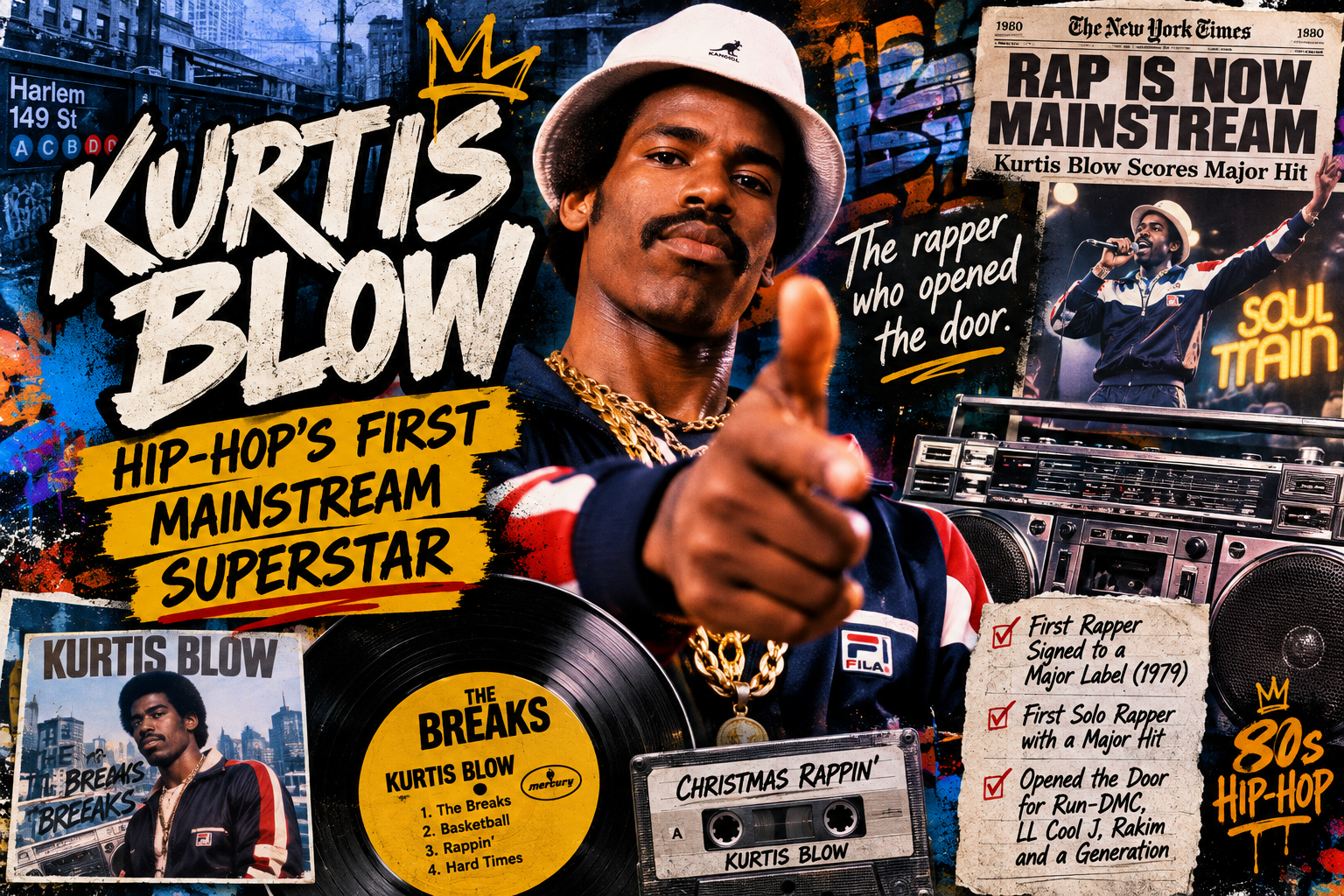
Before Run-DMC, LL Cool J, Public Enemy, Rakim, Ice-T, N.W.A. and the countless rap stars who followed, there was Kurtis Blow.
In the late 1970s, rap was still largely a live experience. DJs controlled neighborhood parties, MCs worked microphones, dancers battled on the floor, and the most important performances often happened in places that would never appear on a concert calendar. Hip-hop was growing rapidly in New York, but the recording industry still viewed it as an underground curiosity.
Kurtis Blow helped change that.
When he released “Christmas Rappin'” in 1979, he became the first rapper signed to a major record label. His follow-up, “The Breaks,” became an enormous success and established him as the first commercially successful solo rap artist.
That accomplishment is easy to underestimate because hip-hop has since become one of the biggest forces in popular music.
Today, rappers routinely dominate the charts. Hip-hop artists headline festivals and arenas, receive major awards, launch fashion companies, appear in movies and television shows, and become some of the most recognizable entertainers on the planet.
None of that was guaranteed when Kurtis Blow walked into a recording studio.
There wasn’t an established path for a rapper to become a star.
Blow helped create one.
His importance isn’t limited to the number of records he sold or the novelty of being an early artist. He helped establish the basic idea that a rapper could be a recording artist, a headliner, a television personality and a legitimate commercial star.
He was there when rap was crossing the line from neighborhood culture into popular culture.
And without that transition, the history of hip-hop would look very different.
Growing Up in New York
Kurtis Walker was born in Harlem in 1959 and grew up surrounded by the musical culture of New York.
New York in the 1960s and 1970s was an extraordinary place for a young person interested in music. Soul, funk, disco, rock and R&B were everywhere. Radio stations provided a constant stream of sounds, while neighborhood DJs developed their own reputations.
The city was also experiencing enormous social change.
The Bronx, Harlem and other communities faced economic problems, crime, poverty and deteriorating infrastructure. Yet young people continued creating their own cultural spaces.
Parties became important.
DJs became important.
Dance crews became important.
And the emerging hip-hop culture gave young people an opportunity to build identities and reputations outside traditional institutions.
Walker became involved in that environment and eventually adopted the name Kurtis Blow.
The name fit the emerging culture perfectly.
It was memorable.
It sounded like a stage name.
And most importantly, it belonged to him.
Before the Record Deal
Blow’s rise did not begin with a record contract.
Like many early hip-hop artists, he developed his skills in the live scene.
He worked as an MC.
He performed at parties.
He became involved with DJs.
He learned how to control an audience.
That last skill would become particularly important.
Early MCing wasn’t simply about writing impressive verses. The MC had to understand a crowd.
When should the energy rise?
When should the performer slow things down?
How should the audience be encouraged to participate?
How could a performer make hundreds of people feel involved?
Kurtis Blow understood the entertainment side of rap.
That helped distinguish him from artists who were focused primarily on technical rhyming.
He was a performer.
He had charisma.
He understood presentation.
And he understood that if rap was going to move into the mainstream, rappers would have to become entertainers as well as MCs.
“Christmas Rappin'” Changes the Game
The breakthrough came in 1979 with “Christmas Rappin’.”
The song was unusual for the time.
Rap records were still a new concept, and the idea of releasing a Christmas rap single for a mainstream audience was even more unconventional.
Yet Blow’s performance demonstrated something important.
A rapper could carry an entire commercial record.
The MC didn’t have to be an accessory to a DJ.
The rapper could be the artist.
That distinction would become fundamental to hip-hop.
The record was released through Mercury Records, making Blow the first rapper signed to a major label.
That alone was historic.
Major record companies had spent decades building their businesses around singers, rock bands, soul artists and pop acts.
Rap was still considered experimental.
Kurtis Blow became one of the first people to prove that a major label could successfully sell a record built around an MC.
The door was open.
It would never close again.
“The Breaks” Becomes a Smash
If “Christmas Rappin'” opened the door, “The Breaks” kicked it wide open.
Released in 1980, “The Breaks” was built around a simple but incredibly effective concept.
The record celebrated the word “break” through a series of rhymes and rhythmic repetitions, creating a song that was instantly recognizable and easy for audiences to participate in.
It was also deeply connected to the culture from which rap had emerged.
The title referenced the breaks that DJs had been extending at Bronx parties.
The record was therefore doing something historically important.
It was taking a fundamental idea from underground hip-hop culture and turning it into a mainstream pop record.
“The Breaks” became a major commercial success and eventually achieved gold status.
For the first time, a solo rapper had a substantial mainstream hit.
That was a major milestone.
The record also demonstrated that rap didn’t need to abandon its roots to become commercially successful.
It could sound like hip-hop and still reach a large audience.
That lesson would become incredibly important during the 1980s.
What Made Kurtis Blow Different?
Kurtis Blow arrived at a moment when rap was still figuring out what a recording artist was supposed to be.
The earliest rap singles often attempted to capture the atmosphere of live parties.
Blow’s records began moving toward a more conventional idea of the artist.
He had a name.
He had a recognizable image.
He had a record label.
He had singles.
He had albums.
He could appear on television.
He could perform for audiences outside New York.
He was becoming a professional entertainer.
That evolution might seem obvious today.
At the time, it was revolutionary.
Blow helped establish a model that later rappers could follow.
A young MC could now look at Kurtis Blow and imagine a career in recorded music.
That was a huge psychological shift.
The Rapper Becomes the Star
One of Blow’s most important contributions was helping move the rapper to the front of the stage.
Early hip-hop had been heavily centered around DJs.
The DJ controlled the records.
The DJ controlled the sound system.
The DJ often had the reputation.
MCs worked alongside them.
As rap records became more successful, however, the balance shifted.
The MC became the central personality.
Kurtis Blow was one of the people responsible for that transition.
He showed that audiences could become attached to the rapper’s personality.
The MC could be the reason someone bought the record.
The voice could become the brand.
That idea would soon be taken much further by Run-DMC, LL Cool J, Public Enemy, Eric B. & Rakim and countless others.
But Kurtis Blow helped establish the foundation.
The Importance of the Album
Blow’s success also helped demonstrate that rap could exist as an album format.
That was important because a hit single could have been dismissed as a novelty.
An album required something more.
It required enough material to sustain an artist’s identity.
It required different songs and different ideas.
It suggested that rap was not simply a temporary trend.
It was becoming a legitimate recording format.
The transition from singles to albums would eventually transform hip-hop.
Artists would create concept albums.
Producers would build distinctive sonic worlds.
Rappers would tell stories over several tracks.
Political ideas could be developed.
Personal identities could become more detailed.
The album would become one of hip-hop’s most important artistic forms.
Kurtis Blow was there near the beginning of that transition.
The Business of Being a Rapper
Blow’s career also demonstrated that becoming a successful rapper involved more than making records.
The music business had to figure out how to market hip-hop.
Record companies had to determine which radio stations would play it.
Promoters had to figure out how to book rap artists.
Television producers had to decide whether rappers belonged on mainstream programs.
Audiences outside New York had to become familiar with the culture.
Kurtis Blow was one of the first artists forced to navigate all of those questions.
His success made those questions easier for the artists who followed.
Once a rapper had already become a successful mainstream recording artist, record companies had less reason to dismiss the next rapper who walked through the door.
That is one of the great effects of pioneering.
The first person has to convince everyone.
The people who come later only have to point at the evidence.
Kurtis Blow was the evidence.
The Sugar Hill Connection
Kurtis Blow’s early career also unfolded during the same period when independent labels such as Sugar Hill Records were proving that rap could be commercially viable.
The Sugarhill Gang had scored a massive success with “Rapper’s Delight.”
Grandmaster Flash and the Furious Five were developing their own recording careers.
The industry was beginning to understand that rap had a market.
Blow’s major-label success reinforced that conclusion from another direction.
Rap was no longer just one isolated success.
There was a scene.
There were artists.
There were labels.
There was an audience.
There was money.
And where there was money, the recording industry was going to pay attention.
The 1980s Begin to Accelerate
The early 1980s were a period of extraordinary change.
New rappers appeared constantly.
DJs developed increasingly sophisticated techniques.
Electro became popular.
Drum machines became more important.
Breakdancers became international stars.
Graffiti became associated with hip-hop culture around the world.
And rap records became more common.
Kurtis Blow was one of the artists who helped make that explosion possible.
His early success made the idea of a professional rap career seem realistic.
That encouraged aspiring MCs.
A teenager could hear “The Breaks” on the radio and think, “I could do that.”
Of course, doing it successfully was another matter.
But the possibility existed.
That possibility was new.
Kurtis Blow and Run-DMC
The relationship between Kurtis Blow and the generation that followed is particularly interesting.
Run-DMC emerged in the early 1980s with a much harder and more stripped-down sound.
Their approach was different from Blow’s.
They were less dependent on the party-oriented structure of early rap.
Their production was minimal.
Their presentation was tougher.
Their fashion was unmistakably street-oriented.
But they were building on a door that Kurtis Blow had already helped open.
The idea that an MC could be a major recording artist was no longer theoretical.
Run-DMC could take that idea and push it much further.
They would eventually become one of the biggest groups in American music.
Their success helped prove that hip-hop had moved beyond novelty.
But Kurtis Blow had already demonstrated the basic commercial possibility.
The Bridge Between Generations
This makes Blow particularly important historically.
He sits directly between two eras.
On one side was the early party culture of the Bronx.
On the other was the fully developed hip-hop industry of the 1980s.
He belonged to both.
He understood the live culture.
He understood the recording business.
He could perform for a neighborhood crowd.
He could make a record for a national audience.
That made him a bridge.
The music was changing around him, but his career represented the transition itself.
More Than “The Breaks”
Because “The Breaks” is such a famous record, it can be easy to reduce Kurtis Blow to one song.
That would be a mistake.
His importance extends beyond that hit.
He released multiple albums during the early 1980s.
He continued recording and performing while the genre changed around him.
He helped establish the visibility of rap on mainstream television.
He collaborated with other artists.
He remained connected to the developing hip-hop community.
He also became an important figure for younger rappers.
His career demonstrated longevity at a time when the recording industry was still unsure whether rap would last.
“Basketball” and the Power of a Simple Idea
Another memorable Kurtis Blow record was “Basketball.”
Released in 1984, it demonstrated his ability to connect rap with mainstream American culture.
Basketball was already hugely popular, but Blow turned it into the subject of a rap record that celebrated the sport and its stars.
The song also demonstrated one of rap’s emerging strengths.
Hip-hop could take an existing part of popular culture and reinterpret it through the MC’s perspective.
That idea would eventually become commonplace.
Rappers would make songs about sports, movies, neighborhoods, politics, fashion, cars, television and virtually every other aspect of American life.
Kurtis Blow was experimenting with that approach early.
Rap as a Celebration of Culture
Blow’s music was often accessible because it understood the importance of celebration.
Not every rap song needed to be confrontational.
Not every record needed to be political.
Not every MC needed to prove technical superiority.
Rap could simply be fun.
That was important in the genre’s early years.
Hip-hop came out of parties.
The party remained part of its identity.
Kurtis Blow understood that.
His music often maintained the sense of excitement and participation that characterized early hip-hop.
That accessibility helped him reach listeners who might otherwise have been unfamiliar with rap.
The Changing Standard for MCs
As the 1980s progressed, the standards for rapping became increasingly demanding.
Grandmaster Caz, Melle Mel and other early MCs had already demonstrated sophisticated writing.
Then artists such as KRS-One, Big Daddy Kane, Slick Rick and Rakim pushed the craft much further.
Rakim’s approach to rhythm and rhyme, in particular, changed expectations for what an MC could do.
Compared with those later artists, Kurtis Blow’s rhymes can sound simpler.
But judging him entirely by later standards misses the point.
Blow was operating in the first generation of commercially recorded rap.
He was helping establish the format.
He didn’t inherit a mature rap industry.
He helped create it.
You don’t judge the first airplane by the standards of a modern jet.
You appreciate what it made possible.
The Visual Image of Kurtis Blow
Kurtis Blow also understood the importance of image.
Early rap artists were developing recognizable looks and personalities.
Blow’s appearance, stage presence and presentation helped demonstrate that rappers could have identities beyond the music itself.
This would become enormously important.
Run-DMC would turn Adidas sneakers and tracksuits into cultural symbols.
LL Cool J would develop his own unmistakable image.
Salt-N-Pepa, Queen Latifah and MC Lyte would establish distinct identities.
Public Enemy would create one of the most recognizable visual presentations in music.
Kurtis Blow belonged to the first generation figuring out how all of this worked.
The Importance of Being First
Being first doesn’t always mean being the greatest.
That distinction is important when discussing Kurtis Blow.
There were MCs before him who were more technically sophisticated.
There were rappers after him who sold more records.
There were artists who developed more influential production styles.
There were lyricists who eventually transformed the craft.
But Kurtis Blow accomplished something none of those later artists could repeat.
He was among the first to prove that a rapper could become a mainstream recording star.
That is a unique achievement.
Once it had been done, it could never be undone.
Hip-Hop Learns to Sell Itself
Blow’s career also helped change how the music industry thought about rap.
Before his success, record executives could dismiss rap as a fad.
After his success, that argument became harder to make.
A rapper could sell.
A rap single could become a hit.
A major label could sign an MC.
A rap album could generate money.
A rapper could tour.
A rapper could appear on television.
That meant other artists could get opportunities.
The industry began searching for the next Kurtis Blow.
Instead, it found an entire generation.
From Kurtis Blow to LL Cool J
LL Cool J’s rise illustrates how quickly the possibilities expanded.
He was younger and more aggressive.
His style was more individualistic.
He was comfortable presenting himself as a star.
Def Jam gave him a platform, and he became one of the most important solo rappers of the 1980s.
That path was much easier to imagine because Kurtis Blow had already established the idea that a solo rapper could have mainstream success.
LL didn’t have to prove that concept from scratch.
He had to expand it.
From Kurtis Blow to Public Enemy
Public Enemy took rap somewhere entirely different.
Their music was political, dense and confrontational.
Chuck D became one of the most commanding voices in hip-hop.
The Bomb Squad created a production style that sounded radically different from early party rap.
Yet even Public Enemy benefited from the earlier transformation of rap into a legitimate commercial medium.
The culture had already demonstrated that an MC could stand at the center of a major musical project.
Public Enemy simply demonstrated how powerful that position could become.
From Kurtis Blow to N.W.A.
The same principle applies to West Coast rap.
N.W.A. could release Straight Outta Compton in 1988 and expect a national audience to listen.
That would have been almost unimaginable fifteen years earlier.
The industry had learned that rap could sell.
The audience had learned that rap could come from anywhere.
The groundwork laid by early commercial artists helped create that environment.
Kurtis Blow was one of the people who helped make it possible.
The First Mainstream Superstar
Calling Kurtis Blow hip-hop’s first mainstream superstar isn’t about claiming that he was the biggest rapper of all time.
He wasn’t.
It’s about chronology and impact.
He arrived before the genre had a well-established commercial infrastructure.
He became a major-label artist when rap was still being treated as something new.
He scored a major hit with “The Breaks.”
He released albums.
He toured.
He appeared in mainstream media.
He became recognizable beyond the underground hip-hop audience.
He demonstrated that the rapper could become the star.
That is what made him a superstar in historical terms.
The Road From the Bronx to the World
Hip-hop’s eventual worldwide success can be traced through a series of breakthroughs.
First came the DJs.
Then the MCs.
Then the first records.
Then commercial hits.
Then major-label deals.
Then albums.
Then MTV.
Then major tours.
Then Hollywood.
Then international audiences.
Kurtis Blow was positioned right at the critical transition between the first records and the major commercial expansion.
He was part of the generation that transformed rap from something happening at neighborhood parties into something people could purchase in stores.
That transition changed everything.
A Legacy Larger Than His Discography
Kurtis Blow’s legacy is therefore larger than his individual catalog.
His greatest contribution was possibility.
He showed young MCs that this could be a career.
He showed record companies that rap could be profitable.
He showed audiences that a rapper could carry a record.
He showed other musicians that hip-hop could become part of mainstream entertainment without losing its basic identity.
And he helped normalize the presence of rappers in American popular culture.
Once that happened, the growth became difficult to stop.
Why Kurtis Blow Still Matters
It is easy for history to focus on the artists who became superstars later.
Run-DMC.
LL Cool J.
Public Enemy.
Rakim.
Ice-T.
N.W.A.
The artists of the late 1980s and early 1990s often receive more attention because their music sounds closer to what modern listeners recognize as hip-hop.
But the story doesn’t begin there.
Before the golden age, there was an earlier generation establishing the rules.
Kurtis Blow was one of its most important figures.
He helped demonstrate that rap could exist beyond the party.
It could be recorded.
It could be sold.
It could be marketed.
It could be performed nationally.
And it could be successful.
Those were enormous breakthroughs.
The Door He Opened
The greatest way to understand Kurtis Blow is to imagine the music industry before him.
A young rapper could perform at a party, impress hundreds of people and still have no obvious path toward a recording career.
There was no guarantee that a label would care.
There was no guarantee that radio would play rap.
There was no guarantee that audiences outside New York would understand the culture.
Kurtis Blow helped change that.
After “The Breaks,” the possibility was real.
A rapper could make a hit.
A rapper could become famous.
A rapper could sign with a major label.
A rapper could make albums.
A rapper could build a career.
Once that door opened, an enormous number of artists walked through it.
Conclusion: The Man Who Proved It Could Be Done
Kurtis Blow’s place in hip-hop history isn’t complicated, even if his contribution is sometimes overlooked.
He was there when rap was still trying to convince the recording industry that it belonged.
He became the first rapper signed to a major label.
He scored one of the earliest major rap hits with “The Breaks.”
He helped move the MC from the side of the DJ’s sound system to the center of the stage.
He showed that a rapper could become a professional recording artist and mainstream celebrity.
Most importantly, he proved that hip-hop could have a future.
That may be his greatest achievement.
The artists who followed had different sounds and different ambitions. Run-DMC brought harder rhythms and a new visual identity. LL Cool J developed the solo rap superstar model. Rakim transformed lyrical technique. Public Enemy turned rap into a powerful political force. N.W.A. brought the realities of Compton to a national audience.
But they were all working in an industry that Kurtis Blow had helped convince to take rap seriously.
His career sits at one of the most important crossroads in music history.
On one side was the Bronx party.
On the other was the global hip-hop industry.
Kurtis Blow helped connect them.
When “The Breaks” became a hit, the significance went far beyond one successful single. A new kind of artist had entered the mainstream.
The rapper was no longer just the person holding the microphone at a party.
The rapper could be the star.
That idea would eventually produce an entire industry.
It would create generations of artists.
It would reshape the music business.
It would influence fashion, television, film, advertising and language.
And it would help turn hip-hop into one of the defining cultural movements of the modern era.
Kurtis Blow didn’t build that entire empire himself.
Nobody could.
But he helped lay the first bricks.
And sometimes the person who opens the door deserves to be remembered just as much as the people who eventually walked through it.
Kurtis Blow was the first rapper to prove that the door was there.
This post has already been read 423 times!