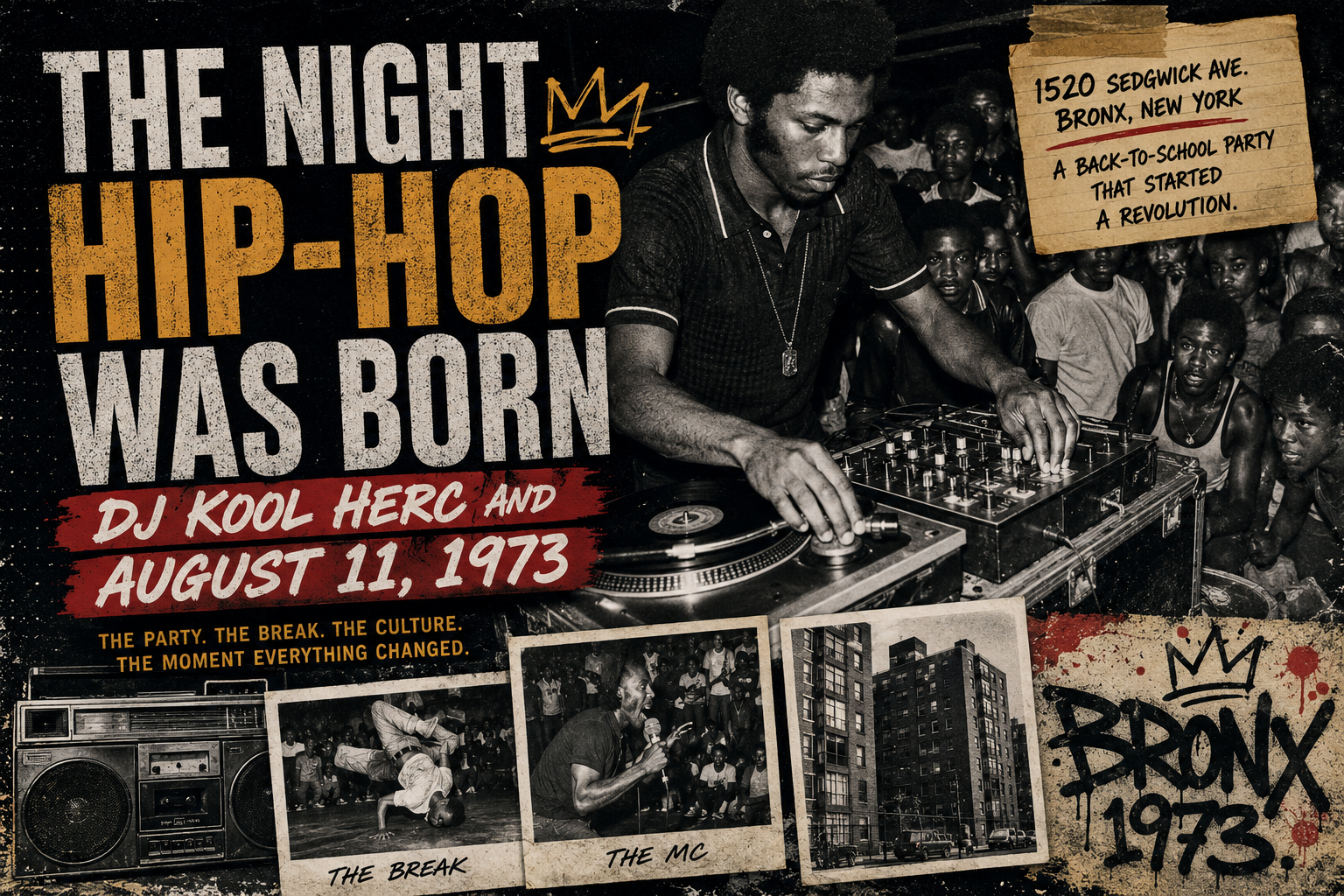
The Party That Changed Music Forever
On August 11, 1973, a back-to-school party was held in the recreation room of an apartment building at 1520 Sedgwick Avenue in the Bronx, New York.
There was no record label involved.
There was no television crew.
There was no major concert promoter.
There wasn’t even a recording being made to document what happened.
There was simply a neighborhood party organized by Cindy Campbell, music played by her brother Clive Campbell, and a crowd of young people looking for a good time before another school year began.
Clive Campbell was already known around the neighborhood by another name: DJ Kool Herc.
What happened that night would eventually become part of the origin story of hip-hop.
Calling August 11, 1973 the exact moment hip-hop was “born” is technically an oversimplification. Hip-hop developed through many people, places and ideas, and its foundations had been forming before that date. DJs, dancers, MCs and graffiti artists were already experimenting with the ingredients that would become the culture.
But August 11 became important because it represents a moment when several of those ingredients came together in a way that pointed toward the future.
Kool Herc had a different way of playing records.
He understood what happened when a great drum break came along.
Instead of letting it disappear after a few seconds, he wanted to keep it going.
He made the break the centerpiece.
That decision changed everything.
The party DJ became something closer to a musical architect. Dancers were given more room to perform. MCs eventually found new ways to interact with the music. Other DJs heard what Herc was doing and developed their own techniques.
Within a few years, an underground Bronx party culture would become a recorded musical genre.
Within a decade, rap would become a major force in American popular music.
And eventually, hip-hop would become a worldwide cultural phenomenon.
It all began with a party.
The Bronx in 1973
To understand why that night mattered, it helps to understand the Bronx that produced it.
The borough was going through enormous social and economic changes during the early 1970s. Poverty was widespread, neighborhoods were struggling, buildings were deteriorating, and many young people had limited access to the kinds of recreational opportunities that existed in wealthier communities.
Yet the Bronx was not simply a place defined by decline.
It was also a place filled with creativity.
Young people created their own entertainment.
Block parties became gathering places.
Apartment buildings hosted events.
Community centers provided spaces for teenagers.
Parks became social hubs.
Sound systems could turn an ordinary outdoor space into a temporary nightclub.
Music was everywhere.
Funk, soul, disco and rock records were available to DJs who knew how to find the right sounds.
The technology was relatively simple. A DJ needed turntables, records, a mixer, amplifiers and speakers.
What mattered was what the DJ could do with them.
That was the environment in which Kool Herc developed.
He was born Clive Campbell in Kingston, Jamaica, in 1955 and moved with his family to the Bronx as a child. His Jamaican background was significant because sound-system culture was already deeply established in Jamaica.
Large outdoor sound systems, selectors choosing records, DJs developing distinctive identities and performers speaking over music were all part of Jamaican musical culture.
Herc brought that experience into a New York environment that was developing its own musical traditions.
He didn’t simply copy Jamaica.
He adapted ideas to the Bronx.
And the Bronx would give those ideas a new direction.
Cindy Campbell and the Back-to-School Party
The August 11 party was organized by Cindy Campbell.
She wanted to raise money for new school clothes and decided to throw a party in the recreation room of the apartment building where she lived with her family.
The location was 1520 Sedgwick Avenue.
That address would eventually become one of the most famous locations in hip-hop history.
At the time, however, it was simply an apartment building.
Cindy handled the organizing.
Her brother handled the music.
That division of labor was typical of the community-based events that helped hip-hop develop.
There was no giant production company creating the event.
People promoted parties through flyers and word of mouth.
A DJ’s reputation mattered.
If a DJ could consistently deliver a great party, people would come back.
Herc had developed that reputation.
He was known for his sound system and his ability to keep people dancing.
But what made him different was not simply the equipment.
It was the way he thought about records.
The Break Becomes the Star
Funk records were full of moments that made dancers react.
A song might contain a powerful drum section that lasted only a few seconds.
Then the singer would return.
The verse would begin.
The energy would change.
For a dancer, those few seconds could be the best part of the entire record.
Herc recognized that.
He began using two copies of the same record to extend those instrumental sections.
When one record reached the end of the break, he could switch to the other copy and keep the break going.
Then he could return to the first record and repeat the process.
The technique became known as the Merry-Go-Round.
The concept was simple.
The effect was revolutionary.
Instead of treating the break as a short transition inside a song, Herc made the break the main event.
Dancers could keep going.
They could develop longer routines.
They could compete.
They could improvise.
The music became less about listening to a complete song from beginning to end and more about experiencing specific musical moments repeatedly.
That changed the relationship between the DJ and the audience.
The DJ wasn’t merely selecting songs.
The DJ was editing the music live.
The Birth of the Breakbeat
The breakbeat became one of the central foundations of hip-hop.
A break could be a drum-heavy section from a funk record.
It could contain bass, percussion, horns or guitar.
What mattered was that it created a strong rhythmic foundation.
Herc became known for using breaks from records such as James Brown’s “Give It Up or Turnit a Loose,” Incredible Bongo Band’s “Apache,” and Babe Ruth’s “The Mexican,” among others.
The records themselves were not hip-hop records.
That is an important distinction.
Hip-hop didn’t begin with musicians entering a studio to create an entirely new musical language.
It began with DJs discovering new ways to use music that already existed.
The record collection became an instrument.
The turntables became instruments.
The break became raw material.
That idea would eventually lead to sampling, one of the most important developments in modern music.
But in 1973, nobody was thinking about digital samplers or sample clearances.
Herc was simply trying to keep the dancers moving.
The Dancers Were Essential
The dancers are an important part of the story because the evolution of the breakbeat was directly connected to what was happening on the dance floor.
The extended breaks gave dancers an opportunity to showcase themselves.
They could perform moves.
They could battle.
They could develop identities.
The term “break-boy” and eventually “B-boy” became associated with dancers who performed during these breaks.
Breaking developed into its own sophisticated art form.
The dancers spun, froze, moved across the floor and competed with one another.
The music encouraged the dance, and the dance influenced the music.
That relationship would remain fundamental to hip-hop.
The DJ needed to understand what dancers wanted.
The dancers needed the DJ to provide the right music.
A great DJ could make a dance floor explode.
A great dancer could make the DJ search for an even better break.
The culture was already becoming interactive.
Herc’s Sound System
Another reason the party mattered was the sound system.
Herc’s equipment was loud enough to transform an ordinary recreation room into something much bigger.
This was partly influenced by Jamaican sound-system culture, where the quality and power of a DJ’s sound could be central to reputation.
A DJ wasn’t simply a person standing behind two turntables.
The sound system itself was part of the identity.
The speakers had to hit.
The bass had to be felt.
The music had to fill the room.
That physical quality of early hip-hop is easy to overlook when listening to the music decades later.
Hip-hop was designed to be experienced in a room with other people.
The bass moved through the floor.
The crowd reacted together.
The DJ could see immediately whether a record worked.
There was instant feedback.
That helped create the experimental nature of early hip-hop.
A DJ could try something new.
If the crowd responded, keep doing it.
If they didn’t, move on.
The MC Enters the Picture
The DJ was the center of the early party, but another important piece of hip-hop was beginning to develop around the microphone.
MCs initially served as hosts and crowd motivators.
They introduced the DJ.
They encouraged dancers.
They shouted out friends.
They kept the energy moving.
Over time, that role developed into rapping.
One of the people associated with Herc’s early parties was Coke La Rock.
He is often described as one of the first major MCs in hip-hop history.
The early MC wasn’t necessarily delivering the complex verses that would become standard in later rap.
The job was different.
The MC was there to control the room.
He could talk to the crowd while Herc controlled the records.
That division of responsibilities created a powerful partnership.
The DJ supplied the music.
The MC supplied the voice.
The dancers supplied the movement.
The crowd supplied the energy.
The culture was beginning to take shape.
Hip-Hop Wasn’t Invented in One Night
The phrase “the night hip-hop was born” makes for a great title, but the reality is more complicated.
Hip-hop did not suddenly appear at 1520 Sedgwick Avenue at one precise moment.
Its ingredients had multiple origins.
Jamaican sound-system culture influenced DJs.
African American funk and soul music provided the musical foundation.
Disco DJs were experimenting with extended dance sections.
MC traditions were developing in New York.
Graffiti had its own history.
Street dancers were creating their own styles.
Young people throughout the city were experimenting with music and performance.
Other DJs were also important.
Grandmaster Flash, Afrika Bambaataa, Grandmaster Caz, Grand Wizzard Theodore and many others would make enormous contributions to the development of hip-hop.
The culture was collaborative.
It was competitive.
It was constantly changing.
August 11, 1973 therefore should not be understood as a magical moment when somebody invented hip-hop from nothing.
It was more like a landmark.
A date that represents the beginning of a movement whose ingredients were already coming together.
That distinction actually makes the story more interesting.
Hip-hop was not the product of one person’s imagination.
It was a community creation.
Why Kool Herc Mattered So Much
If hip-hop had multiple creators, why is Kool Herc so closely associated with its beginning?
The answer is his approach to the break.
Herc understood that a DJ could manipulate the structure of recorded music.
That was the breakthrough.
Traditional listening encouraged people to follow the song.
Herc encouraged people to follow the moment.
The best part of the song didn’t have to happen only once.
It could be repeated.
It could be extended.
It could become a platform for dancers.
That idea changed the function of the DJ.
A DJ could now create something that wasn’t actually present on any individual record.
Two copies of a record could become something new.
A sequence of breaks could become its own composition.
The DJ could effectively remix music before the modern concept of remixing had fully developed.
That approach would eventually become central to hip-hop production.
The Importance of the Break
The break also connected hip-hop to African American musical history.
Funk musicians had already emphasized rhythm.
James Brown’s records were especially important because of their powerful drum and bass sections.
Those sections gave hip-hop DJs an enormous musical vocabulary.
The DJ could pull out the rhythm and let it stand on its own.
That made the drummer, bass player and rhythm section suddenly more important.
Hip-hop would later sample those musicians repeatedly.
In a sense, the early DJs were teaching a new generation to listen differently.
They weren’t necessarily hearing the song the way the original artist intended.
They were searching for pieces.
Where is the drum break?
Where is the bass?
Where does the rhythm drop out?
Where is the best section?
Which part will make dancers move?
That way of listening became one of hip-hop’s defining characteristics.
From Kool Herc to Grandmaster Flash
Herc’s innovations inspired others.
Grandmaster Flash became one of the most important technical innovators in DJ history.
He developed increasingly precise techniques for cutting, backspinning and mixing records.
Flash demonstrated that the turntable could become an instrument.
Afrika Bambaataa expanded the musical possibilities even further, drawing from funk, electronic music, rock and other genres.
The competition between DJs helped accelerate innovation.
Once one DJ developed a technique, another would try to improve it.
A better sound system.
A better break.
A better transition.
A better scratch.
A better MC.
A better party.
This competitive environment became part of hip-hop’s DNA.
The Four Elements Take Shape
As the culture developed, four major elements became commonly associated with hip-hop: DJing, MCing, breaking and graffiti.
The August 1973 party wasn’t necessarily a fully formed example of all four elements operating under one unified name.
That framework developed over time.
Still, the connections were already becoming visible.
The DJ created the music.
The MC controlled the microphone.
The dancers responded to the breaks.
Graffiti artists created a visual language around the same urban youth culture.
Each element gave young people another way to express themselves.
That was one of hip-hop’s greatest strengths.
You didn’t have to be a musician.
You could dance.
You could paint.
You could DJ.
You could rhyme.
You could organize parties.
You could build a reputation in your neighborhood.
Hip-hop created multiple avenues for participation.
The Bronx Becomes the Center
During the years after Herc’s party, the Bronx became a hotbed of DJ activity.
DJs developed reputations and loyal followings.
Crews formed.
Parties became increasingly competitive.
Different neighborhoods had their own stars.
Sound systems became bigger.
MCs became more skilled.
Dancers became more athletic.
The culture developed its own language and etiquette.
This was an underground scene in the truest sense.
The mainstream music industry largely wasn’t paying attention.
That lack of attention gave hip-hop room to develop without having to satisfy record executives.
The people at the parties were the audience.
Their reaction determined what worked.
That allowed experimentation.
Hip-hop could be strange.
It could be rough.
It could be repetitive.
It could be loud.
It could be funny.
It could be competitive.
Nobody had yet decided what a commercially successful rap record was supposed to sound like.
When the Record Industry Finally Noticed
The next major turning point came when the culture moved from parties to records.
That process took several years.
The Sugarhill Gang’s “Rapper’s Delight” became the breakthrough in 1979.
Suddenly, rap could be sold as a record to a national audience.
But “Rapper’s Delight” only makes sense when viewed against the underground culture that came before it.
The record industry didn’t create hip-hop.
It discovered something that was already happening.
That distinction is crucial.
For years, DJs and MCs had been developing techniques in parks, community centers, apartment buildings and neighborhood parties.
The first rap records were attempts to capture that culture.
Once records began selling, the industry realized there was a market.
Then everything accelerated.
The Transition From Party to Song
Recording hip-hop created a new set of problems.
A DJ could control a party in real time.
A record had to be fixed.
A live DJ could extend a break for as long as necessary.
A studio recording had to decide how long the break would last.
An MC could respond to the crowd.
A recorded rapper had to deliver the same performance every time.
The culture had to figure out how to translate improvisation into a permanent recording.
That process transformed rap.
The MC became more important.
Song structures developed.
Producers became increasingly important.
Eventually, the album became an artistic format.
But all of that started with the basic idea that a DJ could take an existing record and manipulate it into something new.
Why August 11 Still Matters
August 11, 1973 matters because it gives hip-hop a physical place and a date.
Music history is full of vague origin stories.
Hip-hop has an unusually specific one.
1520 Sedgwick Avenue.
The recreation room.
Cindy Campbell’s party.
DJ Kool Herc.
The breaks.
The dancers.
The beginning of a new school year.
Those details give the story a human quality.
There were no expectations that history was being made.
Nobody in that room knew that the techniques being developed at Bronx parties would eventually influence musicians around the world.
Nobody knew that rap would become one of the most commercially successful forms of popular music.
Nobody knew that hip-hop fashion would become a multibillion-dollar cultural force.
Nobody knew that DJs and producers would eventually become some of the most influential figures in modern music.
They were simply having a party.
That may be the most remarkable part of the story.
The Long Shadow of One Party
The innovations associated with Kool Herc didn’t remain confined to the Bronx.
They spread through the DJ community.
Other DJs developed their own approaches.
MCs became increasingly sophisticated.
The competition became more intense.
The culture became more organized.
Record labels appeared.
Rap records became commercially successful.
Run-DMC eventually brought hip-hop into the center of American popular culture.
Public Enemy demonstrated its political power.
Eric B. & Rakim transformed expectations for MCs.
N.W.A. established a powerful West Coast identity.
By the end of the 1980s, hip-hop had become a global force.
The journey from August 1973 to 1990 was astonishing.
The journey after 1990 would be even more dramatic.
But every stage of that development can be traced back to the fundamental idea that a DJ could create something new from existing music.
Kool Herc’s Legacy
Kool Herc never became the kind of superstar that later hip-hop artists became.
There were no massive international tours.
There wasn’t a long string of hit albums.
His name was not constantly appearing on the radio.
His importance was different.
He was a pioneer.
He helped establish a way of thinking about music.
He demonstrated that the DJ could be the creator rather than simply the person playing records.
He demonstrated that the break could become the foundation.
He helped create an environment in which dancers, MCs and DJs could develop together.
And he helped establish the basic party-centered environment from which hip-hop emerged.
His legacy therefore isn’t measured by record sales.
It is measured by influence.
Every time a hip-hop producer searches for the perfect drum break, there is a connection to that original idea.
Every time a DJ extends a musical section for dancers, there is a connection.
Every time an MC performs over a loop, there is a connection.
Every time a producer transforms an old recording into something new, there is a connection.
The Sound That Became a Culture
The most fascinating thing about hip-hop’s origin is that the first breakthrough was not really a new sound.
It was a new way of using sound.
Kool Herc didn’t invent funk.
He didn’t invent turntables.
He didn’t invent dancing.
He didn’t invent MCing.
He didn’t invent the concept of a party.
What he did was combine existing ideas in a new way.
That is essentially the philosophy that would define hip-hop for decades.
Take what already exists.
Find the best part.
Break it apart.
Rearrange it.
Add something of your own.
Turn it into something nobody expected.
That approach eventually became sampling, remixing, scratching and production.
It became one of the most important creative philosophies in modern music.
The Night That Started a Revolution
The party at 1520 Sedgwick Avenue was not a stadium concert.
It wasn’t broadcast around the world.
There were no cameras documenting the crowd.
There was no marketing campaign announcing the arrival of a new musical movement.
It was a neighborhood party.
Yet it represented something extraordinary.
A young DJ had figured out that the most exciting part of a record didn’t have to disappear.
He could bring it back.
He could extend it.
He could build a party around it.
Dancers could respond.
MCs could speak over it.
Other DJs could hear it and develop their own ideas.
That chain reaction would eventually produce an entirely new culture.
The first generation of hip-hop had no idea how far it would travel.
The music would move from the Bronx to Manhattan, Brooklyn, Queens and beyond.
Then it would move across America.
Then Europe.
Then Asia.
Then Africa.
Then South America.
Eventually, hip-hop would become a global language.
The techniques developed at neighborhood parties would influence pop, rock, R&B, electronic music and countless other genres.
The DJ would become a producer.
The MC would become a superstar.
The break would become a sample.
The party would become an industry.
And the culture would become one of the most powerful artistic movements of the modern era.
Conclusion: August 11, 1973
There is something fitting about the fact that hip-hop’s most famous origin story begins with a party.
The culture has always been about bringing people together.
It is about sound systems, DJs, MCs, dancers, artists and audiences.
It is about competition, creativity and community.
It is about taking what is available and turning it into something greater.
On August 11, 1973, Cindy Campbell wanted to raise money for school clothes.
Her brother wanted to play music.
The neighborhood wanted to dance.
Nobody knew they were creating history.
Kool Herc simply wanted to keep the best parts of the records going.
That simple idea became revolutionary.
The break was extended.
The dancers kept moving.
The MC grabbed the microphone.
The crowd responded.
And an entirely new culture began to take shape.
Hip-hop would eventually produce some of the most important artists and albums in modern music. It would influence fashion, language, dance, visual art, business and entertainment. It would create stars whose fame reached far beyond the neighborhoods where the culture began.
But beneath all of that success was a simple idea born in a Bronx recreation room.
Don’t let the break end.
Keep it going.
Give the dancers more time.
Give the MC more room.
Give the crowd another reason to move.
That is the essence of August 11, 1973.
It wasn’t necessarily the single instant when hip-hop magically appeared.
It was something more meaningful: a moment when the ideas that would become hip-hop became impossible to stop.
The Bronx had found its sound.
The DJ had found his break.
And the world was about to hear what happened when a party became a culture.
This post has already been read 437 times!