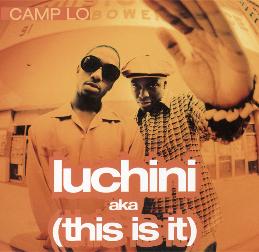
 In the mid-1990s, hip-hop was expanding in every direction at once. The grit of East Coast boom-bap, the glossy rise of Bad Boy, and the global takeover of West Coast G-funk all competed for attention. But every so often, a track would slip through the cracks that didn’t sound like anything else on the radio. It didn’t chase trends—it created its own atmosphere. That’s exactly what happened in 1997 when Camp Lo released “Luchini (This Is It),” a song that felt like it had been beamed in from another era entirely.
From the first seconds, “Luchini” announces itself with a sense of cool that’s almost untouchable. Built on a lush sample of Dynasty’s “Adventures in the Land of Music,” the track glides rather than hits. It’s smooth, jazzy, and unmistakably cinematic—like stepping into a velvet-lined time machine. And over that groove, Camp Lo doesn’t just rap—they float, delivering verses packed with slang so dense and inventive that it feels like a language all its own.
A Different Kind of Hip-Hop Duo
Camp Lo—comprised of Sonny Cheeba and Geechi Suede—weren’t interested in playing by the usual rules. While many of their contemporaries leaned into street realism or radio-friendly hooks, Camp Lo carved out a lane defined by abstraction, style, and nostalgia. Their debut album, Uptown Saturday Night, plays like a love letter to 1970s blaxploitation films, complete with references to hustlers, Cadillacs, and champagne-soaked escapism.
“Luchini” is the centerpiece of that vision. It’s not just a song—it’s a mood, a setting, a fully realized aesthetic. Listening to it feels like walking into a dimly lit lounge where the dress code is immaculate and the conversations are coded.
The Language of Luxury
One of the first things that strikes listeners about “Luchini” is its vocabulary. Camp Lo didn’t just write lyrics—they invented a dialect. Words twist and reshape themselves into something both familiar and alien. “Flamboyant for the spurts,” “sipping on bubbly,” “high rollers”—these phrases don’t just describe wealth; they embody it.
The title itself, “Luchini,” is slang for money, and the song revolves around the pursuit and enjoyment of it. But unlike many hip-hop tracks that focus on wealth as a symbol of power or survival, “Luchini” treats it as part of a broader lifestyle—a world of elegance, leisure, and indulgence.
Sonny Cheeba and Geechi Suede rap with a laid-back precision that perfectly matches the beat. There’s no urgency in their delivery, no need to prove anything. They sound like they’ve already arrived, already won. That confidence is infectious, pulling the listener into their orbit.
Ski Beatz and the Sound of Silk
Behind the boards, Ski Beatz deserves enormous credit for crafting one of the most distinctive beats of the decade. The sample from Dynasty is flipped into something hypnotic, with shimmering keys, crisp drums, and a bassline that feels like it’s gliding across polished marble floors.
Ski Beatz understood that less could be more. The production never overwhelms the vocals; instead, it creates space for them to breathe. Every element feels intentional, from the subtle percussion to the way the sample loops just enough to stay catchy without becoming repetitive.
The result is a track that feels timeless. It’s rooted in the past—drawing heavily from 1970s funk—but it doesn’t sound dated. Instead, it exists in a kind of sonic limbo, equally at home in 1997 or decades later.
A Cinematic Experience
Part of what makes “Luchini” so memorable is its cinematic quality. It doesn’t just sound like a movie—it feels like one. The imagery in the lyrics, combined with the lush production, creates a vivid sense of place.
That feeling is amplified in the music video, which leans heavily into the song’s retro aesthetic. Dressed in sharp suits and surrounded by vintage cars and glamorous settings, Camp Lo fully commits to their vision. It’s not ironic or tongue-in-cheek—it’s immersive. They’re not just referencing the past; they’re living in it.
At a time when many hip-hop videos focused on realism or spectacle, “Luchini” stood out for its stylization. It was less about documenting reality and more about creating a fantasy—a world where everything is smooth, stylish, and just a little bit untouchable.
The Hook That Floats
Unlike many hip-hop songs of its era, “Luchini” doesn’t rely on a traditional, hard-hitting chorus. Instead, its hook feels like an extension of the groove itself. “This is it, what”—the phrase repeats with a casual confidence, almost as if it’s being said in passing.
That understated approach works perfectly. The hook doesn’t demand attention; it invites it. It becomes part of the song’s overall texture, blending seamlessly with the beat and the verses.
This subtlety is part of what gives “Luchini” its staying power. It’s not trying to be the loudest track in the room—it’s the coolest one, the one that doesn’t need to raise its voice.
A Cult Classic That Endured
While “Luchini” wasn’t the biggest commercial hit of its time, it has proven remarkably durable. Over the years, it’s become a cult classic, beloved by hip-hop fans and crate diggers alike. Its influence can be heard in the work of artists who prioritize vibe and aesthetic over traditional song structure.
Tracks like They Reminisce Over You (T.R.O.Y.) and the catalog of A Tribe Called Quest share a similar emphasis on jazz-inflected production and laid-back lyricism, but “Luchini” takes that sensibility in a more stylized, almost surreal direction.
In the years since its release, the song has appeared in films, commercials, and countless playlists, each time introducing it to a new generation of listeners. And each time, it feels just as fresh as it did in 1997.
Why “Luchini” Still Hits
So what makes “Luchini (This Is It)” endure? Part of it is the production—smooth, elegant, and endlessly replayable. Part of it is the lyricism—dense, inventive, and full of personality. But more than anything, it’s the attitude.
“Luchini” doesn’t try to be everything to everyone. It knows exactly what it is and leans into it completely. That clarity gives it a kind of purity that’s rare in any genre.
In a musical landscape that often rewards immediacy and repetition, “Luchini” stands as a reminder that style matters—that the way something feels can be just as important as what it says. It’s a song that invites you to slow down, to sink into its groove, and to appreciate the details.
The Legacy of Effortless Cool
For Camp Lo, “Luchini” remains their defining moment—a track that encapsulates everything that made them unique. While they continued to release music, nothing quite captured the same lightning-in-a-bottle magic of this single.
And maybe that’s part of its charm. “Luchini” feels singular, like a snapshot of a specific moment when everything aligned perfectly. It’s not just a great hip-hop track—it’s a piece of art that exists in its own lane, untouched by trends or expectations.
Nearly three decades later, it still sounds like the coolest thing in the room. And in a genre built on evolution and reinvention, that kind of timelessness is its own form of currency.
Because in the end, “Luchini” isn’t just about money—it’s about the feeling of having it, of living in a world where everything is just a little smoother, a little sharper, a little more refined.
This is it.
This post has already been read 479 times!