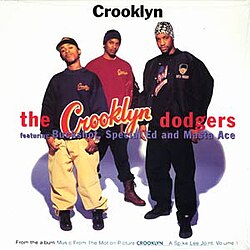
 In 1994, hip-hop was in the middle of one of its most fertile creative periods. The East Coast was reasserting itself with a renewed sense of purpose, grounded in lyricism, jazz-infused production, and vivid street narratives. It was a time when regional identity mattered—when where you were from shaped how you sounded, how you dressed, and how you told your story. Few songs capture that sense of place as vividly and authentically as “Crooklyn” by Crooklyn Dodgers.
Released as part of the soundtrack to Crooklyn, directed by Spike Lee, the track isn’t just a companion piece—it’s an extension of the film’s soul. Featuring verses from Buckshot, Masta Ace, and Special Ed, “Crooklyn” stands as a time capsule of Brooklyn life, filtered through the lens of three MCs who lived it, breathed it, and translated it into poetry.
A Sound Rooted in Memory
From the first notes, “Crooklyn” feels warm, almost nostalgic. The production—handled by Q-Tip of A Tribe Called Quest—leans heavily on a jazz sample that instantly sets the tone. It’s laid-back but purposeful, built on soft piano chords and a steady drum loop that feels like it’s been playing in the background of a summer afternoon for decades.
Q-Tip’s touch is unmistakable. Rather than crafting a beat that demands attention, he creates one that invites reflection. It’s the sonic equivalent of sitting on a stoop, watching the neighborhood go by. The music doesn’t rush—it breathes. And in that space, the lyrics have room to resonate.
The track’s warmth contrasts with the harder-edged sounds that were also defining the era. While artists like Wu-Tang Clan were delivering gritty, raw street narratives, “Crooklyn” opts for something more reflective. It’s not about confrontation—it’s about recollection.
Three Voices, One Borough
What makes “Crooklyn” especially powerful is how it brings together three distinct voices, each offering a different perspective on Brooklyn life.
Buckshot opens the track with a grounded, conversational style. As a member of Black Moon, he was already known for his no-nonsense delivery, and here he sets the tone with vivid snapshots of everyday life. His verse feels immediate, like he’s walking you through the neighborhood in real time.
Masta Ace follows with a more introspective approach. His verse is filled with detail—small, specific moments that add up to a larger picture. Ace has always had a gift for storytelling, and on “Crooklyn,” he uses it to paint a portrait of a community that’s both imperfect and deeply human.
Then there’s Special Ed, whose laid-back confidence provides the perfect closing note. Known for his smooth flow and charismatic presence, he brings a sense of ease to the track, tying together the themes introduced by the previous verses.
Together, the three MCs create a layered narrative that feels authentic and lived-in. They’re not trying to outdo each other—they’re contributing to a shared story.
The Meaning of “Crooklyn”
The title itself is a play on words. “Crooklyn” blends “crook” and “Brooklyn,” hinting at the borough’s rough edges while also reclaiming them. It’s an acknowledgment of the challenges and contradictions that define urban life.
But the song doesn’t dwell on negativity. Instead, it embraces the complexity of the environment. There’s pride in these verses—pride in the culture, the resilience, the sense of community that persists despite hardship.
Lines about block parties, neighborhood characters, and everyday routines create a vivid sense of place. You can almost hear the sounds of the street—the laughter, the arguments, the music drifting from open windows. It’s a world that feels alive, not romanticized but deeply appreciated.
A Perfect Companion to Film
Crooklyn is itself a deeply personal project for Spike Lee, drawing on his own childhood experiences growing up in Brooklyn. The film is less about plot and more about atmosphere—a series of moments that, taken together, create a portrait of a time and place.
The song “Crooklyn” mirrors that approach. Like the film, it doesn’t rely on a single narrative arc. Instead, it offers fragments—memories, observations, feelings—that combine to form something larger.
This synergy between music and film is part of what makes the track so enduring. It doesn’t just accompany the visuals; it enhances them, adding another layer of emotional depth.
A Snapshot of an Era
Listening to “Crooklyn” today feels like opening a time capsule. It captures a specific moment in hip-hop history, when the genre was deeply connected to its roots in storytelling and community.
The mid-1990s saw the rise of artists who prioritized lyricism and authenticity. Albums like Illmatic by Nas and Ready to Die by The Notorious B.I.G. were redefining what hip-hop could be—introspective, poetic, and deeply personal.
“Crooklyn” fits squarely within that tradition, but it also stands apart. Where many tracks of the era focused on individual perspective, this one feels communal. It’s not just one story—it’s many, woven together.
The Power of Simplicity
Part of the song’s brilliance lies in its simplicity. There’s no flashy hook, no elaborate structure. The beat loops, the verses unfold, and that’s it. But within that simplicity is a depth that rewards repeated listens.
Each time you hear it, new details emerge—a line you missed, a nuance in the delivery, a subtle shift in the beat. It’s the kind of song that grows with you, revealing more as you bring your own experiences to it.
That restraint is a testament to Q-Tip’s production and the MCs’ confidence. They don’t need to overcomplicate things. They trust the material.
Legacy and Influence
While “Crooklyn” may not have the same mainstream recognition as some of the era’s biggest hits, its impact is undeniable. It’s a touchstone for a certain kind of hip-hop—one that values storytelling, atmosphere, and authenticity over spectacle.
Artists in the years since have drawn on that blueprint, from underground MCs to more mainstream acts looking to reconnect with the genre’s roots. The idea that a song can be both specific and universal—that it can tell a local story while resonating globally—is something “Crooklyn” embodies perfectly.
Why It Still Matters
More than three decades after its release, “Crooklyn” remains as compelling as ever. In a musical landscape that often prioritizes immediacy and virality, it stands as a reminder of the power of patience and detail.
It doesn’t rush. It doesn’t shout. It simply exists, confident in its ability to connect with listeners who are willing to meet it on its terms.
For Crooklyn Dodgers, the song represents a unique moment—a collaboration that captured something real and lasting. It’s not just a piece of music; it’s a document, a snapshot, a love letter to a place and time.
And for listeners, it offers something rare: a chance to step into that world, to see it through the eyes of those who knew it best, and to feel—if only for a few minutes—what it was like to be there.
Because “Crooklyn” isn’t just about Brooklyn. It’s about memory, identity, and the stories that shape who we are. And those themes, like the song itself, never go out of style.
This post has already been read 438 times!