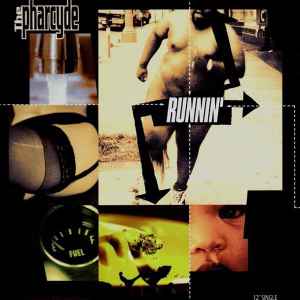
 By the mid-1990s, hip-hop had grown into a complex, multifaceted culture. The West Coast, in particular, was often associated with the polished grooves of G-funk and the stark narratives of gangsta rap. But not every voice from California fit that mold. Some artists were carving out a more introspective, experimental path—one that leaned into jazz influences, abstract storytelling, and emotional depth.
The Pharcyde had already established themselves as one of those groups with their debut Bizarre Ride II the Pharcyde, a project filled with humor, personality, and offbeat creativity. But when they returned in 1995 with Labcabincalifornia, they took a noticeably different turn. The energy was more subdued, the tone more reflective.
At the center of that shift was “Runnin’,” a track that would become not only their most iconic song, but one of the most quietly powerful statements in 90s hip-hop.
A Beat That Breathes and Drifts
“Runnin’” opens with a sample that immediately sets it apart: a smooth, airy loop drawn from Stan Getz’s jazz rendition of “Saudade Vem Correndo.” The production, handled by a then-emerging J Dilla (credited as Jay Dee), feels almost weightless.
There’s no heavy bassline dominating the mix. No aggressive drums demanding attention. Instead, the beat glides.
Soft percussion taps gently beneath the surface, while the melodic loop carries the song forward like a breeze. It creates a sense of motion without urgency—a feeling of drifting rather than driving.
This is crucial to the track’s identity.
The beat doesn’t push the listener. It invites them to float along, to get lost in the atmosphere. It’s introspective without being somber, relaxed without being empty.
In many ways, the production mirrors the song’s central theme: movement without resolution.
The Concept of Running Without Arrival
At its core, “Runnin’” is about escape—or more specifically, the illusion of escape.
The hook, simple and hypnotic, repeats the idea of running but never quite reaching a destination. It’s not framed as triumph or failure. It’s just a state of being.
This ambiguity is what gives the song its depth.
Each member of The Pharcyde approaches the concept from a slightly different angle, but the underlying theme remains consistent: no matter how far you go, you can’t fully outrun your problems, your past, or yourself.
It’s a message that resonates on multiple levels.
For some, it’s about relationships. For others, it’s about ambition, identity, or the pressures of life. The beauty of the song is that it doesn’t lock itself into a single interpretation.
It leaves space for the listener to fill in the gaps.
Verses That Feel Personal and Unfiltered
One of the defining characteristics of “Runnin’” is the honesty in its verses.
There’s no bravado here. No exaggerated personas. Instead, the members of The Pharcyde deliver lines that feel grounded in real experiences and emotions.
They reflect on struggles, frustrations, and the constant push-and-pull of trying to move forward while being held back by something unseen. The tone is conversational, almost confessional, as if they’re thinking out loud rather than performing.
This approach creates a sense of intimacy that draws the listener in.
You’re not just hearing a song—you’re being let into a mindset.
And because the delivery is so understated, the impact is even stronger. There’s no need for dramatic emphasis or elaborate wordplay. The truth speaks for itself.
J Dilla’s Subtle Genius
It’s impossible to talk about “Runnin’” without acknowledging the role of J Dilla.
At the time, he was still early in his career, but this track showcases the elements that would later define his legendary status: a deep understanding of rhythm, a love for jazz and soul, and an ability to create beats that feel alive.
The way he flips the Stan Getz sample is particularly notable. Instead of chopping it into something unrecognizable, he preserves its essence, allowing the natural flow of the melody to guide the track.
This decision gives “Runnin’” its timeless quality.
The beat doesn’t feel tied to a specific era. It exists in its own space, untouched by trends or expectations.
Dilla’s production doesn’t demand attention—it earns it quietly, through nuance and feel.
A Shift in The Pharcyde’s Identity
“Runnin’” also represents a significant evolution for The Pharcyde as a group.
Their debut album was known for its playful, almost comedic energy. Tracks like “Passin’ Me By” showed that they could balance humor with emotion, but there was still a sense of youthful exuberance.
With Labcabincalifornia, that energy gave way to something more mature and introspective.
“Runnin’” embodies that shift perfectly.
It’s not concerned with entertaining in the traditional sense. It’s more reflective, more subdued, more focused on mood and message than on immediate impact.
This change wasn’t universally embraced at the time, but it has aged remarkably well.
Looking back, it’s clear that The Pharcyde were ahead of their time, exploring sounds and themes that would become more prominent in later years.
The Music Video: A Visual Loop
The music video for “Runnin’,” directed by Spike Jonze, adds another layer to the song’s meaning.
In the video, the group appears to be running forward while the world around them moves in reverse. It’s a simple concept, but it perfectly captures the song’s central idea.
No matter how much effort is put into moving forward, there’s a sense that progress is being undone, that time and circumstances are pulling things back.
It’s a visual metaphor for the cycle of running without arriving.
The video’s understated creativity mirrors the song itself—thoughtful, unconventional, and quietly impactful.
A Different Kind of West Coast Sound
At a time when the West Coast was dominated by certain sonic and thematic trends, “Runnin’” stood apart.
It didn’t rely on the funk-driven bounce of G-funk or the intensity of gangsta narratives. Instead, it leaned into jazz influences, introspection, and subtlety.
This alternative approach helped broaden the perception of what West Coast hip-hop could be.
It showed that the region wasn’t defined by a single sound or style. There was room for experimentation, for vulnerability, for something softer and more reflective.
“Runnin’” became a key example of that diversity.
Enduring Influence and Legacy
Over time, “Runnin’” has grown in stature, becoming one of the most respected tracks of its era.
Its influence can be heard in the work of artists who prioritize mood, introspection, and musicality over aggression or spectacle. The blend of jazz-inspired production and honest lyricism has become a blueprint for a certain kind of hip-hop—one that values depth and atmosphere.
J Dilla’s production, in particular, has had a lasting impact, inspiring producers across genres to explore more organic, soulful approaches to beat-making.
And for listeners, the song continues to resonate because its message remains relevant.
The idea of running—of trying to escape something without fully understanding what it is—is a universal experience.
It doesn’t fade with time.
Conclusion: Motion Without Resolution
“Runnin’” is not a song that demands immediate attention. It doesn’t shout. It doesn’t overwhelm. Instead, it lingers.
It’s the kind of track that reveals more with each listen, its meaning unfolding gradually as you sit with it.
Through its airy production, honest lyricism, and understated delivery, it captures a feeling that is both specific and universal—the sense of moving forward without ever quite arriving.
In a genre often defined by bold statements and definitive conclusions, “Runnin’” offers something different.
It embraces uncertainty.
And in doing so, it creates something timeless.
Because sometimes, the journey isn’t about where you’re going.
Sometimes, it’s about understanding why you’re still running.
This post has already been read 122 times!