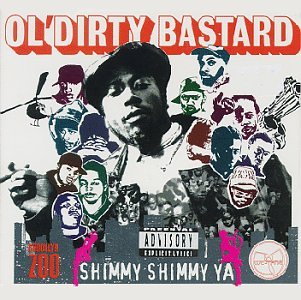
 In the sprawling mythology of the Wu-Tang Clan, each member carved out a distinct identity. There was the cerebral sharpness of the GZA, the streetwise authority of Raekwon, the rugged charisma of Method Man. But then there was Ol’ Dirty Bastard—Russell Jones—a force of nature who seemed to exist entirely outside the rules that governed everyone else.
When “Shimmy Shimmy Ya” dropped in 1995 as the lead single from his debut album Return to the 36 Chambers: The Dirty Version, it didn’t just introduce a solo artist. It unleashed a personality so raw, chaotic, and unpredictable that it redefined what an MC could be.
This wasn’t polished lyricism. This wasn’t radio-friendly structure. This was something else entirely—unfiltered expression, delivered with wild energy and bizarre brilliance.
And somehow, it worked perfectly.
A Beat That Leaves Space for Madness
Produced by RZA, the track’s instrumental is deceptively simple. Built around a skeletal piano loop, dusty drums, and just enough bounce to keep it moving, the beat feels almost unfinished at first listen.
But that minimalism is intentional.
The production leaves wide open space for Ol’ Dirty Bastard to fill—and he fills it in ways no one else could. Where other rappers might have treated the beat as a foundation for tight, structured verses, ODB treats it like a playground.
The piano loop itself has a strange, off-kilter feel, almost like a warped nursery rhyme. It’s catchy, but slightly unsettling. That tension becomes the perfect backdrop for ODB’s unpredictable delivery.
RZA understood exactly what he was doing. Instead of trying to contain ODB, he built a beat that let him run free.
A Voice Like No Other
From the moment ODB begins, it’s clear this isn’t going to be a conventional performance.
“Shimmy shimmy ya, shimmy yam, shimmy yay…”
The opening chant is instantly memorable, drawing loosely from old-school hip-hop cadences while twisting them into something uniquely his own. It’s playful, almost childlike—but there’s an edge to it, a sense that anything could happen next.
And then the verse hits.
ODB’s voice shifts, bends, cracks, and explodes. He doesn’t just rap—he yells, sings, mumbles, and improvises, often within the same bar. His delivery feels spontaneous, like he’s discovering the song as he goes.
There’s a looseness to his flow that defies traditional rhythm, yet somehow stays locked into the beat. It’s chaotic, but never completely out of control.
That’s the genius of Ol’ Dirty Bastard. What sounds messy on the surface reveals a deeper instinct for timing and energy.
Lyrics That Break Every Rule
If you’re looking for tightly structured storytelling or intricate wordplay, “Shimmy Shimmy Ya” might seem like an outlier. ODB isn’t concerned with linear narratives or conventional punchlines.
Instead, his lyrics feel like a stream of consciousness—random, absurd, and often hilarious.
He jumps from topic to topic with no warning, delivering lines that range from braggadocious to nonsensical to oddly profound. One moment he’s asserting his dominance as an MC, the next he’s referencing food, sex, or something completely unexpected.
It shouldn’t work.
But it does.
Because the appeal isn’t in the logic—it’s in the personality. Every line feels authentic to ODB’s character. He’s not trying to fit into any mold; he’s creating his own.
And in doing so, he challenges the very idea of what “good” lyricism is supposed to be.
The Return of Old-School Spirit
Despite its wild unpredictability, “Shimmy Shimmy Ya” is deeply rooted in hip-hop tradition.
The chant-like hook, the playful energy, the call-and-response feel—it all harkens back to the early days of hip-hop, when MCing was as much about entertaining the crowd as it was about lyrical skill.
ODB channels that old-school spirit but filters it through his own unorthodox lens. It’s as if he’s taking the foundation laid by pioneers and reinterpreting it in real time, without any concern for expectations.
In an era when hip-hop was becoming increasingly polished and competitive, “Shimmy Shimmy Ya” felt like a reminder of the genre’s raw, unfiltered origins.
It brought the fun back—but in a way that was completely unpredictable.
The Anti-MC Persona
One of the most fascinating aspects of Ol’ Dirty Bastard is how he positioned himself within hip-hop.
While many MCs strive for perfection—tight flows, complex rhymes, carefully crafted images—ODB does the opposite. He embraces imperfection. He leans into chaos. He presents himself as unpredictable, even unstable.
But this isn’t a lack of skill.
It’s a deliberate rejection of convention.
ODB’s “anti-MC” persona challenges listeners to rethink their expectations. He proves that charisma, originality, and energy can be just as compelling as technical precision.
In fact, his refusal to conform is what makes him stand out.
“Shimmy Shimmy Ya” is the purest expression of that philosophy.
Humor, Shock, and Unpredictability
Part of what makes the track so memorable is its sense of humor. ODB doesn’t take himself too seriously, and that playfulness comes through in every line.
At the same time, there’s an element of shock value. You never quite know what he’s going to say next, and that unpredictability keeps listeners engaged.
It’s a delicate balance. Too much randomness, and the song could fall apart. But ODB maintains just enough control to keep everything cohesive.
The result is a track that feels alive—constantly shifting, constantly surprising.
A Breakout Moment
As the lead single from Return to the 36 Chambers, “Shimmy Shimmy Ya” served as the world’s introduction to Ol’ Dirty Bastard as a solo artist.
And what an introduction it was.
While the Wu-Tang Clan had already established themselves as a dominant force in hip-hop, ODB’s solo work revealed a completely different side of the group’s creative spectrum.
Where other members leaned into gritty realism or lyrical complexity, ODB brought chaos and personality.
The song’s success proved that there was room in hip-hop for something unconventional—something that didn’t fit neatly into existing categories.
It also solidified ODB as one of the most unique voices in the genre.
Cultural Impact and Influence
Over the years, “Shimmy Shimmy Ya” has become more than just a song—it’s a cultural touchstone.
The hook alone has been referenced, sampled, and quoted countless times. Its infectious energy makes it instantly recognizable, even to those who may not be familiar with ODB’s broader catalog.
But beyond its surface appeal, the track’s influence runs deeper.
ODB’s willingness to break rules and embrace individuality has inspired generations of artists. His approach opened the door for more experimental, personality-driven styles in hip-hop.
Artists who prioritize vibe, character, and originality over technical perfection owe something to ODB’s blueprint.
He showed that being different isn’t a weakness—it’s a strength.
The Legacy of Ol’ Dirty Bastard
Looking back, “Shimmy Shimmy Ya” stands as one of the defining moments of Ol’ Dirty Bastard’s career.
It captures everything that made him special: his unpredictability, his humor, his raw energy, and his refusal to conform.
But it also serves as a reminder of what hip-hop can be at its most unfiltered.
ODB wasn’t trying to be the best in a traditional sense. He was trying to be himself—completely and unapologetically.
And that authenticity is what continues to resonate.
Conclusion: Chaos as Art
“Shimmy Shimmy Ya” isn’t a song you analyze in the traditional sense. It’s a song you experience.
It’s messy, loud, strange, and completely unforgettable.
Through its minimalist production, unpredictable delivery, and larger-than-life personality, the track captures a moment when hip-hop felt limitless—when there were no rules, only possibilities.
Ol’ Dirty Bastard didn’t just push boundaries—he ignored them entirely.
And in doing so, he created something that still feels fresh, still feels exciting, and still feels unlike anything else.
Because sometimes, the most powerful art doesn’t come from control.
Sometimes, it comes from letting go.
And no one embodied that better than Ol’ Dirty Bastard.
This post has already been read 605 times!