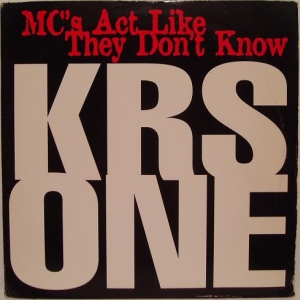
 In 1995, hip-hop stood at a crossroads. The genre had already exploded into the mainstream, with platinum records, MTV dominance, and larger-than-life personalities reshaping what it meant to be an MC. But amid the glitz, something deeper was beginning to fade—the foundational principles that built the culture in the first place. Into that moment stepped KRS-One with “MCs Act Like They Don’t Know,” a track that wasn’t just a song—it was a warning, a lecture, and a battle cry rolled into one.
Released on KRS-One, his second solo album after the dissolution of Boogie Down Productions, the track feels like a direct transmission from hip-hop’s original philosophy. It’s raw, stripped-down, and confrontational in a way that demands attention. Where many artists of the mid-90s were leaning into polished production and crossover appeal, KRS-One went the opposite direction. He doubled down on authenticity.
And in doing so, he created one of the most powerful statements about the role of the MC ever recorded.
A Beat That Leaves No Place to Hide
From the moment the track begins, its production sets the tone. DJ Premier, one of the most respected producers in hip-hop history, crafts a minimalist yet hard-hitting backdrop. The beat is built around a loop that feels almost skeletal—tight drums, a gritty bassline, and sharp scratches that cut through the mix like a blade.
There’s no excess here. No glossy sheen. No distraction.
This is intentional.
The stripped-down production forces the listener to focus on what matters most: the lyrics. In an era when production was becoming increasingly layered and commercial, Premier’s approach feels almost defiant. It’s as if the beat itself is saying, “Pay attention. This is important.”
And KRS-One rises to that challenge immediately.
The Voice of Authority
KRS-One doesn’t ease into the track. He storms in with confidence, delivering lines with the authority of someone who has nothing left to prove but everything left to say. His voice carries a weight that few MCs can match—equal parts teacher, battle rapper, and philosopher.
“MCs act like they don’t know…”
The hook is simple, but it hits like a hammer. It’s not just catchy—it’s accusatory. It calls out an entire generation of rappers who, in KRS-One’s view, had lost sight of what it meant to be an MC.
For KRS, being an MC isn’t about fame, money, or chart positions. It’s about skill. It’s about knowledge. It’s about representing the culture with integrity.
And throughout the song, he makes it clear that too many artists had abandoned those principles.
A Direct Challenge to the Industry
One of the most striking aspects of “MCs Act Like They Don’t Know” is how unapologetically confrontational it is. KRS-One isn’t speaking in vague generalities—he’s calling people out.
While he doesn’t always name names explicitly, the targets are obvious: commercial rappers, trend-chasers, and anyone who prioritizes image over substance. His critique isn’t rooted in jealousy or bitterness—it’s rooted in frustration.
To KRS-One, hip-hop is more than entertainment. It’s a cultural movement with a history, a purpose, and a responsibility. And when artists ignore that, they’re not just making bad music—they’re disrespecting the culture itself.
Lines throughout the track reinforce this idea. He challenges MCs to step up lyrically, to sharpen their skills, and to remember the foundations of the art form. There’s an almost pedagogical tone to his delivery, as if he’s teaching a class—and the entire rap industry is his student body.
The Teacher Returns
By 1995, KRS-One had long been known as “The Teacher,” a nickname that reflected his commitment to education and consciousness in hip-hop. With Boogie Down Productions, he had already tackled topics ranging from street violence to black empowerment to the very definition of hip-hop itself.
“MCs Act Like They Don’t Know” continues that tradition, but with a sharper edge.
This isn’t just education—it’s correction.
KRS-One positions himself as a guardian of the culture, someone who has seen its evolution and refuses to let it lose its way. There’s a sense of urgency in his delivery, as if he knows that hip-hop is at risk of forgetting its roots.
And in many ways, he’s right.
The mid-90s were a period of rapid change for hip-hop. The genre was becoming more commercial, more global, and more diverse. While this growth brought new opportunities, it also brought new challenges. The balance between authenticity and accessibility was becoming harder to maintain.
KRS-One’s response was to double down on authenticity.
Lyrical Precision and Battle Energy
Beyond its message, “MCs Act Like They Don’t Know” is also a masterclass in lyricism. KRS-One’s flow is tight, controlled, and relentless. He switches cadences effortlessly, maintaining a rhythm that feels both natural and commanding.
There’s a battle rap energy throughout the track—a sense that every line is meant to outdo the last. This isn’t just a lecture; it’s a demonstration. KRS-One isn’t just telling MCs to step their game up—he’s showing them how it’s done.
His wordplay is sharp, his metaphors are effective, and his delivery is impeccable. Every bar feels deliberate, crafted to hit with maximum impact. It’s the kind of performance that reminds listeners why KRS-One is considered one of the greatest MCs of all time.
The Role of DJ Premier
While KRS-One dominates the track lyrically, DJ Premier’s contribution cannot be overstated. His production provides the perfect canvas for KRS-One’s message.
Premier’s signature style—crisp drums, chopped samples, and expertly placed scratches—creates a sound that is both timeless and unmistakably rooted in hip-hop’s golden era. The scratches, in particular, add an extra layer of texture, reinforcing the track’s connection to DJ culture.
In many ways, the production embodies the very principles KRS-One is advocating for. It’s authentic, skillful, and deeply connected to hip-hop’s roots.
Together, KRS-One and DJ Premier create a synergy that elevates the track to another level.
A Snapshot of Hip-Hop’s Identity Crisis
Listening to “MCs Act Like They Don’t Know” today, it’s impossible not to view it as a snapshot of a pivotal moment in hip-hop history. The song captures a time when the genre was grappling with its own identity—caught between its underground origins and its mainstream success.
KRS-One’s perspective represents one side of that tension: the purist view that hip-hop must remain true to its roots. While other artists were pushing the boundaries of what hip-hop could be, KRS-One was focused on preserving what it already was.
This tension is part of what makes the song so compelling. It’s not just a critique—it’s a conversation. It raises questions about authenticity, evolution, and the responsibilities of artists within a cultural movement.
And those questions are still relevant today.
Enduring Relevance
More than 25 years after its release, “MCs Act Like They Don’t Know” still resonates. In fact, it may be even more relevant now than it was in 1995.
Hip-hop has continued to evolve, expanding into new sounds, styles, and global markets. But with that evolution has come ongoing debates about authenticity, skill, and the essence of the culture.
KRS-One’s message—that MCs should respect the craft and understand the culture—remains a powerful reminder.
In an era dominated by streaming numbers, viral moments, and social media presence, the questions he raises feel as urgent as ever. What does it mean to be an MC? What responsibilities come with that title? And how do artists balance innovation with respect for tradition?
“MCs Act Like They Don’t Know” doesn’t provide easy answers, but it forces listeners to confront those questions.
Legacy of the Track
Within KRS-One’s catalog, “MCs Act Like They Don’t Know” stands as one of his defining solo moments. It encapsulates everything that makes him unique: his intelligence, his passion, his lyrical skill, and his unwavering commitment to hip-hop.
The track also serves as a benchmark for what a hip-hop record can be. It’s not just about entertainment—it’s about expression, education, and engagement with the culture.
Over the years, countless MCs have been influenced by KRS-One’s approach, whether directly or indirectly. His emphasis on lyricism and authenticity has left a lasting imprint on the genre.
And this song, in particular, remains a touchstone for those values.
Conclusion: A Lesson That Still Echoes
“MCs Act Like They Don’t Know” is more than a song—it’s a statement of purpose. It’s KRS-One standing at the forefront of a changing culture, refusing to let it lose sight of its origins.
With a minimalist beat, razor-sharp lyrics, and an unrelenting sense of conviction, he delivers a message that cuts through time. It’s a reminder that hip-hop is not just a genre—it’s a culture built on skill, knowledge, and authenticity.
And for those willing to listen, the lesson is clear.
Act like you know.
This post has already been read 2102 times!