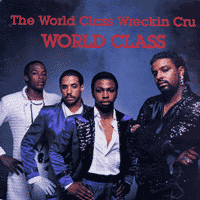
 World Class Wreckin’ Cru is a seminal West Coast hip-hop group whose influence stretches far beyond their initial club hits in the 1980s. While often remembered as the early crew that helped launch the careers of Dr. Dre and DJ Yella, the group deserves recognition in its own right as pioneers of electro-rap, West Coast funk, and the visual style that would define the Los Angeles hip-hop scene. Combining smooth production, flashy aesthetic, and a penchant for both party tracks and streetwise themes, World Class Wreckin’ Cru laid the foundation for much of what would later define West Coast rap, bridging the gap between dance-floor electro-funk and the emerging gangsta rap sound of the late 1980s and early 1990s.
Formed in the early 1980s in Compton, California, World Class Wreckin’ Cru was spearheaded by Antoine “DJ Yella” Carraby and Andre “Dr. Dre” Young, who were both students of the vibrant Los Angeles DJ scene. The group initially started as a collective of DJs and MCs experimenting with new electronic equipment and drum machines, embracing the era’s fascination with the Roland TR-808, synthesizers, and sequenced beats. At the time, hip-hop on the West Coast was still finding its identity, often overshadowed by the dominance of East Coast artists in New York. World Class Wreckin’ Cru’s approach was innovative: they fused funk grooves with electronic textures and rapped over these beats, creating a sound that was both danceable and futuristic.
The group’s early recordings reflected the club culture of Los Angeles in the early 1980s. Tracks like “Surgery” and “Juice” showcased their love of electro-funk, featuring syncopated drum machine patterns, shimmering synthesizer lines, and catchy hooks. Their music was heavily influenced by the electro movement, particularly artists like Afrika Bambaataa and Egyptian Lover, but the Wreckin’ Cru infused a West Coast flavor with laid-back rhythms and funk-inspired basslines. This combination of rhythm, melody, and style helped them stand out in a crowded Los Angeles club scene, earning them a devoted following at parties and underground dance events.
What made World Class Wreckin’ Cru particularly distinctive was their embrace of style and visual presentation. The group was known for their flamboyant fashion, including sequined jackets, shiny suits, and theatrical hairstyles. This glamorous, flashy aesthetic—sometimes referred to as the “glam rap” style—set them apart from the more street-focused image of later West Coast artists. While some critics derided their look as overly polished, it represented a bold, confident statement of individuality and showmanship, demonstrating that hip-hop could be fun, stylish, and performance-driven, not just gritty or confrontational.
One of the group’s most notable releases was the 1986 album World Class, which featured singles like “Surgery” and “Cabbage Patch.” These tracks highlighted both Dr. Dre and DJ Yella’s production talents, blending drum machine-driven grooves with smooth, layered synths. The lyrical content leaned heavily toward party themes, dance instructions, and playful braggadocio, reflecting the group’s roots in Los Angeles club culture. While not overtly political or socially conscious, the tracks provided an essential soundtrack to the nightlife of Southern California and helped establish the West Coast as a viable force in hip-hop, alongside the more established East Coast scene.
World Class Wreckin’ Cru’s music was also innovative in its technical execution. Dr. Dre and DJ Yella demonstrated a mastery of studio technology that would later become legendary. Their ability to manipulate drum machines, synths, and sequencing allowed them to create tracks with precision, polish, and a futuristic sound that stood out from the rawer recordings of many early hip-hop acts. These technical skills foreshadowed the production brilliance that Dr. Dre would later bring to N.W.A., Snoop Dogg, and countless other artists. In this sense, the Wreckin’ Cru served as a training ground for some of hip-hop’s most influential producers.
Despite their focus on party tracks and electro-funk, World Class Wreckin’ Cru also experimented with more narrative and romantic themes. Songs like “Turn Off the Lights” displayed a surprising level of musicality and sophistication, combining smooth grooves with melodic vocals and playful yet intimate lyrics. This track, in particular, became one of their best-known songs and exemplified the group’s versatility. They were able to move effortlessly between high-energy club tracks and slower, more sensual grooves, appealing to a broad audience and demonstrating that hip-hop could encompass multiple moods and textures.
The group’s legacy is inseparable from its members’ later accomplishments. Dr. Dre and DJ Yella would go on to form N.W.A., creating the blueprint for gangsta rap and fundamentally reshaping hip-hop culture. While N.W.A. focused on street narratives, political commentary, and raw aggression, the Wreckin’ Cru showcased the duo’s early experimentation with sound, rhythm, and studio craft. Listening to World Class Wreckin’ Cru’s recordings today, it’s clear that the production techniques, beat layering, and attention to sonic detail foreshadowed the innovations that Dre and Yella would bring to rap music in the years to come.
The group’s influence also extends to the broader West Coast electro and dance scenes. By blending hip-hop with club-ready beats and synth-driven arrangements, World Class Wreckin’ Cru helped establish Los Angeles as a hub for electronic experimentation within rap music. DJs, producers, and MCs in the region drew inspiration from their approach, creating tracks that were both rhythmically inventive and accessible to club audiences. In this sense, the Wreckin’ Cru contributed to the development of a uniquely West Coast sound that balanced funk, electronic innovation, and hip-hop lyricism.
While their commercial success was limited compared to later acts, the cultural impact of World Class Wreckin’ Cru is undeniable. They helped put Los Angeles on the hip-hop map, introduced production techniques that would become industry standards, and demonstrated that style, musicality, and performance could coexist with lyricism and street credibility. They were also early adopters of music videos as a promotional tool, crafting visual presentations that emphasized both fashion and performance, helping to shape the emerging visual language of West Coast hip-hop.
Ultimately, World Class Wreckin’ Cru’s significance lies in their innovation, versatility, and foundational role in West Coast hip-hop. Their recordings capture a moment in time when electro-funk and rap were intersecting, and when the Los Angeles scene was experimenting with sound, style, and production techniques that would later dominate mainstream hip-hop. The group’s work serves as a reminder that hip-hop’s evolution was not only about lyrical content but also about production, aesthetic presentation, and the creative integration of multiple musical influences.
In conclusion, World Class Wreckin’ Cru stands as a vital chapter in the history of hip-hop. From their beginnings in Compton to their pioneering electro-funk recordings, they demonstrated that innovation, style, and technical mastery could coexist in the hip-hop realm. While Dr. Dre and DJ Yella would go on to achieve global fame through N.W.A., the Wreckin’ Cru laid the groundwork, showcasing their early brilliance and creative vision. Their influence can be heard in the evolution of West Coast rap, the integration of electronic sounds in hip-hop, and the continued appreciation for smooth, polished production. For fans and scholars of the genre, World Class Wreckin’ Cru represents the perfect blend of experimentation, musicality, and cultural significance—a group whose contributions deserve recognition alongside the more celebrated acts of their era.
This post has already been read 1066 times!