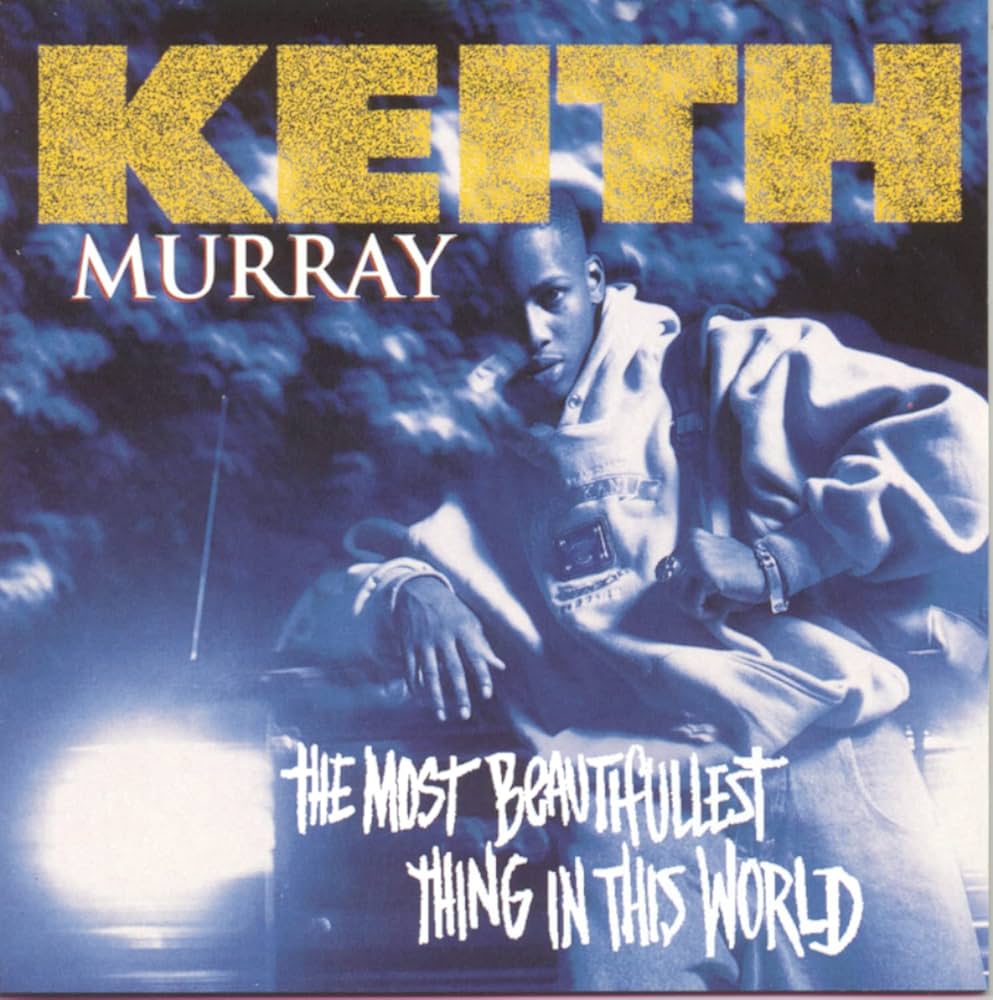
 Before hip-hop became obsessed with hooks engineered for streaming playlists, before minimalism dominated production trends, there was a moment when pure lyrical dexterity was the headline attraction. In that space—wild, unpredictable, and gloriously technical—stood Keith Murray with a debut single that felt like a verbal tornado.
That single was “The Most Beautifullest Thing in This World.”
The album of the same name, The Most Beautifullest Thing in This World, followed soon after.
The title alone signaled something different. Misspelled. Playful. Slightly absurd. It wasn’t polished or corporate. It was eccentric. And that eccentricity became the foundation of Murray’s identity—an MC who thrived on twisting language until it sounded like it might snap.
More than just a breakout track, “The Most Beautifullest Thing in This World” is a showcase of lyrical elasticity, Long Island grit, and the competitive spirit that defined mid-’90s East Coast hip-hop.
The Arrival of a Verbal Contortionist
Keith Murray didn’t ease his way into the rap landscape—he erupted into it.
Emerging from the Def Squad camp alongside artists like Erick Sermon and Redman, Murray quickly established himself as the crew’s most unpredictable lyricist. Where Sermon was smooth and measured, and Redman was charismatic and humorous, Murray was frenetic and cerebral.
“The Most Beautifullest Thing in This World” functions as his manifesto. It’s not built around a traditional narrative. There’s no emotional arc or autobiographical confessional. Instead, the track is a lyrical exhibition—an athlete stretching every muscle of the English language.
From the opening bars, Murray bends syntax, stacks multi-syllabic rhymes, and ricochets between ideas at dizzying speed. It feels less like listening to a rap song and more like watching a freestyle battle in fast-forward.
Production: Funk with an Edge
The beat, produced by Erick Sermon, draws from the thick, rubbery basslines and dusty drums that defined the Def Squad sound. It’s funky but not soft. There’s bounce, but there’s also grit.
The instrumental leaves room for Murray’s voice to dominate. The bassline grooves steadily while the drums knock with unpolished force. It’s not flashy. It doesn’t need to be.
What makes the production work is its restraint. Sermon understands that the main event is Murray’s flow. The beat provides a foundation sturdy enough to handle the lyrical gymnastics happening on top of it.
Organized Chaos
If you tried to diagram Murray’s rhyme schemes on this track, you’d need a whiteboard.
He strings together internal rhymes, near rhymes, and unexpected word pairings with relentless intensity. Lines don’t just end with rhymes—they contain multiple layers of them. Consonants snap against each other. Syllables cascade.
Yet somehow, it doesn’t feel forced.
There’s a looseness to Murray’s delivery that keeps the complexity from sounding academic. He sounds excited—almost amused—by how far he can stretch language.
That sense of playful aggression is key. “The Most Beautifullest Thing in This World” isn’t angry. It’s competitive. It’s an MC stepping into the ring and daring anyone to keep up.
Long Island’s Distinct Flavor
While New York City’s five boroughs often dominate hip-hop’s historical narrative, Long Island carved out its own legacy. Artists from the region carried a slightly different energy—less about street reportage, more about lyrical exhibitionism and funk-driven beats.
Keith Murray embodies that distinction.
There’s grit in his voice, but it’s paired with intellectual curiosity. He references science, philosophy, and wordplay with equal enthusiasm. His style feels unrestrained, as if the studio walls barely contain him.
This approach aligns him with fellow Def Squad member Redman, whose own unpredictable delivery reshaped expectations of East Coast rap. But Murray’s energy leans more cerebral—less comedic, more intense.
The Hook That Isn’t a Hook
Like many mid-’90s East Coast tracks, “The Most Beautifullest Thing in This World” doesn’t rely on a sugary chorus. The title phrase functions as a recurring motif, but it’s not sung or heavily melodic.
Instead, the hook feels like a declaration—a stamp of identity.
The unusual spelling of “Beautifullest” reinforces the track’s refusal to conform. It’s grammatically incorrect on purpose. It challenges linguistic rules the same way Murray challenges rhythmic norms.
The title itself becomes a metaphor: beauty doesn’t have to be conventional to be powerful.
The Competitive Spirit of the Era
Hip-hop in the mid-’90s was fiercely competitive. MCs measured themselves by lyrical prowess. Battle culture thrived. Wordplay mattered deeply.
In that environment, “The Most Beautifullest Thing in This World” felt like a gauntlet thrown down.
Where artists like Nas leaned into vivid street storytelling and The Notorious B.I.G. mastered smooth narrative flow, Keith Murray chose density and velocity.
His style wasn’t about painting cinematic scenes. It was about overwhelming the listener with sheer verbal firepower.
And for hip-hop purists, that was intoxicating.
Controlled Intensity
Despite the apparent chaos of his rhymes, Murray’s flow is tightly controlled. He lands precisely on the beat, weaving through rhythm without tripping over himself.
That balance—wild language paired with rhythmic discipline—is what elevates the track beyond novelty. Anyone can rap fast. Few can rap complex and still stay locked into the pocket.
Murray makes it sound effortless.
His voice carries a sharp, slightly nasal edge that cuts through the mix. There’s urgency in his tone, but it never becomes shrill. Instead, it feels focused—like a scientist conducting experiments with sound.
Impact and Legacy
While Keith Murray never achieved the commercial dominance of some of his contemporaries, “The Most Beautifullest Thing in This World” secured his place in hip-hop’s technical pantheon.
The track influenced a generation of lyricists who valued complexity over catchiness. It reminded MCs that experimentation could coexist with funk-driven production.
It also reinforced the Def Squad’s reputation as a powerhouse collective. Alongside Erick Sermon and Redman, Murray helped define a sound that was both playful and aggressive, intellectual and street-savvy.
The song remains a favorite among hip-hop heads who appreciate lyrical craftsmanship.
Listening Today
Hearing “The Most Beautifullest Thing in This World” now feels like stepping into a different era of rap—one where attention spans were longer and audiences leaned in to decode bars.
In today’s streaming landscape, where brevity often wins, Murray’s dense verses feel almost rebellious.
But that’s part of the charm.
The track rewards repeat listens. Each spin reveals another rhyme pattern, another clever twist of phrase. It invites analysis without demanding it.
And in that way, it remains timeless—not because it conforms to current trends, but because it refuses to.
Why It Endures
The song endures for a simple reason: authenticity.
Keith Murray sounds like no one else on this track. His cadence, vocabulary, and energy form a distinct fingerprint. There’s no chasing radio formulas. No pandering.
It’s pure expression.
“The Most Beautifullest Thing in This World” captures a moment when hip-hop celebrated individuality at its loudest. It reminds us that beauty—in art, in language, in music—often lives in imperfection.
The misspelling in the title isn’t a mistake. It’s a statement.
Final Reflection
“The Most Beautifullest Thing in This World” isn’t about love. It isn’t about wealth. It isn’t about trauma or triumph.
It’s about mastery.
It’s about pushing language to its limits and daring it to keep up. It’s about rhythm as playground and battleground at the same time.
Keith Murray stepped into the rap arena with this track and announced himself as a lyrical technician unafraid of complexity. The song stands as a testament to an era when wordplay ruled and individuality thrived.
In a world that often chases the simplest hook, there’s something refreshing about a track that demands your attention and refuses to simplify itself.
That refusal—that stubborn, creative defiance—might just be the most beautifullest thing of all.
This post has already been read 185 times!