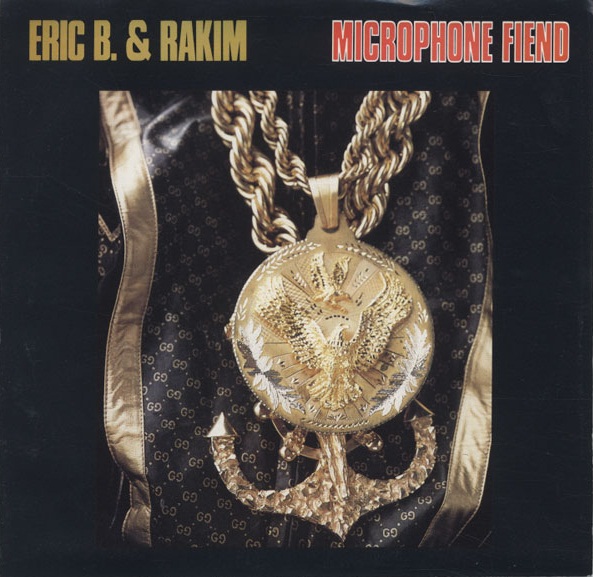
 In the pantheon of classic hip-hop tracks, few songs capture the art of lyrical obsession and musical minimalism quite like Eric B. & Rakim’s Microphone Fiend. Released in 1988 on their seminal second album, Follow the Leader, the track is a masterclass in precision, flow, and attitude, distilling the duo’s immense talents into a sharp, addictive three-and-a-half-minute burst of raw energy. It’s a song that defines not just the era, but also the concept of being possessed by the craft of rapping — a literal “fiend” for the microphone.
From the opening bassline, Microphone Fiend announces itself as something special. Eric B.’s production is deceptively simple, built around a looping sample from Average White Band’s 1975 track “School Boy Crush.” That minimalist groove forms the foundation for Rakim’s intricate wordplay, a combination that makes the song feel both hypnotic and urgent. Unlike some contemporaneous tracks, which leaned on flashy instrumentation or gimmicks, this song is lean, taut, and focused entirely on the interaction between beat and rhyme. The instrumental is a perfect canvas for Rakim’s virtuosity — a groove that is hypnotic enough to draw the listener in while leaving plenty of space for his verbal acrobatics to shine.
Rakim’s delivery on Microphone Fiend is nothing short of revolutionary. By 1988, he had already established himself as one of hip-hop’s most technically proficient lyricists, and this track solidified his reputation. Unlike the staccato, punchy rhythms of many early MCs, Rakim’s flow is smooth, measured, and deceptively effortless. He rides the beat with an internal logic, dropping multisyllabic rhymes and complex internal schemes that sound natural rather than forced. Lines like “I was a fiend before I became a teen / I melted microphones instead of cones of ice cream” demonstrate his ability to blend humor, clever wordplay, and streetwise braggadocio without ever sounding strained.
The lyrics of Microphone Fiend read like a declaration of absolute dedication. Rakim compares his addiction to the microphone with an actual fiend’s craving, turning his craft into a metaphor for obsession. It’s not about material wealth or flashy fame; it’s about mastery and the compulsion to create. This was an era when hip-hop was rapidly evolving, moving from party anthems to complex expressions of skill, and Rakim exemplifies that transformation. His words convey intensity without arrogance, technical mastery without self-indulgence. The listener understands immediately that the artist isn’t playing — he is consumed by his art.
Eric B.’s production complements this lyrical intensity perfectly. By anchoring the song in a repetitive yet irresistible loop, he creates a sense of inevitability. The beat is sparse enough that nothing distracts from Rakim’s words, but rich enough in texture to remain engaging throughout. The bass line and drum sample lock into a hypnotic groove, giving the track a forward momentum that mirrors the unstoppable energy of Rakim’s performance. The combination of simplicity and sophistication in the production is emblematic of what made Eric B. & Rakim groundbreaking as a duo: every element serves the music, every sound has purpose, and every beat elevates the rhymes rather than competing with them.
Another striking aspect of Microphone Fiend is its pacing and structure. The song opens immediately, with no extraneous intro or gimmick. The sample loops, the drums hit, and Rakim’s first verse sets the tone: precise, confident, and unrelenting. He moves seamlessly between couplets, internal rhymes, and double entendres, creating a flow that is technically dazzling but easy to follow. By the second verse, the song has already established its hypnotic rhythm, allowing the listener to become immersed in Rakim’s lyrical world. It’s a perfect example of form following function — the production and lyrics are interlocked so tightly that the track feels inevitable, like it had to exist exactly as it does.
The influence of Microphone Fiend on hip-hop cannot be overstated. Rakim’s technical innovations — his internal rhymes, his smooth, laid-back flow, and his ability to manipulate rhythm and cadence — became a template for future generations of MCs. Many of today’s top lyricists cite Rakim as a major influence, and it’s easy to see why in this track. The song’s combination of simplicity in production and complexity in lyricism proved that hip-hop could be sophisticated, cerebral, and still irresistibly catchy. It shifted the expectations for what an MC could accomplish, showing that lyrical obsession and dedication could itself be a subject for a compelling song.
The song also highlights the chemistry between Eric B. and Rakim, one of the most celebrated partnerships in hip-hop history. While Rakim’s voice carries the narrative, Eric B.’s production provides both foundation and accent. The looping sample isn’t just a backdrop; it’s a pulse that drives the track forward, providing continuity and reinforcing the thematic concept of addiction and repetition. This partnership set a high standard for producer-MC dynamics, showing that the best hip-hop songs arise when both elements — beat and lyric — are in perfect harmony.
What’s remarkable about Microphone Fiend is how well it has aged. While the sonic textures of the late 1980s are present — the drum machines, the sampled breakbeats — they never feel dated or gimmicky. The track is timeless because the core of the song is its obsession, its narrative, and its performance. Modern listeners can still feel the urgency, the energy, and the brilliance of Rakim’s delivery without needing nostalgia to carry it. In that sense, it’s a song that transcends era, showcasing the universal power of a masterful MC over a compelling beat.
Lyrically, the song is also notable for its playfulness. Rakim peppers his verses with clever turns of phrase and humorous images, giving the song a life beyond mere braggadocio. He compares his addiction to ice cream, likens his verbal dominance to magical powers, and delivers these lines with such effortless flow that they feel natural rather than showy. This balance of wit, intelligence, and streetwise bravado is a hallmark of Rakim’s style and one of the reasons Microphone Fiend continues to resonate decades later. The track isn’t just about skill; it’s about personality, presence, and the magnetic pull of an artist fully consumed by his craft.
Another important element is the song’s pacing and dynamic tension. Rakim never rushes, even though the beat loops insistently. He stretches syllables, plays with cadence, and uses space as effectively as he uses rhyme. The result is a hypnotic ebb and flow, where every pause and inflection adds meaning. By the end of the track, the listener is left with a sense of urgency, exhaustion, and exhilaration — a musical experience that mirrors the thematic obsession with the microphone itself.
Over the years, Microphone Fiend has been sampled, referenced, and celebrated by countless artists, from Nas to The Notorious B.I.G. to Jay-Z, all acknowledging the track as a masterclass in lyrical skill. Its influence can also be heard in the way modern hip-hop balances minimalism in production with maximalism in lyricism. The song demonstrates that you don’t need a bombastic instrumental to make an unforgettable track — what you need is precision, vision, and unmatched talent behind the mic.
Thematically, the song stands out because it is meta. It is a song about being a rapper, but it’s also a display of why that obsession is necessary. It’s a celebration of dedication to craft, an acknowledgment of the almost compulsive drive required to excel in hip-hop, and a demonstration of the intoxicating allure of performance. It’s not just about boasting — it’s about an artist’s relationship with his instrument, with rhythm, and with the audience. In doing so, Rakim elevates a simple concept into something universal: the artist’s need to create and dominate his medium.
Finally, Microphone Fiend exemplifies the era’s blend of raw energy and technical innovation. The late 1980s were a period of rapid experimentation in hip-hop, and Eric B. & Rakim were at the forefront. While other artists focused on flashy samples or danceable hooks, this duo demonstrated that subtlety and intellect could be just as compelling. The song’s enduring appeal lies in its balance: it is technically dazzling, conceptually clever, rhythmically irresistible, and emotionally engaging all at once. Few tracks of the era achieved that level of coherence and impact.
In retrospect, Microphone Fiend stands not just as one of Eric B. & Rakim’s greatest songs, but also as one of the most influential tracks in hip-hop history. It embodies the duo’s philosophy of lyrical mastery, musical minimalism, and artistic obsession. The song is proof that hip-hop can be intelligent, meticulous, and deeply affecting, all while remaining undeniably infectious. For anyone exploring the roots of sophisticated rap, it remains essential listening — a track that demonstrates the power of focus, dedication, and pure skill.
Decades after its release, Microphone Fiend continues to resonate because the themes it explores are eternal. The allure of artistic obsession, the thrill of mastery, and the addictive pull of the craft itself are experiences that any artist, musician, or fan can understand. Rakim’s delivery, Eric B.’s minimalist brilliance, and the song’s hypnotic energy combine to create a piece of music that is as vital today as it was in 1988. It is, in every sense, a microcosm of what makes hip-hop a powerful and enduring art form.
In short, Microphone Fiend is more than a song. It is a manifesto of dedication, a showcase of technical genius, and an enduring influence on generations of MCs. Eric B. & Rakim’s collaboration on this track highlights everything that makes their music timeless: intelligence, precision, groove, and presence. It remains a high-water mark in hip-hop history and a reminder that true artistry often comes from obsession, mastery, and the relentless pursuit of excellence.
This track remains a defining moment for hip-hop fans, musicians, and anyone who appreciates the craft of lyrical precision. Microphone Fiend isn’t just a song about being a rapper — it’s a demonstration of what it means to live and breathe your art. Its minimalist production, clever wordplay, and hypnotic groove make it timeless, and its influence can still be heard in the music of today.
This post has already been read 233 times!