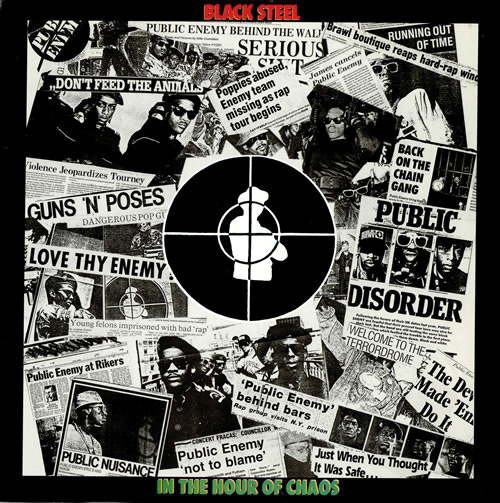
 In the landscape of late-1980s hip-hop, few songs carried the urgency, intelligence, and political fire of Public Enemy’s Black Steel In The Hour of Chaos. Released in 1988 on their second album, It Takes a Nation of Millions to Hold Us Back, the track stands as a stark, powerful example of rap’s potential as a vehicle for social commentary, protest, and storytelling. Unlike the party anthems and braggadocio-driven tracks dominating the airwaves at the time, Black Steel was raw, uncompromising, and deeply provocative — a song that demanded attention and forced listeners to confront systemic injustice, the prison-industrial complex, and the realities of life for marginalized communities in America.
From its opening notes, Black Steel In The Hour of Chaos is immediately recognizable. The song begins with a chilling, militaristic drum machine pattern paired with a sparse, almost industrial sample loop. The soundscape sets the tone for what is essentially a narrative of rebellion, resistance, and righteous anger. It’s minimalistic in its arrangement, but every element is purposeful — the drums pound like a heartbeat, the bass hits with urgency, and the sampling creates a sense of tension that mirrors the story unfolding in the lyrics. Unlike many tracks of the era, which emphasized hooks and danceability, Black Steel demands focus: you cannot passively absorb it. It commands your attention.
Chuck D’s voice dominates the track with an authority and gravitas that few MCs could match. His delivery is precise, deliberate, and almost militant, perfectly suited to the subject matter. Unlike the rapid-fire style of some contemporaries, Chuck D’s flow on Black Steel is measured, each word enunciated with clarity and purpose. The narrative unfolds like a mini-film, chronicling the story of a conscientious objector sentenced to prison and the desperate, radical measures taken to resist an oppressive system. The lyrics are vivid and cinematic, blending social commentary with storytelling in a way that elevates rap from mere entertainment to urgent political statement.
Flavor Flav’s contributions add another layer of complexity and texture to the track. His high-energy interjections, the famous clock-adorned vocals, and ad-libs provide contrast to Chuck D’s serious tone. The interplay between Chuck D and Flavor Flav creates tension and dynamism, drawing the listener into the narrative while also humanizing it. Flav’s voice functions almost like a Greek chorus — commenting, reacting, and emphasizing moments of high tension within the story. The duo’s chemistry was revolutionary, demonstrating how two very different voices could coexist to elevate both the art and the message of a song.
The lyrics themselves are a searing indictment of systemic oppression and racial injustice. Chuck D portrays a protagonist caught in a cycle of injustice, coerced by a legal system that targets black communities. Lines like “I got a letter from the government, the other day / I opened and read it, it said they were suckers / They wanted me for their army or whatever” highlight the absurdity and cruelty of conscription and institutional control, while the decision to break out of prison underscores both desperation and resistance. The song blends storytelling with metaphor, presenting the prison as a symbol of broader societal constraints. It’s not just about one man — it’s about an entire system designed to subjugate and control.
Production-wise, the track exemplifies the revolutionary approach that Public Enemy and the Bomb Squad brought to hip-hop. The layering of samples, the use of industrial textures, and the unconventional structure all contribute to a sense of urgency and unease. Unlike traditional beats designed for dancing, the arrangement of Black Steel is intentionally disruptive, reinforcing the song’s themes of chaos, rebellion, and societal tension. Bomb Squad’s genius lies in making the production feel alive — every snare hit, every sample, every pause contributes to the narrative and the emotional intensity. The track feels cinematic, like a soundtrack for revolution, pulling the listener into its world of conflict and resistance.
Black Steel In The Hour of Chaos is also significant for its engagement with political consciousness. At a time when hip-hop was often dismissed as mere party music or braggadocio, Public Enemy insisted that it could be a platform for social critique. The track does not shy away from difficult topics, addressing issues like the draft, mass incarceration, and systemic oppression with clarity and moral force. It challenges the listener to think critically about the society they inhabit and the forces that shape it. This sense of responsibility — to educate, to agitate, and to provoke thought — is a hallmark of Public Enemy’s work, and Black Steel exemplifies it perfectly.
The storytelling in the song is cinematic and precise. Chuck D paints scenes with remarkable economy: the protagonist is conscripted, refuses, is imprisoned, plans a breakout, and ultimately executes it. Every verse builds tension, every rhyme adds stakes, and the narrative pacing keeps listeners engaged throughout. The use of first-person perspective creates immediacy, making it feel like the listener is living through the protagonist’s struggle. By combining narrative techniques with lyrical mastery, Chuck D turns a rap song into a compelling short story, one that is both entertaining and politically urgent.
The cultural impact of Black Steel In The Hour of Chaos cannot be overstated. The song influenced countless artists who sought to address social issues through hip-hop, paving the way for politically conscious rap in the 1990s and beyond. It also reinforced Public Enemy’s reputation as a revolutionary force in music: a group that refused to separate entertainment from activism, performance from politics. The track became a touchstone for discussions about race, power, and resistance in music, demonstrating the potential of hip-hop as a form of social commentary.
Even decades after its release, Black Steel resonates with contemporary audiences. Its themes of systemic oppression, racial inequality, and resistance remain relevant, and the urgency of Chuck D’s delivery still hits with the same intensity as it did in 1988. The track’s minimalistic yet powerful production ensures that its message is front and center, while its narrative style makes it endlessly engaging on repeated listens. It is both a historical artifact and a living, breathing piece of music that continues to inspire and challenge listeners.
One of the most remarkable aspects of the song is how it blends musical innovation with political consciousness. The use of dissonant samples, pauses, and layered textures mirrors the chaos and tension within the story, creating a track that is as emotionally impactful as it is intellectually provocative. The interplay between narrative and production makes Black Steel more than a song — it’s an experience, a call to attention, and an embodiment of the transformative power of hip-hop.
The track also highlights Public Enemy’s mastery of persona and voice. Chuck D’s commanding presence, Flavor Flav’s eccentric commentary, and the tension built through production all combine to create a sense of realism and urgency. The song’s narrative is immersive: listeners are not just hearing a story; they are living it alongside the protagonist. This ability to engage the audience both intellectually and emotionally is a testament to the group’s artistry and vision.
Black Steel In The Hour of Chaos is an enduring reminder of hip-hop’s potential to challenge, provoke, and educate. It is not a song about trivialities or fleeting trends — it is a declaration of resistance, a story of courage, and a meditation on systemic injustice. Its relevance has only grown over time, as conversations about incarceration, inequality, and activism continue to dominate cultural discourse. By combining lyrical brilliance, innovative production, and a commitment to social awareness, Public Enemy created a track that is both timeless and urgently relevant.
The legacy of the track extends beyond its immediate impact. It set a standard for politically conscious rap, proving that the genre could tackle serious subjects with intelligence and artistry. It influenced generations of MCs who sought to infuse their music with purpose and meaning, showing that hip-hop could be a platform for resistance, education, and empowerment. Its combination of narrative precision, technical skill, and social commentary remains a benchmark for any artist hoping to use music as a tool for change.
Ultimately, Black Steel In The Hour of Chaos is more than a song — it is a statement of purpose. It exemplifies Public Enemy’s revolutionary approach to hip-hop, blending artistry, activism, and storytelling in a way that few tracks have ever matched. The song’s intensity, intelligence, and relevance make it essential listening for anyone interested in the power of music to reflect and challenge society. Chuck D and Flavor Flav created not just a track, but a cultural touchstone, one that continues to inspire, provoke, and resonate more than thirty years after its release.
In a world where music often prioritizes entertainment over substance, Black Steel In The Hour of Chaos remains a reminder of what hip-hop can achieve at its best: a fusion of rhythm, wordcraft, and social consciousness that educates, agitates, and empowers. Its legacy endures because it confronts the listener, challenges assumptions, and elevates the craft of the MC to an act of rebellion, reflection, and resistance.
This post has already been read 927 times!